

Fifth Sunday of Easter. April 24, 2016 [John 13:31-33a, 34-35]
“I give you a new commandment: love one another. As I have loved you, so you also should love one another (Jn 13:34).”
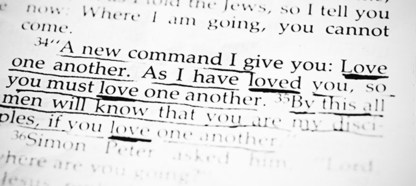 The first time God gave His commandment was on the Mount Sinai. To Moses and the Israelites, He made His covenant that He will be their God and they will be His People. And to live as a Holy People, God gave them the Law, famously called the Ten Commandment (Exo 19-20). Then, centuries after Moses, at the Upper Room, in old city Jerusalem, God gave His new commandment. This time, His Law is simpler and yet, more radical than the old one. Jesus handed to them the greatest command: Love one another as He has loved them.
John was called the beloved. Perhaps, it is because he was loved by Jesus in special way, but I believe, it is because among other disciples, John is the one who struggled the most to understand Jesus’ love for him and for all of us. Jesus’ love is extremely puzzling. In the culture of tooth-for-tooth retaliation, to forgive an enemy is unthinkable, but Jesus asked them to forgive them seventy times seven, to love them and pray for them! When society abhorred sinners, tax-collectors, and law-breakers, Jesus welcome them. Yet, He Himself demanded from them to repent and be perfect as the Father is perfect. When He was left alone, tortured and crucified, He manifested His greatest love as He forgave His tormentors. It does not stop there. The risen Lord came back and precisely to renew His love for His scattered and hopeless disciples. John then concluded in his letter, indeed God is love (1 John 4:8). He is not only loving, merciful, and forgiving, but love itself.
Why did God create universe, despite He is actually perfect and self-sufficient? Because Love cannot but share itself. Why did God trouble Himself by taking close care of His creations? Because Love means caring. Why did God make us human in his image? Because lLve begets another love. Why did God give us freedom despite the fact that we tend to abuse this freedom? Because Love cannot be true unless there is freedom.
Love is difficult and indeed, often full of sacrifices. Parents are struggling to understand and caring their teenage kids who are involved in drug addiction. A wife is fighting for her marriage that begins to crumble because of her husband’s secret affair. A parish priest is giving his best effort to educate his parishioners in faith despite so many criticism and misunderstanding against him. The movie Of Gods and Of Man is a true story of a community of French Trappist monks in Algeria, and they were eventually kidnapped and murdered in1996 by the terrorists. In one meeting, they were arguing whether to leave the monastery and the Muslim villagers they served, or stay and face uncertain future. One of the younger monks said to the Prior, “I did not become a monk to die.” And the prior answered back, “But you have already given away your life.” They finally decided to stay and continue to love until the end.
One time, I faced a profound crisis in my vocation. Honestly, I was confused: both to be a lay and a priest are holy and dignified call. Then, my formator would give this precious advice: “Bayu, choose the path that offers you more sufferings, because there, you may love more.” Indeed, love is tough and demanding, but only through loving, we can become the Disciples of Christ, that reflects His very image.
Br. Valentinus Bayuhadi Ruseno, OP
 In Medio Ecclesiae