
Fourth Sunday of Lent. March 26, 2017 [John 9:1-41]
“it is so that the works of God might be made visible through him. (Joh 9:3)”
 Blindness is the most dreadful disability for many of us. It is the loss of vision, living in total darkness for our entire lives. Blindness is the inability to see the beauty of the world and people who love us. In the Old Testament, blindness puts one in great disadvantages. The well-known story of Isaac who was tricked by his own son Jacob so that he might get his blessing began with Isaac losing his eyesight. Blind people are also hindered from fulfilling their religious duties. The Law of Moses dictates that the blind cannot offer sacrifice to the Lord,p; even blind animals can not be offered to the Lord! (see Lev 21-22). Blindness was associated with sinners. (see Deu 28:29). That is why Jesus’ disciples asked whether the man’s blindness was caused by his sin or his parents’ sin.
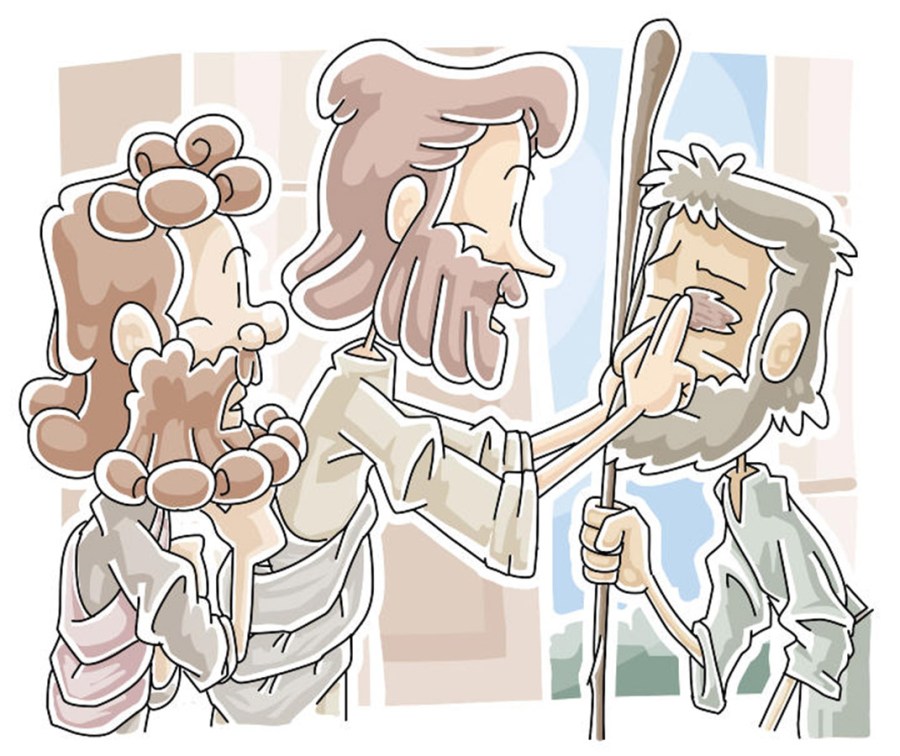
The healing of a blind person in the Old Testament is rare, but the prophets foretold that the Messianic age will be marked by the healing of the blind and the crippled. Thus, in the Gospels, we read many stories of the blind cured by Jesus, and this tells us that Jesus is the long-expected Messiah and that His kingdom has begun. In the Gospel of John, the stories of healing a blind person occurred rarely, but John devoted the entire chapter 9 to one unnamed blind man. This man was healed by Jesus on the Sabbath day. Unfortunately, healing on the Sabbath is forbidden by the Law, and the Pharisees logged a series of inquiries on the man, questioning the authority of Jesus. The man was convinced that despite the violation of the Sabbath’s rest, Jesus was holy because no sinner can heal. The story ended with him expelled from the synagogue. The irony in the story is that as the blind was able to see and believe in Jesus, the some Pharisees continued living in darkness and did not believe in Jesus.
The story of the blind man reminded me of the story of Louis Braille. Louis lost his vision at a very young age because a sharp object accidently pierced his eyes. Yet, he was determined to learn to navigate the world with the other senses left. His father made him a cane, his brother taught him echolocation, the village priest taught him to recognize trees by touch and birds by their song, and his mother taught him to play dominoes by counting the dots with his fingertips. He wanted to read and learn more, but it was practically impossible. After some time, he received the news that Charles Barbier, an army commander invented a military communication code using patterns of dots to represent sounds. Louis adopted the system for himself, yet he felt the coding was yet too slow. So, instead of representing sound, he engineered a dot system that represented letters. He punched the dots on the paper by a sharp and small tool akin to an awl, a tool that caused his blindness. At the age of 15, he invented the Braille alphabet. His determination has helped countless people with blindness and low visibility to read and see the world of ideas.
Certainly, our eyes are fine because we are able to read this reflection! But, the real question is, in this Lenten season, whether our eyes help us to see what matters most in life. Do we appreciate the gift of sight that we have? Does our vision lead us to a deeper faith? Have we helped others to see Jesus?
Br. Valentinus Bayuhadi Ruseno, OP
 In Medio Ecclesiae