
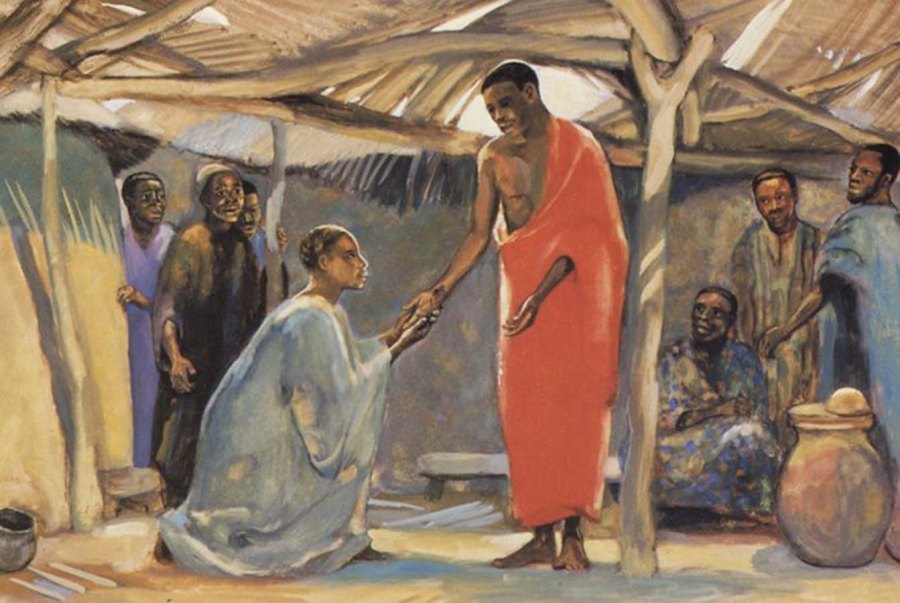
Second Sunday of Easter. April 23, 2017 [John 20:19-31]
“Unless I see the mark of the nails in his hands and put my finger into the nailmarks and put my hand into his side, I will not believe (John 20:25).”
 Thomas was looking for a proof that Jesus truly rose from the dead. Not only seeing Him in person, he required another sign: touching the crucifixion marks that Jesus bore. He was one of the Twelve, the inner cycle of Jesus’ disciples, and being one, he had the privilege to walk with Jesus, dine with Him, and witness His mighty deeds. At a first glance, he would easily recognize Jesus, his Master, but still, he demanded the marks of the nails. Why did Thomas insist on searching the wounds?
The reason is that Thomas wanted to make sure that he and other disciples were not seeing a ghost or just hallucinating. Moreover, he wanted to confirm that the person he was going to meet was truly Jesus and not an impostor. The crucifixion wounds of Jesus became a practical identification of the risen Christ. Though it is really practical, there is also a downside of it. Thomas identified Jesus primarily with His wounds. Thomas was not alone here. Often, not only doubting, we follow Thomas also in identifying other people with their wounds and weaknesses.
Napoleon Bonaparte was once a great general and he led his army to conquer Europe. Yet, in 1815, in the battle of Waterloo in present-day Belgium, Napoleon was defeated and it was sealed his fate. Waterloo gradually becomes not only the crucifixion mark of Napoleon but also a metaphor for the failures of many people. The same goes with Achilles who was a hero in Greek Mythology and the main protagonist of Homer’s epic, the Iliad. He was the most skillful warrior who brought the mighty Troy to its knees. He had only one vulnerable point in his body, his heel, and indeed, he died after the enemy shot an arrow to his heel. Even the greatest warrior has his weakness, and since then, the Achilles’ heel becomes a symbol of fatal weakness to everyone.
We have our own weaknesses, failures, and vulnerabilities. Often, we associate ourselves or other people with this wounds and marks. Bayu, who is always late; Alex, the jobless; Ram, the sickly; Andre, the obsessed; Francis, the ex-con; Peter, the impulsive denier; Thomas, the doubter; Mary, possessed by the seven demons; Judas, the betrayer; Jesus, the crucified. We are our wounds. We are as good as the mark we bear.
However, in today’s Gospel, Jesus did not rebuke Thomas for looking only for His marks. Jesus did not demand Thomas to focus on the best of Him. He even asked him to see and touch the wounds. Jesus embraced the very marks of His defeat and made it a sign of His resurrection. This has become the proof of God’s marvelous works, and the counter place between Thomas and God. It is not a ‘positive talk’ that goes “if you fail a hundred times, get up one hundred and one times!” It goes beyond it. The resurrection calls us neither to deny nor to hide our weaknesses, but to see the Lord even in these lowest situations of our lives. At times, when we are weak, our defenses are down, and it is the time, God enters our lives. At times, when we fail and lose, we fall to our knees and pray. This is the paradox of the resurrection!
Br. Valentinus Bayuhadi Ruseno, OP
 In Medio Ecclesiae