
Reflection on the 26th Sunday in Ordinary Time [September 30, 2018] Mark 9:36-43, 45, 47-48
“If your hand causes you to sin, cut it off. (Mk. 9:43 )”
 When I was assigned to the hospital to serve as a chaplain, I witnessed the rise of diabetic cases as well as its terrifying effects on the patients. In simple term, diabetes is a condition in a person who can no longer naturally manage their blood sugar. In more serious cases, the body loses its natural ability to heal its wounds. In the beginning, it was a small open wound, yet since the body no longer heals, the infections set in, and this leads into gangrene or the death of the body’s tissues. I accompanied some patients who were struggling with this situation and witnessed how their fingers or even foot were darkened and deformed. When the ordinary treatment no longer worked, the amputation became the only merciful option as to prevent the spread of infections. As a chaplain, accompanying these patients was one of my toughest missions in the hospital.
In today’s Gospel, Jesus’ words are pretty harsh, if not violent. He wants the one who causes the believers to sin to be thrown into the sea. He wants hands and feet cut, and eyes plugged. He even describes Gehenna in more vivid details, “where their worm does not die, and the fire is not quenched.” The image of Jesus seems to be far different from Jesus who is gentle and merciful. What is going on? Is Jesus promoting violence? Is Jesus a schizophrenic or having a split personality?
Jesus is perfectly sane. Yet, he becomes passionate because he is teaching a serious matter with a grave consequence. This is none other than sin. Jesus knows well that sin corrupts, and like growing roots, it corrupts to every side. Sin destroys our souls, our neighbors, our environment and even our holy relationship with God. What more sinister about sin is that deforms our conscience and makes us believe that we are just doing fine. In his book ‘The Name of God is Mercy, Pope Francis speaks of the effect of sinful corruption, “Corruption is not an act but a condition, a personal and social state we become accustomed to living in… The corrupt man always has the cheek to say, ‘It wasn’t me!”…He is the one who goes to Mass every Sunday but has no problem using his powerful position to demand kickbacks…then he boasts to his friends about his cunning ways.”
Like in the case of a person struggling with diabetes and having gangrene in his finger, it is better for him to amputate the affected finger as to prevent the spreading of infection, and thus, save his other organs, and life. So it is with sin. Jesus commands us to “amputate” those areas in our lives that are corrupted by sin, as to save our souls. But, this is not easy. Like some of the patients I ministered to, they refuse to give up the precious parts of their bodies. They deny, get angry and frustrated, and try to bargain with the doctors to avoid amputation. With the same mentality, we often deny that we nurture our vices. We get angry when people correct us and reveal us our sins. We also bargain with the Lord to keep our favorite sins and tell Him that we are going to be better in other aspects of our lives. However, these do not work. A radical “amputation” is necessary to save our ailing souls.
The good news, however, is that unlike the body which will never regain the lost limbs, our souls will, in fact, grow even holier after the “amputation.” The relationship between others will be purified, our attitude towards the environment will be filled with care and mercy, and our love for God will be deepened.
What are our sinful attitudes that harm ourselves, others and the environment ? Are we humble enough to receive corrections? Are we courageous enough to acknowledge them as sins? Do we ask God’s grace to prepare us for the sacrament of confession?
Br. Valentinus Bayuhadi Ruseno, OP
 Ketika saya bertugas pelayanan di rumah sakit di Manila, saya menyadari bahwa kasus diabetes berkembang secara pesat, dan juga efeknya yang menakutkan bagi para pasien. Secara sederhana, diabetes adalah suatu kondisi pada seseorang yang tidak lagi dapat secara alami mengelola gula darahnya. Dalam kasus yang lebih serius, tubuh kehilangan kemampuan alami untuk menyembuhkan luka-lukanya. Pada awalnya adalah luka yang kecil, namun karena tubuh tidak lagi bisa meyembuhkan, infeksi-infeksi pun berkembang, dan ini mengarah pada gangren atau kematian jaringan-jaringan tubuh. Saya menemani beberapa pasien yang bergulat dengan situasi ini, dan menyaksikan bagaimana jari atau bahkan kaki mereka menghitam dan berubah bentuk. Ketika pengobatan biasa tidak lagi bekerja, amputasi menjadi satu-satunya pilihan untuk mencegah penyebaran infeksi. Sebagai seorang frater yang bertugas di rumah sakit, mendampingi pasien-pasien ini adalah salah satu misi terberat saya di rumah sakit.
 While I was reflecting on this Sunday’s Gospel, I was able to discover some news about our Church. Good News! The Catholic Church in the Philippines is preparing herself for the 500 years of the arrival of Christianity in this archipelago. The first baptism and Eucharist were taking place in 1521 as the Spanish missionaries began their evangelization mission. As part of this grand preparation, the Bishops of the Philippines have decided to celebrate this year as the year of the clergy and the consecrated persons. The major theme of this year is the renewed servant-leaders for the new evangelization. In view of this, many programs and activities are organized to help both the ordained ministers and the religious brothers and sisters to deepen their commitment to God and their service to the people.
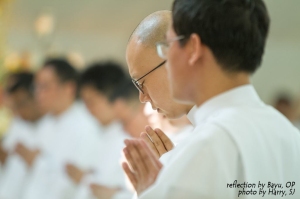 Ketika saya merenungkan Injil hari Minggu ini, saya membaca beberapa berita tentang Gereja. Ada Kabar baik. Gereja Katolik di Filipina mempersiapkan diri untuk perayaan 500 tahun kedatangan iman Kristiani di negara ini. Baptisan dan Ekaristi pertama terjadi pada tahun 1521 sewaktu para misionaris Spanyol memulai misi evangelisasi mereka. Sebagai bagian dari persiapan besar ini, para Uskup Filipina memutuskan untuk merayakan tahun ini sebagai tahun para klerus [daikon, imam, dan uskup] dan rohaniwan. Dengan demikian, banyak program dan kegiatan diselenggarakan di berbagai keuskupan di Filipina untuk membantu para klerus dan biarawan untuk memperdalam komitmen mereka pada Allah dan pelayanan mereka kepada umat dan bangsa.
 Several years ago, I gave a talk on the introduction to Christology to a group of young Filipino professionals who wished to deepen their spirituality. The first question I asked them as we commenced the short course was, “Who do you say that Jesus is?” The answers were varied. Some gave a dogmatic formula like Jesus is God, one quoted the Bible saying Jesus is the Word made flesh, one expressed boldly that Jesus is Savior and Lord, and the rest shared personal convictions like Jesus is their closest friend, or Jesus is their Shepherd. All these answers were right, but nobody claimed that Jesus is the Christ. Considering that our subject was Christology, we missed the basic Jesus’ title, in Greek, “Christos,” in Hebrew, “Messiah,” and translated into English, the Anointed One. Fortunately, around two thousand years ago, Simon Peter was able to spell the title when Jesus Himself asked the question.
 Beberapa tahun yang lalu, saya memberikan ceramah pengantar Kristologi bagi sekelompok profesional muda Filipina yang ingin memperdalam spiritualitas mereka. Pertanyaan pertama yang saya tanyakan kepada mereka adalah, “Menurut kamu, siapakah Yesus itu?” Jawabannya beragam. Beberapa memberikan formula dogmatis seperti Yesus adalah Allah, ada yang mengutip Alkitab dan mengatakan Yesus adalah Firman yang menjadi daging, seseorang menyatakan dengan berani bahwa Yesus adalah Juruselamat dan Tuhan, dan sisanya berbagi keyakinan pribadi seperti Yesus adalah sahabat terdekat mereka, atau Yesus adalah Gembala mereka. Semua jawaban ini benar, tetapi tidak ada yang mengklaim bahwa Yesus adalah Kristus. Mempertimbangkan bahwa ceramah kami adalah Kristologi, kami sepertinya lupa akan identitas dasar Yesus, dalam bahasa Yunani, “Christos,” dalam bahasa Ibrani, “Mesias,” yang berarti “Yang Diurapi”. Untungnya, sekitar dua ribu tahun yang lalu, Simon Petrus mampu mengucapkan identitas dasar ini ketika Yesus Sendiri menanyakan pertanyaan ini.
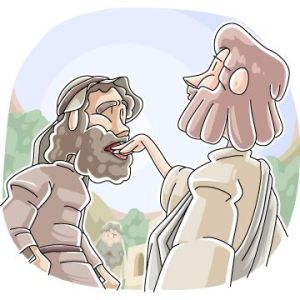 The deaf man whom Jesus heals is so blessed. He is able to see Jesus, and He finds healing. Inspired by this miracle, we wish that we will also meet Jesus and He will heal our sickness and solve our problems. Thus, we come to various places where we believe Jesus will heal us. We visit pilgrimage sites, we attend prayer and worship meetings, we recite various novenas, and we become actively involved in the Church’s organizations. We believe that our faith in Jesus will save us. However, what if our prayers are not granted? What if our problems are not solved but rather grow in number? What if our sickness is not healed, but gets worse? What if we do not feel that we are saved? One time, I visited Flora [not her real name], a colon-cancer patient, and she asked me, “Brother, I have faith in God, and I faithfully serve the Church, but why am I suffering from this terrible sickness?” Surely, it was a tough question.
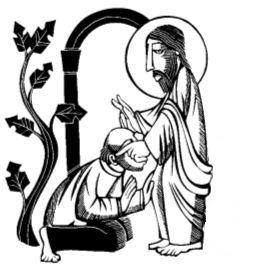 Minggu ini kita mendengar tentang Yesus yang menyembuhkan seorang tuli dan bisu. Terinspirasi oleh mukjizat ini, kita berharap bahwa Yesus akan menyembuhkan penyakit kita dan memecahkan segala masalah kita. Jadi, kita pergi ke berbagai tempat ataupun kegiatan di mana kita percaya Yesus akan menyembuhkan kita. Kita pergi ke situs ziarah, kita menghadiri pertemuan doa, dan kita menjadi aktif terlibat di Gereja. Kita percaya bahwa iman kita kepada Yesus akan menyelamatkan kita. Namun, bagaimana jika doa kita tidak dikabulkan? Bagaimana jika masalah kita tidak selesai tetapi bertambah jumlahnya? Bagaimana jika penyakit kita tidak sembuh, tetapi semakin parah? Suatu kali, saya mengunjungi Flora [bukan nama sebenarnya], pasien kanker usus besar, dan dia bertanya kepada saya, “Frater, saya memiliki iman kepada Tuhan Yesus, dan saya dengan setia melayani di Gereja, tetapi mengapa saya menderita penyakit yang mengerikan ini? “Tentunya, ini pertanyaan yang sulit dijawab.
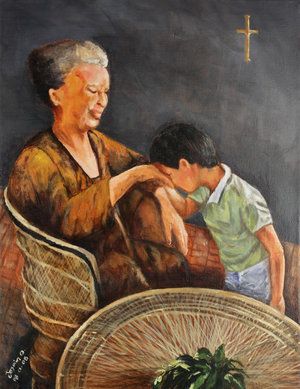 In today’s Gospel, Jesus seems to denounce all traditions. However, this position is rather simplistic and unattainable. The reason is that human beings are the creatures of traditions. Tradition comes from Latin word, “tradere”, meaning “to hand down”. Thus, crudely put, tradition is anything that has been handed down from our predecessors. Traditions range from something tangible like technologies and fashions, to something intangible like values, languages, sciences and many more. I remember how my mother taught me basic Christian prayers, like Our Father, Hail Mary, and the Rosary, and how my father would regularly bring us to the Church every Sunday. This is my family’s religious traditions. As an Indonesian living in the Philippines, I appreciate the “Mano Po” tradition among the Filipinos. This is a simple gesture of respect and blessing. The younger Filipinos are to hold a hand of older Filipino, and place it on their forehead.
 Dalam Injil hari ini, Yesus tampaknya menolak semua tradisi. Namun, pernyataan ini terlalu disederhanakan. Alasannya adalah bahwa manusia adalah makhluk tradisi. Tradisi berasal dari kata Latin, “tradere”, yang berarti “menurunkan”. Jadi, secara sederhana, tradisi adalah segala sesuatu yang telah diturunkan atau diwariskan dari para pendahulu kita. Tradisi berkisar dari sesuatu yang berwujud seperti teknologi, hingga sesuatu yang tidak berwujud seperti bahasa, ilmu pengetahuan, dan banyak lagi. Saya ingat bagaimana ibu saya mengajarkan saya doa-doa dasar, seperti Bapa Kami, Salam Maria, dan Rosario, dan bagaimana ayah saya secara teratur membawa kami ke Gereja setiap Minggu. Ini adalah tradisi agama keluarga saya. Sebagai orang Indonesia yang tinggal di Filipina, saya mengapresiasi tradisi “Pano Po” di antara orang Filipina. Ini adalah sikap menghormati orang yang lebih tua dan juga memberi berkat kepada yang lebih muda. Orang Filipina yang lebih muda akan memegang tangan mereka yang lebih tua, dan meletakkannya di dahi mereka.
 In Medio Ecclesiae