

Reflection on the 30th Sunday in Ordinary Time [October 28, 2018] Mark 10:46-52
“Jesus, son of David, have mercy on me.” (Mk. 10:47)
 I made my religious vow more than eight years ago with 12 other Dominican brothers. One of the most touching moments within this rite of the religious profession was when Fr. Provincial asked us, “What do you seek?” and we all prostrated, kiss the ground, and declared, “God’s mercy and yours!” After a brief moment, Fr. Provincial asked us to stand, and we began professing our vows before him. As I recall this defining moment in my life, I am pondering in my heart, “Why it has to be mercy?” Why do we not choose other Christian virtues? Why not fortitude, one of the cardinal virtues in the Christian tradition? Why not love, the greatest of all virtues?
However, religious profession is not an isolated case. If we observe our celebration of the Holy Eucharist, the rite is filled with our pleading for mercy. At the beginning of the Mass, after recalling our sins, we say, “Lord, have mercy” three times. In the Eucharistic prayer, we once again beg mercy that we may be coheirs of eternal life. And, before we receive the Holy Communion, we pray to the Lamb of God who takes away the sin of the world, that He may have mercy on us. Not only in the Eucharist, but an appeal for mercy is also found in the other sacraments and devotions. In the sacrament of confession, the formula of absolution begins with addressing God as the Father of Mercy. In every litany to the saints, it always commences with the plead of mercy to the Holy Trinity. Again, the question is why does it have to be mercy?
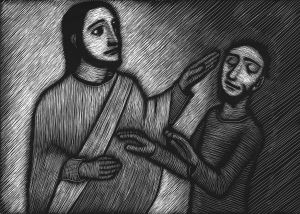
We may see the glimpse of the answer in our Gospel today. Jesus is leaving Jericho and making his final journey to Jerusalem. Then, suddenly Bartimaeus, a blind beggar, shouts to the top of his lungs, “Jesus, Son of David, have mercy on me!” He was so persistent that after being rebuked by others, he shouts even louder. Upon hearing the plea of mercy, Jesus who has set his sight on Jerusalem decides to stop. Jesus simply cannot be deaf to Bartimaeus’ appeal. He cannot just ignore mercy. Yet, this is not the only episode where Jesus changes His initial plans and listens to the request for mercy. He cleanses a leper because of mercy (Mrk 1:41). Moved by mercy, He feeds the five thousand and more people (Mrk 6:30). If there is anything that can change the mind and heart of Jesus, the mind and heart of God, it is mercy.
Pope Francis echoes his predecessors, St. Pope John Paul II, and Pope Benedict XVI, saying that the first and essential attribute of God is mercy. Indeed, God as being merciful is discovered in many places in the Bible (see Exo 34:6,7; Dt 4:31; Ps 62:12, etc.). That is why the name of God is mercy. It is our faith that proclaims that God cannot but be merciful. He is God who goes as far as to become human and die on the cross to embrace the wretched sinners like us.
However, what makes Bartimaeus unique is that he was the first in the Gospel of Mark to verbalize the plead for mercy to Jesus. Following the example of Bartimaeus, the Church has continued to become the beggar of God’s mercy. Like Bartimaeus, we verbalize our need for God’s mercy in our worship, our prayers, and our life. We ask mercy when life become tough and unforgiving. We cry “Mercy!” when we are tempted, we fail to please God, or so much harm has been done to ourselves and other people. Every night before I close my eyes, I recite “Lord, have mercy!” several times, hoping that this will be a habit and my last words when I meet my Creator. We plead for mercy when knowing that we are not worthy of God, we are confident that God will change “His mind” and embrace us once again.
Br. Valentinus Bayuhadi Ruseno, OP
 Saya mengucapkan kaul lebih dari delapan tahun yang lalu bersama dengan 12 frater lainnya. Salah satu momen paling menyentuh dalam ritual profesi religius ini adalah ketika Romo Provinsial bertanya kepada kami, “Apa yang kamu cari?” Dan kami semua bersujud dan berbaring di lantai, sambil berseru, “Belas kasih Tuhan dan juga komunitas!” Setelah beberapa saat, Pastor Provinsi meminta kami untuk berdiri, dan kami mulai mengucapkan kaul kami di hadapannya. Saat saya mengingat momen yang penting ini, saya merenungkan dalam hati saya, “Mengapa harus meminta belas kasih?” Mengapa kita tidak memilih keutamaan lainnya? Mengapa tidak keadilan, yang adalah salah satu keutamaan penting dalam tradisi Kristiani? Mengapa tidak cinta kasih, yang adalah keutamaan terbesar dari semua keutamaan?
 “Power tends to corrupt, and absolute power corrupts absolutely.” This familiar adage comes from an English noble, Lord Acton in his letter to Bishop Mandell Creighton in 1887. Lord Acton observed that people who possessed absolute control over other persons were inclined to abuse their power and exploit their subjects. This happens throughout human history. Jesus and His disciples themselves witnessed these corrupt powerful leaders during their time and eventually, became victims of this corruption.
 “Power tends to corrupt, and absolute power corrupts absolutely.” Pepatah ini berasal dari bangsawan Inggris, Lord Acton dalam suratnya kepada Uskup Mandell Creighton pada 1887. Lord Acton mengamati bahwa orang-orang yang memiliki kekuasaan mutlak atas orang lain cenderung menyalahgunakan kekuasaan mereka dan mengeksploitasi bawahan mereka. Ini terjadi sepanjang sejarah manusia. Yesus dan murid-murid-Nya sendiri menyaksikan para pemimpin korup ini pada zaman mereka dan akhirnya, menjadi korban kekuasaan yang korup tersebut.
 We discover at least three instances in the Bible in which Jesus explicitly expresses that He loves someone. The first instance is that Jesus loves the young rich man who seeks the eternal life (Mrk 10:21). The second is Jesus loves Martha, Mary, and Lazarus (Jn 11:5). The third is Jesus’ love for His disciples, especially His beloved disciple (Jn 13:34).
 Kita menemukan setidaknya tiga episode dalam Alkitab di mana Yesus secara eksplisit menyatakan bahwa Dia mengasihi seseorang. Yang pertama adalah Yesus yang mengasihi Marta, Maria, dan Lazarus (Yohanes 11: 5). Yang kedua adalah kasih Yesus bagi murid-murid-Nya (Yohanes 13:34). Yang ketiga dan menjadi fokus kita hari ini adalah Yesus yang mengasihi orang muda kaya yang mencari kehidupan kekal (Mrk 10:21).
 If there is one prayer that can change the course of world history, it is the earnest recitation of the holy rosary. In 1571, through the unceasing prayer of the rosary, a league of Christian nations called by Pope Pius V was able to stop the military advancement of the mighty Ottoman empire to western Europe in the Gulf of Patras, near Lepanto, Greece. In 1917, Our Lady appeared to three little children in Fatima, and one of her messages was to pray the rosary for the peace of the world. Through nation-wide recitation of the rosary, Austria was freed from the communist regime in 1955. In 1960, led by Catholic women marching the streets while praying the rosary, Brazil was also spared from communism.
 Jika ada satu doa yang mampu mengubah jalannya sejarah dunia, itu adalah pendarasan rosario. Pada 1571, melalui doa rosario tanpa henti, liga negara-negara Katolik yang dipanggil oleh Paus Pius V mampu menghentikan kemajuan militer dari kerajaan Ottoman ke Eropa Barat di perang Lepanto, dekat Yunani. Pada tahun 1917, Bunda Maria menampakkan diri kepada tiga anak kecil di Fatima, dan salah satu pesannya adalah berdoa rosario untuk kedamaian dunia. Melalui pendarasaan rosario secara nasional, Austria terbebas dari rezim komunis pada tahun 1955. Pada tahun 1960, dipimpin oleh wanita-wanita Katolik yang turun ke jalan sambil berdoa rosario, Brasil juga terhindar dari komunisme.
 In Medio Ecclesiae