

Second Sunday of Easter/ Divine Mercy Sunday [April 28, 2019] John 20:19-31
 Today is the Divine Mercy Sunday. From the Gospel, Jesus institutes the sacrament of reconciliation as He bestows His Holy Spirit upon the Disciples. He grants them the divine authority to forgive (and not to forgive) sins and charges them to be the agents of Mercy. While it is true that only priests can minister the sacrament of confession, every disciple of Christ is called to be an agent of Mercy and forgiveness. Yet, how we are going to be the bearers of Mercy and Forgiveness? I think we need to understand first the dynamic of fear and peace.
Fear is one of the human most basic emotions. It makes us flee from impending danger and normally, it is good and necessary for our survival. Yet, what is unique with us humans is that the object of fear is not only physical real danger like an earthquake, fire, or venomous animals, but it extends to moral judgment. When we commit a mistake, we are afraid of the judgment as well as the consequences. Quite often too, fearful of the judgment and condemnation, we are run away and hide. In fact, the story of fear is a primordial story. We recall our first parents, Adam and Eve. After they violated the Law of God, they realized that they have terribly sinned against the Lord, and afraid of God’s judgment, they hid.
After the passion and death of Jesus we find out that Jesus’ disciples themselves are afraid and hiding. The disciples lock themselves inside the room because they are afraid. However, the real fear is not from the Jewish authority or the Roman troops, but from Jesus’ judgment. We remember that Judas handed over Jesus to the Jewish authority, Peter, the leader, denied Jesus three times, and most of the disciples were running away. Even before the crucial moments of Jesus, they have deserted their Master and Messiah. In a court martial, a soldier who deserts his army, especially during the pick of the battle, is considered a traitor not only to the army, but to the entire nation, and he deserves no less than capital punishment. The disciples are hiding because of fear that Jesus will bring His severe judgment, and get back on them. The disciples are afraid that Jesus may come anytime, condemn them, and throw a fireball on them.
Indeed, Jesus comes to them, but he brings not condemnation but the gift of peace, “Shalom”. This peace only ensues from forgiveness. This peace, however, is not the absence of judgment, but rather it presupposes one. Unless the disciples recognize and own up their terrible mistakes, they will not appreciate Jesus’ forgiveness and mercy. The peace will be just a mirage, and fear still reigns.
To become an agent of Mercy, we first dare to pronounce judgment. If we pretend that the sin never happens, and keep telling ourselves that everything is just fine, we deceive ourselves and never become sincerely peaceful. Indeed, it is difficult, but as we cannot heal unless there is prognosis, we cannot truly forgive unless there is judgment.
Just last week, several suicide bombers blew themselves up at several churches in Sri Lanka and killed hundreds of Christians. A religious sister, who lost several of her community members in the explosion, wrote an open letter to the perpetrators. She judged that what they did was an act of terrorism, pure evil. Yet, she reminds them that Christians will not be cowed and afraid because we know how to forgive. She said that the Catholic Church remains an open-door Church because she is not afraid to welcome everyone including those who tried to destroy her.
There is no peace without forgiveness, and there is no forgiveness and mercy without true judgment.
Deacon Valentinus Bayuhadi Ruseno, OP
 Hari ini adalah Hari Minggu Kerahiman Ilahi. Dari Injil, Yesus membentuk sakramen rekonsiliasi saat Ia menganugerahkan Roh Kudus-Nya kepada para Murid. Dia memberi mereka otoritas ilahi untuk mengampuni (dan tidak mengampuni) dosa dan mengutus mereka sebagai pekerja Kerahiman. Meskipun benar bahwa hanya imam yang dapat melayani sakramen pengakuan dosa, setiap murid Kristus dipanggil untuk menjadi pekerja Kerahiman dan pengampunan. Namun, bagaimana kita akan menjadi pembawa Kerahiman dan Pengampunan? Kita perlu memahami dulu dinamika antara rasa takut dan kedamaian.
 Maria Magdalena adalah seorang murid perempuan yang sangat mencintai gurunya, dan sebagai seorang wanita, ada sesuatu yang dia ajarkan kepada kita. Lukas mengatakan dalam Injilnya bahwa Maria adalah sebagai seorang wanita “yang darinya tujuh setan keluar” [lihat Luk 8:2]. Pastinya merupakan pengalaman yang mengerikan untuk disiksa oleh tujuh setan, dan ketika Yesus menyembuhkannya, ia mengungkapkan rasa terima kasihnya yang mendalam dengan mengikuti Yesus. Sebagai salah satu murid Yesus, ia terbukti paling setia kepada gurunya. Ketika banyak pengikut Yesus melarikan diri untuk menyelamatkan hidup mereka, dan bahkan Petrus, tokoh utama dalam kelompok itu, menyangkal Yesus, Maria mengikuti Yesus dalam jalan Salib-Nya sampai akhir. Dia menerima penghinaan yang Yesus terima, dia menanggung malu yang Yesus tanggung. Bahkan, dia berdiri di samping salib bersama dengan ibu Yesus dan Yohanes yang terkasih.
 One of the greatest gifts to humanity is the gift of memory. It gives us a sense of identity. Biology teaches us that almost all our body parts are being replaced over the years. One-year-old Stephen is biologically different from thirty-year-old Stephen. All bodily cells, with the sole exception of his eyes’ lens, are changed. What unites thirty-year-old Stephen with his younger self as well as his future self is his memory.
 Salah satu karunia terbesar bagi umat manusia adalah memori. Ini memberi kesadaran akan identitas kita. Biologi mengajarkan kita bahwa hampir semua bagian tubuh kita akan tergantikan saat kita hidup. Stephen yang berusia satu tahun secara biologis berbeda dari Stephen yang berusia tiga puluh tahun. Semua sel tubuhnya telah digantikan dan akan terus digantikan sampai ia wafat. Apa yang menyatukan Stephen yang berusia tiga puluh tahun dengan dirinya yang lebih muda serta diri di masa depannya adalah ingatannya.
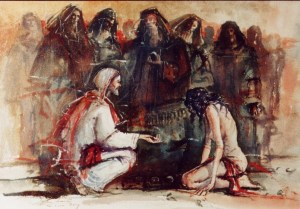 Adultery is a serious sin according to the Law of Moses. It is a violence against the Basic Law, the Ten Commandments. It is in fact, one of the few crimes that are punishable by death [Lev 20:10]. Why so cruel? It is a grave sin because adultery profanes the holiness of marriage and the gift of sexuality. In the Book of Genesis, God has willed that man and woman through marriage and their sexuality participate in God’s work of creation and caring of creation. Since marriage is a sacred calling, violation to this holy mission is an utmost insult to God who calls man and woman into marriage.
 Perzinahan adalah dosa serius menurut Hukum Musa. Ini adalah pelanggaran terhadap Sepuluh Perintah Allah. Pezinahan adalah satu dari sedikit dosa yang bisa dihukum mati [Im 20:10]. Kenapa begitu kejam? Ini adalah dosa besar karena perzinahan mencemarkan kekudusan pernikahan dan karunia seksualitas. Dalam Kitab Kejadian, Tuhan menghendaki pria dan wanita melalui pernikahan dan seksualitas mereka berpartisipasi dalam karya penciptaan. Karena pernikahan adalah panggilan suci, pelanggaran terhadap misi suci ini adalah salah satu penghinaan terbesar bagi Allah yang memanggil pria dan wanita ke dalam pernikahan.
 In Medio Ecclesiae