

Reflection on the 26th Sunday in Ordinary Time [C] – September 29, 2019 – Luke 16:19-31
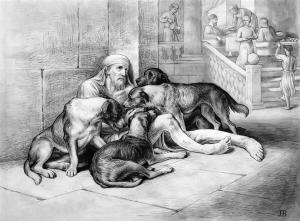 Once again, we listen to one of Jesus’s most remarkable stories. There is a rich man, and this guy is insanely wealthy. He is described as someone clothed with purple and fine linen. In ancient time, fine purple linen is an utmost luxury, and usually only nobilities could afford to buy this kind of cloth. Before the coming of synthetic coloring, purple dye is coming from snails of Mediterranean Sea, and it takes thousands of snails just to dye one ordinary garment. This rich guy is also throwing party every night. At the time of Jesus, where majority must toil to earn a little and to have something to eat, to enjoy feast every night is madly extravagant. At that time, fork, knife, and napkins were not common; thus, people are eating with their hands. In very wealthy houses, they will cleanse their hands by wiping them on hunks of bread that will be thrown away. These are pieces of bread Lazarus longs to receive.
Lazarus is a Latinized form of Eleazar, meaning “God is my help.” Yet, it seems that he does not get much help from the Lord during his lifetime. He is a beggar, and as one living with terrible hygiene, skin diseases come and plague his body. Even the dogs are licking his wounds. He is now no different from a dog! However, God is just and gives His help to Lazarus in his death. He is brought by the angels to Abraham’s bosom to receive comfort, while the superrich guy is thrown to hell.
This is a powerful story that reminds us that apathy can send us to hell. The rich guy possesses tremendous amount of wealth, and yet he closes his eyes on his brother who is greatly in distress. A deeper root of apathy is just our selfishness. We only care about ourselves. We notice how the rich guy in hell asks Lazarus to quench his thirst, his immediate need. Then, the rich guy suddenly remembers that he has other brothers and he wants Lazarus to warn them. It might be a hint of empathy, but it can be the sign of deeper selfishness. He wants only those close to him are saved. He never utters any single word of sorry to Lazarus, for being too cruel. Fr. Richard Rohr, a Franciscan spiritual writer, once says, “The ego hates losing – even to God.”
God hates apathy because apathy is directly opposed to His mercy. The word Mercy in Latin is Misericordia, and it means the heart of those who are suffering. In the Bible, if there is one thing that always moves God, it is when someone begs for mercy. Pope Benedict XVI reminds us that God is mercy, and He cannot be but merciful. Thus, apathy is simply against God; it is a rejection of heaven.
Surely, we do not have to solve all the problem of the world; neither do we have to become the wealthiest guy in the world to care for others. We just need to look outside ourselves, outside our gadgets, outside our social media, outside places and people that give us comfort. Perhaps, our kids need someone to talk with, someone who can listen without judging. Maybe, the person beside us is having a bad day, and our little smile may help significantly. After all, Mother Teresa of Calcutta once said, “We shall never know all the good that a simple smile can do.”
Let us make our mission today to say a kind word and do a kind deed to someone who needs it. As Mother Teresa once again says, “Kind words can be short and easy to speak, but their echoes are truly endless.”
Valentinus Bayuhadi Ruseno, OP

 There is something strange in our Gospel today. Jesus is praising the cunning steward. Why does Jesus commend his shrewd action? To understand Jesus’ words, we need to comprehend first what really takes place with this servant and his master.
 Ada sesuatu yang aneh dalam Injil kita hari ini. Yesus memuji pelayan yang curang itu. Mengapa Yesus memuji tindakan cerdiknya? Untuk memahami kata-kata Yesus, kita perlu memahami terlebih dahulu apa yang sebenarnya terjadi dengan hamba ini dan tuannya.
 Chapter 15 of the Gospel of Luke contains three of the most heartwarming as well as powerful parables in the entire Bible. These three parables are known as the parable of the lost sheep, the parable of the lost coin, and the parable of the prodigal son. If we look closer into these three parables, what is so stunning and astonishing is how Jesus bends, twists and stretches human logic and natural tendency to nail His point.
 Bab 15 dari Injil Lukas berisi tiga perumpamaan yang paling mengharukan dan indah di seluruh Alkitab. Tiga perumpamaan ini dikenal sebagai perumpamaan tentang domba yang hilang, perumpamaan tentang koin yang hilang, dan juga perumpamaan tentang anak yang hilang. Jika kita melihat lebih dekat ke dalam ketiga perumpamaan ini, apa yang begitu menakjubkan dan mencengangkan adalah bagaimana Yesus membengkokkan, memutar dan merentangkan logika manusia dan budaya Israel untuk menyampaikan poin terdalam-Nya.
 Today we listen to one of Jesus’ hard sayings. If we want to follow Jesus, we need to hate our fathers, mothers, our other siblings, and even our own lives; otherwise we are not worthy of Him [Luk 14:25]. Is Jesus serious? Jesus must be kidding around. NO, he means what he says. So, how are we going to understand this hard saying? Jesus teaches love, mercy, and compassion, and the only thing He hates is a sin. Does Jesus change his mind and now turn to be the promoter of hatred? If we can hate our family, we now hate practically everyone. Is this what Jesus intending to say?
 Hari ini kita mendengarkan salah satu ucapan keras Yesus. Jika kita ingin mengikuti Yesus, kita perlu membenci ayah, ibu, saudara kita, dan bahkan hidup kita sendiri; kalau tidak, kita tidak layak bagi-Nya [Luk 14:25]. Apakah Yesus serius? Yesus pasti bercanda!? TIDAK, Dia tidak bercanda dan sungguh-sungguh dengan apa yang Dia katakan. Jadi, bagaimana kita bisa memahami perkataan yang sulit ini? Yesus mengajarkan cinta kasih, belas kasihan, dan pengampunan, dan satu-satunya hal yang Ia benci adalah dosa. Apakah Yesus berubah pikiran dan sekarang berubah menjadi provokator kebencian? Jika kita bisa membenci keluarga kita, kita sekarang bisa membenci semua orang. Apakah ini yang ingin dikatakan Yesus?
 Humility is actually being simple and doing simple, yet it is so simple that many of us find it difficult to be and do. It seems paradoxical but it is the reality that we experience in our day to day life. It is because we are living in the world that is so proud with itself and it continuously influences us to become proud as well. We can practically be proud of anything. We can be proud of our personality, family and clan, personal achievements, successful careers and status in life. We can be proud of the good things we have done or even the bad things we have committed. Eventually, the awful irony in our life is when we are even proud of our humility.
 Kerendahan hati sebenarnya adalah melakukan hal yang sederhana dan menjadi orang yang sederhana, tetapi karena hal ini sangat sederhana, banyak dari kita merasa sulit untuk melakukannya. Inilah adalah paradoks yang kita alami dalam kehidupan kita sehari-hari. Hal ini dikarenakan kita hidup di dunia yang begitu sombong dengan dirinya sendiri, dengan segala kemajuan, kejayaan, kekayaan, dan dunia ini terus memengaruhi kita untuk menjadi angkuh. Kita bisa jadi sombong karena banyak hal. Kita bisa sombong karena kepribadian, keluarga dan klan kita, prestasi pribadi, karier dan status yang sukses dalam hidup. Kita bisa menyombongkan hal-hal baik yang telah kita lakukan atau bahkan hal-hal buruk yang telah kita lakukan. Akhirnya, ironi mengerikan dalam hidup kita adalah ketika kita bahkan menyombongkan kerendahan hati kita.
 In Medio Ecclesiae