

First Sunday of Advent [B]
November 29, 2020
Mark 13:33-37
 We are entering a joyful season of Advent. The first Sunday of Advent is also the beginning of the liturgical year of the Catholic Church. Advent is from the Latin word “adventus” meaning “the coming.” From this name alone, we can already deduce the purposes of this lovely season. It is to prepare us for the coming of Jesus, yet we must not forget that the Church teaches us that there are two comings. The first coming is two thousand years ago in Bethlehem, as a baby at Mary’s hands. The second coming is Jesus’ arrival at the end of time as the glorious king and the judge.
Our Gospel points to this fundamental truth of the second coming. Jesus will surely come, but He does not give us the timetable, and thus, we need to be prepared and be watchful. The illustration Jesus presents is a master who is travelling abroad. In ancient times, travelling is stunning different from our time. Nowadays, with the advances of technologies and modern transport systems, we can determine even the exact location of a particular train and even an airplane. We are used to following a fixed schedule of travel itineraries. However, the ancient people knew nothing about the internet or GPS, and travelling was often hard to endure. People who needed to cross the sea may get stranded because of the unpredictable storms. Some people had to spend weeks in a town because the winter was unbearably chilling for travellers. Paul, the apostle to the gentiles, knew well how punishing travelling was. Robbers ambushed him, his ship was capsized several times, and he had to spend hours on the sea. The master will come, but nobody knows when, and thus, the servants have to be watchful.
Humanity is living in a time of great sadness and fear. We are still battling the covid-19 that kills thousands, renders countless people jobless, and changes the way we live and interact. Aside from this tiny virus, we are constantly scared by possible global catastrophe caused by nuclear wars, global warming, even zombies and alien attacks. Yet, this season of Advent gives us a reason for hope. Despite everything, Jesus will surely come, and He remains in control.
We learn from the advent wreath. This tradition attached to advent season comes from northern Europe, who knew well how dark and cold winter could be, especially in December. Unlike us, who live in tropical, our brethren living near the arctic zone sometimes experience brutal winter. They are living in freezing temperatures and often without sunlight. These gloomy and dark conditions may affect our mental health. However, our brothers and sisters refused to give up and look for the sign of hope. They discovered the evergreen leaves that decline to wither and found out that small light shines brighter in the dark. This advent wreath points to us Christ, our Hope. Every time we enter the season of Advent, we are assured that there is always hope, even in the face of our world’s brokenness.
Valentinus Bayuhadi Ruseno, OP
photocredit: joanna kosinka
 Kita memasuki masa Adven. Minggu pertama Adven juga merupakan awal tahun liturgi Gereja Katolik. Adven sendiri berasal dari kata Latin “adventus” yang berarti “kedatangan”. Dari nama ini saja kita sudah bisa menyimpulkan tujuan dari masa liturgi yang satu ini. Masa Adven mempersiapkan kita bagi kedatangan Yesus, namun kita tidak boleh lupa bahwa Gereja mengajarkan kita bahwa ada dua kedatangan Yesus. Kedatangan pertama terjadi dua ribu tahun yang lalu di Bethlehem, sebagai bayi kecil di tangan Maria. Kedatangan kedua adalah kedatangan Yesus di akhir zaman sebagai raja dan hakim yang mulia.
 To be the subject of a king is a foreign experience for many of us. I was born in Indonesia, and our country is a republic, and we espouse democracy to elect our leader. Some of us are citizens of kingdoms like Great Britain, Belgium, Thailand, and Japan, but the kings or queens here are serving under the constitution. When we speak of absolute monarchs, we are reminded of the powerful ancient kingdoms like Assyrian, Babylonian, and Persian empires. Here, the king’s words are the highest law, and disobedient to the king’s wish is acts of treason. Surprisingly, we still have some existing absolute monarchs in our time, like Brunei, Saudi Arabia, and the Vatican!
 Menjadi abdi seorang raja adalah pengalaman asing bagi banyak dari kita. Saya lahir di Indonesia, dan negara kita adalah republik dan kita menjunjung demokrasi sebagai cara untuk memilih pemimpin kita. Mungkin kita pernah ke negara kerajaan seperti Inggris, Belgia, Thailand, dan Jepang, tetapi raja atau ratu di sini juga berdasarkan konstitusi atau undang-undang dasar. Ketika kita berbicara tentang monarki absolut, kita diingatkan tentang kerajaan kuno yang kuat seperti kerajaan Asyur, Babel, dan Persia. Di sini perkataan raja adalah hukum tertinggi, dan tidak mematuhi keinginan raja adalah tindakan pengkhianatan. Sebenarnya, kita masih memiliki beberapa monarki absolut yang ada di zaman kita, seperti Kerajaan Brunei, Arab Saudi dan Vatikan!
 The original meaning of talent is not God’s given ability, but a unit of weight and value, normally gold and silver. More importantly, talent is a huge amount of money. One talent is equal to around six thousand denarii. If one denarius is the wage of ordinary daily labor, one talent means six thousand days of works or approximately seventeen to twenty years of work.
 Sejatinya talenta bukanlah bakat atau kemampuan yang diberikan Tuhan, tetapi sebuah unit bobot dan nilai, biasanya dari emas dan perak. Mudahnya, talenta adalah jumlah uang yang sangat besar. Satu talenta setara dengan sekitar enam ribu dinar. Jika satu dinar adalah upah kerja satu hari, satu talenta berarti enam ribu hari kerja atau sekitar tujuh belas hingga dua puluh tahun kerja.
 A wedding ceremony is one of the most beautiful events in many cultures and societies. This includes the Jewish community in the first century AD Palestine. For the Hebrew people living in the time of Jesus, the wedding ceremony has two stages. The first one is the exchange of vows or betrothal. The couple is officially married, and they are recognized as husband and wife in the eyes of the Jewish community. Yet, they are going to wait for around one year before they are living together. The husband will prepare for the house as well as the reception celebration that may last for seven days.
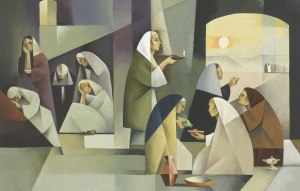 Upacara pernikahan adalah salah satu acara terindah di banyak budaya dan masyarakat. Ini termasuk di masyarakat Yahudi di Palestina abad pertama Masehi. Bagi orang Ibrani yang hidup pada zaman Yesus tersebut, upacara pernikahan memiliki dua tahap. Yang pertama adalah pertukaran janji. Pasangan tersebut sudah menikah secara resmi, dan mereka diakui sebagai suami dan istri di mata komunitas Yahudi. Namun, mereka akan menunggu sekitar satu tahun sebelum mereka bisa hidup bersama. Sang suami akan mempersiapkan rumah mereka serta perayaan pesta nikah yang mungkin berlangsung selama 7 hari lamanya.
 In Medio Ecclesiae