

Palm Sunday of the Lord’s Passion [B]
March 28, 2021
Mark 11:1-10; Mark 14 – 15
Palm Sunday marks the beginning of the Holy Week, a most sacred week in our liturgical year. This year’s celebration may be different from other years because of the pandemic, but this does not stop us from having a solemn and meaningful celebration. One of the usual questions people ask about the celebration of Palm Sunday: “Why did Jesus ride a donkey?” Jokingly I replied, “well, an online taxi was not yet available during that time!”
The standard answer to this question is that Jesus would like to show Himself as a meek and humble king, rather than a power-lust and war freak general who rides a stallion. This answer is correct, but it does not give us a complete picture. If we try to go deeper into Mark gospel alone, we will unearth the Old Testaments’ fulfillments.

The choice of the colt is deliberate on the part of Jesus because He is fulfilling the prophecy of Zachariah. In essence, the prophet Zechariah foretold that someday a gentle, yet victorious king will enter Jerusalem, riding a colt [see Zec 9:9]. Yet, there are more!
If we go back to the Old Testament, we will find a king of Israel who indeed rode this humble animal. He was Salomon, David’s son when he was ascending to his throne [1 Kings 1:33]. By riding a colt, He signifies that He is the new Salomon ascending to His new throne, the cross.
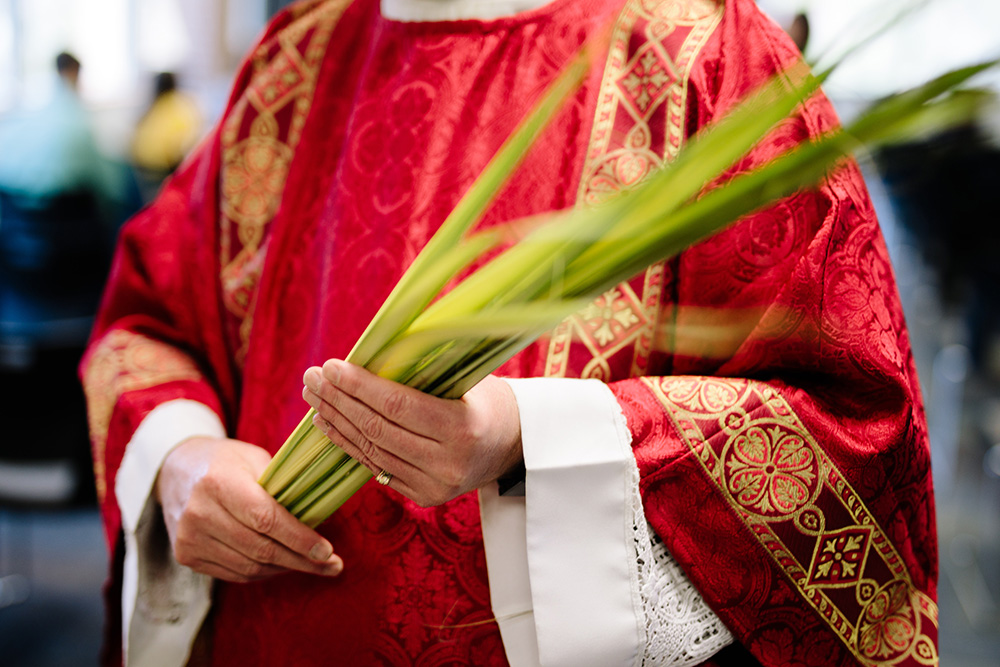
Mark is telling us also that people are spreading their clothes also before Jesus. Going back to the Old Testament, we also discover a king of Judah whose ascension to the throne received this kind of gesture also from the people. His name is Jehu [2 Kings 9:12]. Aside from that, Mark is informing us that people welcome Jesus with leafy branches. Again, if we go back to the old testament, green branches were used to receive Judas Maccabeus, who retook Jerusalem from the enemy’s hands [2 Mac 10:7]. Jesus is indeed a gentle king, but He is also a victorious conqueror of His enemies. One more thing is that Mark added the expression ‘… our Father David…” David is undoubtedly not one of the Israelites patriarchs [Abraham, Isaac, and Jacob]. Still, the people of Israel recognized king David as the nation’s father, a king that protects and provides for his people.
From here, we can draw a stunning conclusion on this Palm Sunday. Jesus is riding on the unridden colt to show that He is Messiah King in the line of David, in the likeness of Salomon and Jehu, as well as a victorious king who will conquer His enemies. Yet, there is something even remarkable. Mark gives us a unique detail: this colt is untamed and untrained. Jesus’ choice to ride this wild animal shows His mastery over wild beasts and nature. He is not just the king of Israel, the king of humankind, but He is a king of all nature. Indeed, a colt is a good ride for the king of the universe.
However, we must not be happy too soon. There are more secrets to be opened and more prophesies to be fulfilled as we enter the drama of Holy Week.
Valentinus Bayuhadi Ruseno, OP
 Traditionally, the Gospel of John is divided into two major divisions: the Book of Sign [chapter 1-12] and the Book of Glory [Chapter 13-21]. The book of Sign focuses on the public ministry of Jesus and presents the seven signs of Jesus. In John’s Gospel, Sign is a technical term for a miracle. Jesus’ signs begin with changing water into wine in Cana and reaching its culmination in raising Lazarus from the dead. Meanwhile, the book of Glory tells us how Jesus is glorified. The second part starts with Jesus and his disciples in the Upperroom and culminates in His Passion, death, and resurrection.
 njil Yohanes biasanya dibagi menjadi dua divisi utama: Buku Tanda-Tanda [bab 1-12] dan Buku Kemuliaan [Bab 13-21]. Buku Tanda-Tanda berfokus pada pelayanan publik Yesus dan juga tujuh ‘tanda’ Yesus. Dalam Injil Yohanes, ‘Tanda’ adalah istilah teknis untuk mukjizat. Tanda-tanda Yesus ini dimulai dengan mengubah air menjadi anggur di Kana dan mencapai puncaknya dengan membangkitkan Lazarus dari kematian. Sedangkan Buku Kemuliaan menjelaskan kepada kita bagaimana Yesus ‘dimuliakan’. Buku kedua dimulai dengan Yesus dan murid-murid-Nya di Ruang Atas dan berpuncak pada sengsara, wafat, dan kebangkitan-Nya.
 Today’s Gospel presents us with one of the most cryptic sayings of Jesus, “Just as Moses lifted up the serpent in the desert, so must the Son of Man be lifted up, so that everyone who believes in him may have eternal life.” To unpack this, we cannot but go back to the Old Testament, especially the Book of Numbers.
 Injil hari ini memberi kita salah satu perkataan Yesus yang paling sulit dimengerti, “sama seperti Musa meninggikan ular di padang gurun, demikian juga Anak Manusia harus ditinggikan, supaya setiap orang yang percaya kepada-Nya beroleh hidup yang kekal.” Untuk memahami perkataan ini, kita perlu kembali ke Perjanjian Lama, terutama Kitab Bilangan.
 We, modern readers, often misunderstand today’s Gospel. This particular Jesus’ story becomes a basis for some to refuse the church building and parish vicinities for non-religious activities, however good its intention is. I personally agree that the inside of the Church’s building is a place set aside for worship and prayer. This is the sacred ground for people to encounter God and experience heaven.
 In Medio Ecclesiae