Why do we obey Jesus?

6th Sunday of Easter [C]

May 22, 2022

John 14:23-29

There are at least three reasons why someone obeys. The first reason is that fear, and fear is a potent motivation. Fear commonly becomes the foundation of master-slave relationship. Slaves do things because they are afraid of their master’s punishments. They fear the pain, and yet paradoxically, they turn to be dependent to their master as they would do anything their masters order without much thinking. Sometimes, we see God as a kind divine master of slaves, and we obey God’s word and rules because we are afraid of punishments. In turn, we become rigid also to others who fail to do God’s commandments or Church’s precepts.

photocredit: Austin Kehmeier

The second reason is profitability. Benefit or profit is another strong drive of life. Profit-oriented motivation usually is reflected in business relationship or contract. People follow their boss or the contracts as long as it is profitable. The moment it is no longer beneficial for them, they stop obeying. They either go disappointed or get angry. Sometimes, we treat God no more than just a business partner or a company boss, and we go to Him when we feel beneficial for us. We pray when we have troubles and want God to fix everything in instant. We go to the Church when we need to feel blessed. Yet, when we do not get what we what, either we are frustrated or get angry.  

The ultimate reason is love. This motive is extraordinary because unlike fear and profit, love gives us neither external punishment nor rewards. Love flows from within and fills others with goodness. Relationship based on love can be seen in friendship. Genuine friends care and do good for one another, but they do not fear each other neither seek only the personal benefits. True friends stay in times of troubles, and true friends remains despite getting nothing in return. They simply know what the right things to do, and they do it for the sake of their friends. Thus, ‘friends in need are friends indeed.’

Jesus understands this dynamism very well, and thus, He does not call His disciples ‘slaves’ but ‘friends’. “You are my friends if you do what I command you [Jn 15:14].” The true drive in obeying and faithful to Jesus is love, and not fear or profit. Why? Because our God is neither cruel master that looks for mistakes nor a boss who constantly monitors our performance. Our God is love.

 Love begets love, and love demands love. Jesus loves His disciples to the end, and His only demand is to love Him to the end. Yet, the paradox is one cannot coerce true love. Despite Jesus binds us with the commandment of love, He does not force, and because of that, there is always possibility of betrayal and denial. However, despite these ugly possibilities, Jesus continues loving us because He cannot deny Himself who is love.

We are primarily slaves nor employees of God, but we are His friends of Jesus. Thus, we ask God for the necessary grace to live our identity as good friends of Christ.

Valentinus Bayuhadi Ruseno, OP

Why Love

5th Sunday of Easter [C]
May 14, 2022
John 13:31-35

Jesus is giving His disciples a new commandment: to love one another. This is not just a recommendation, advice, or suggestion. It is a commandment, and therefore, it is a must to do. What is more interesting is that Jesus consciously connects His New Commandments with the old ones: the Ten Commandments. What are the connections and why does Jesus make this new commandment?

photocredit: Jon Tyson

If we go back to the historical context of the giving of the Ten Commandments, the Israelites were just miraculously freed from Egypt, and they camped at Mount Sinai. There, God came and offered His covenant: The Lord will be their God, and Israel will be their people. Then, God gave the Ten Commandments and other laws as the basic constitutions of what it is to be the people of God. By obeying and living these Commandments, they were going to be the holy nation. They were a nation different from other nations, but a nation separated for God.

Fast forward to Jesus’ Last Supper, Jesus gives the New Commandment. Connecting with the Old Testament, Jesus’ commandment is not just a must to do, it is also our constitutive identity as Jesus’ disciples. This is the commandment that makes us different from the rest. No wonder Jesus explains to His disciples, “By this everyone will know that you are my disciples if you have a love for one another [John 13:35].” This is the commandment that makes us holy, set apart from the others and for Jesus.

However, to love is tough. To love someone means we become vulnerable, and we are open to the possibility of getting hurt. We are betrayed by people we love and trust, our friends, our spouse, our brothers, and our children. I am a priest for barely three years, but living in Surabaya, one of the major cities in Indonesia, I have to listen to a good number of people with broken relationships in marriages and families. I am saddened by the terrible situations that they have to endure, and I cannot help much. Sometimes, people must bear the painful consequence of broken relationships throughout their lives. Wounded by betrayal, we tend to build walls around our hearts, and our capacity to love is gradually dwindling.

Why does Jesus insist on love, to the point of making it the new commandment? The answer is that love is who Jesus is. ‘Love one another as I have loved you!’ Jesus loved His disciples, but after the Last Supper, a disciple betrayed Him, another denied Him, and many were abandoning Him. The people He loved dearly, crucified Him. Yet, Jesus was never a helpless victim. He entered His suffering willingly, and He transformed His death into an act of total self-giving. Jesus knew that His disciples would do terrible things, but He chose to celebrate an intimate Last Supper with them. He forgave people who crucified Him. He gave His dying love to His mother and the beloved disciple. Even death does not stop Him from loving. He has to rise again and bring forgiveness and peace to His disciples. He then sends His Holy Spirit as a sign of His abiding love.

To love fully and sacrificially is our identity as Jesus’ disciples. Though loving is often tough and sometimes, heart-breaking, love is who we are as God’s image. There is no way to heaven except the way of love.

Valentinus Bayuhadi Ruseno, OP

Vocations

4th Sunday of Easter [C]
May 8, 2022
John 10:27-30

The fourth Sunday of Easter is famously called ‘the Good Shepherd Sunday’. This reason is that the Gospel is always taken from John chapter 10, and John 10 speaks of Jesus who introduces Himself as the Good Shepherd. This Sunday is also dedicated as ‘Vocations Sunday’. This tradition starts in 1964 when Pope Paul VI instituted the fourth Sunday of Easter as ‘the World Day of Prayer for vocations.’ This is because, in today’s Gospel, we listen, “My sheep hear My voice, and I know them, and they follow Me [John 10:27].”

In the Catholic Church, we understand vocation as the Good Shepherd’s calling to each one of us to follow Him. Thus, the primary vocation is to follow Jesus, stay with Him, and live in Him. In essence, our universal vocation is holiness.

Yet, through the centuries, the Church has recognized several authentic manifestations of this fundamental vocation. The biggest two categories are the laypeople and the clergy. The easiest way to distinguish the two is the sacred ordinations. After the ordination, a man is no longer a layperson, but a member of the clergy. They are three kinds of ordained ministers: the deacons, the priests, and the bishops. The Church teaches that “The ministerial priesthood is a means by which Christ unceasingly builds up and leads his Church [CCC 1547].” The ordained ministers are called to sanctify the people of God by offering the sacraments and teaching the truth of faith.

The second group is the laypeople, and this is the great majority of the Church’s members. Lay people are called to sanctify their lives, families, and societies. Particular to lay people is the vocation to married life and family. In marriage, a husband and a wife become holy when they love each other totally and radically in Christ. Like Christ who offers Himself up for the sake of the Church, the couple is called to give themselves entirely to each other. Meanwhile, parents’ vocation is to sanctify their children. They do not only give their children nutritious food, proper clothing, a strong house, and high-quality education, but also true faith and right morality. Perhaps, not all parents can explain well the faith, but they can always lead through upright examples and genuine witnessing.

Aside from these two grand categories, the Church also has a special vocation. These are people who professed vows. Traditionally, there are three vows: obedience, chastity, and poverty. When men and women make their vows, they become ‘a religious’ and usually they stay together in a community. If a priest has vowed, he will be a religious priest. Meanwhile, a priest without vows is called a diocesan priest because he attaches himself to a particular diocese. When a woman professes vows, she becomes a religious woman or ‘religious sister’. When a layman possesses vows, he turns to be a religious man or ‘religious brother’. With their vows, they dedicate themselves fully to God and for God’s affairs [see 1 Cor 7:32]

How do you know that you are called to a priest or a lay, as a religious sister, or as a married woman? There are no fixed answers for this, but we can use three easy steps.
The first one is recognizing our desire. A simple wish and attraction to a priestly life or religious life is already a seed God planted in us. Don’t waste it!
The second step is to know deeper and weigh different options in prayer. We look for more information and ask people who are living their lives. We may discover different yet interesting options. We also bring this effort in prayer and ask the Lord to guide our decision.
The third and final phase is to decide and commit fully. All vocations are good and ways to holiness. Thus, there is no wrong vocation, yet we can ruin it when we do not give our all to this vocation. It only bears fruits abundantly when we faithfully nurture and love our chosen vocation.

Valentinus Bayuhadi Ruseno, OP

Do You Love Me?

3rd Sunday of Easter [C]
John 21:1-19
May 1, 2022

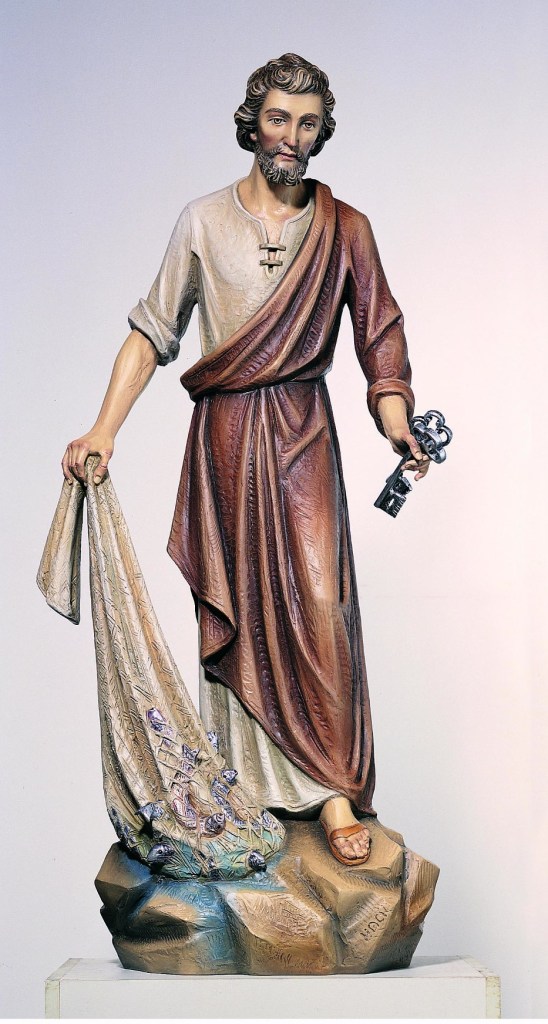
Simon Peter is a total mess. He is impulsive and even perhaps explosive. One time, he tried to remind his Master and thought he was better than Jesus, but immediately, Jesus scolded him and even told him, “get behind me Satan.” At the Gethsemane, Jesus told His disciples that they would desert Him, Simon once again was full of confidence, and said, “Though all become deserters because of you, I will never desert you.” Jesus famously prophesied that Peter would eventually deny Him. Simon immediately countered, “Even though I must die with you, I will not deny you” [Mat 26:31-35]

Unfortunately, Peter was nothing but empty words and promises. When Jesus was arrested and detained in the high priest’s house, Peter was near the charcoal fire and tried to warm himself on a chilling night. While Jesus was thrown into the dungeon, Simon only care about himself and conveniently refused to acknowledge his identity as Jesus’ disciple. When the rooster crowed, Simon remembered what Jesus has said, and he went away and wept bitterly. Peter’s pride was shattered into pieces, and he must have realized that he was nothing but a big failure.

Indeed, Peter could have ended as a total mess, yet Jesus did not give up on him. In Galilee, Peter once again saw his Risen Master, and Jesus had prepared a charcoal fire and fish and bread. Seeing this charcoal, Peter was brought back to that moment he denied the Lord. Peter had chosen his warm and comfort zone in exchange for the Lord. Then, the Lord asked Peter, “Simon, son of John, do you love me more than these?” John the evangelist informs us that Jesus is using the word ‘agape’, a higher and sacrificial love. This question shook Simon’s heart. Peter remembered how he used to say ‘I will sacrifice my life for Jesus’, but it was nothing but empty words. Now, Jesus demanded sacrificial love from Peter. Humbled by his failure, the best answer Simon could give is, ‘You know, I love you, Lord.” Here, Peter used the word ‘filia,’ a friendship friend.

Once again, Jesus demanded a total and radical love. For the second time, Peter could only offer ‘filia’. Simon did not want to repeat the same prideful mistake and knew at that moment, that Simon could only love Jesus as a friend. However, in the third question, Jesus made a dramatic change. Jesus did not longer demand sacrificial love, but rather accommodate Simon’s ability. Jesus asks, ‘do you love as a friend?’ Peter could not contain himself and was sorrowful. Jesus understood Peter’s heart and capacity and forgave and accepted Simon the way he was. Yet, that’s not the end of the story. Simon’s love for Jesus must grow, and the time would come when Peter would love Jesus radically and give himself up for Jesus.

The story of Peter is our story as well. Our lives have been a mess, but Jesus does not give up on us. And, when we are afraid to love Him, Jesus accepts us still. He journeys with us and enables us to grow in love, until the time we can say, “You know Lord, I love you!”

Valentinus Bayuhadi Ruseno, OP