

Fourth Sunday in Ordinary Time [B]
January 28, 2024
Mark 1:21-28
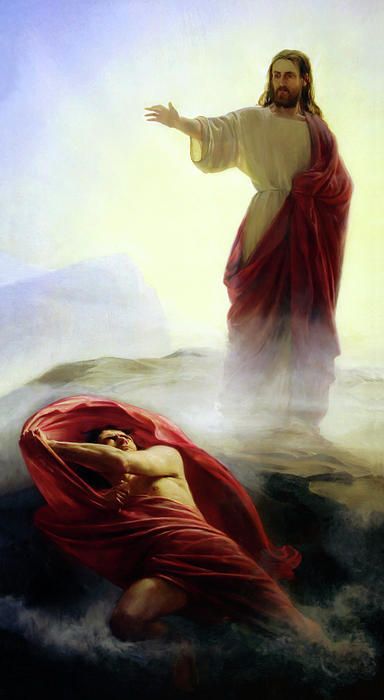
One of the highlights of Jesus’ ministry is the exorcism of the unclean spirits. Mark, the evangelist even, does not hesitate to write that expelling the unclean spirits is part of Jesus’ teaching with authority. Jesus’ authority does not only affect His human hearers but also controls the unclean spirits. Yet, who are these unclean spirits? Why does Jesus have authority over them? And how do they affect our lives?

Based on the revelation and the tradition, the Church teaches that these spirits are also God’s creation. By nature, they are spirits or angels. As a spirit, they are creatures without a body, and since they are not affected by material limitations, they are naturally superior to us humans. However, unlike the good angels that use their power to help humans, these spirits do the opposite. They wish to harm men and women. That’s why they are called the evil spirits.
If God is good, why did God create evil beings? In the beginning, God created them as good spirits. Yet, as creatures with freedom, they made a definitive choice to go against their Creator. Their rebellion against God made them fall from grace, and thus, they were called ‘the fallen angels.’ (see CCC 391-395)
Then, why do the unclean spirits obey Jesus? The answer is straightforward. Jesus is their Creator. Jesus’ authority is reflected in the Greek word chosen when Jesus drives away the demons, ‘φιμοω’ (read: phimoo). Ordinarily, this word is translated as ‘be quiet,’ but literally, it means ‘to put a muzzle.’ It is like a farmer who places a muzzle on the mouth of his rowdy ox and thus puts it under submission. The idea is that Jesus is extremely powerful to the point that He could easily put evil spirits that are beyond human comprehension under His control.
One interesting fact also is that Mark does not call these fallen angels ‘evil spirits’ but rather ‘unclean spirits’ (πνευμα ἀκάθαρτον – pneuma akatarton). In the Jewish context, to be unclean means to be ritually unfit for God. Something or someone impure cannot enter the Temple of God and, thus, cannot offer worship and become far from God. These spirits are unclean precisely because they are not fit for God and, thus, far from Him.
We can also see the uncleanliness as an effect of the evil spirits. One who is under the dominion of the evil spirits becomes unclean and, thus, is far from God. One who lives in sin and, thus, distant from God is under the influence of evil spirits to a certain extent. From here, we can understand that Jesus’ mission to drive out the unclean spirits is an integral part of His mission to make people holy and to unite people with God.
The discussion on the evil spirits is certainly vast and intriguing, but it suffices to say that Jesus is infinitely superior to the evil spirits. Therefore, to live with and in Jesus is the only way to drive away the unclean ones. It is also true that as we go closer to Jesus, the evil spirits will double their efforts, and in this situation, all the more we must cling to Jesus.
Rome
Valentinus Bayuhadi Ruseno, OP




 In Medio Ecclesiae