

The Solemnity of the Holy Trinity
May 26, 2024
Matthew 28:16-20
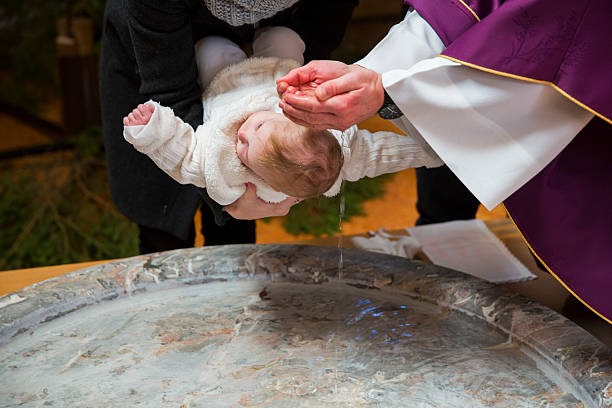
As we celebrate the mystery of the Holy Trinity, the Church invites us to meditate on our Baptism. We are baptized in the formula given by Jesus Himself. Jesus instructed His disciples, “Go therefore and make disciples of all nations, baptizing them in the name of the Father and of the Son and of the Holy Spirit (Mat 28:19).” Yet, what does it mean to be baptized with this Trinitarian formula?

Baptism claims us for God. We are baptized ‘in’ the name of the Father, and of the Son, and of the Holy Spirit. In New Testament Greek, the preposition ‘in’ is ‘εἰς’ (read: eis), and this points to a movement from one place to another or from an old condition to a new one. Thus, Baptism allows us to enter a new place, state, and status.
In Baptism, we are no longer outside of God, but now we are inside of God. We no longer belong to the world but now to God. We are no longer under the influence of Satan, but now we are animated by God’s grace. The grace of Baptism recreates us from the fallen children of Adam into God’s holy children. The same grace transforms us into redeemed members of Jesus’ body. And finally, this grace also sanctifies us and makes us become the temple of the Holy Spirit.
Since Baptism leads us to communion with the Holy Trinity and heaven is nothing but permanent union with God, Baptism is necessary for our salvation. No wonder St. Peter teaches with authority that Baptism saves us (1 Pet 3:21). However, we must remember that the grace we receive in Baptism must be properly received and manifested in our lives.
This union with God is not only something spiritual and invisible but concrete and visible. In this world, we believe that the family of God, the Body of Christ, and the Temple of the Holy Spirit have a visible manifestation: the Church. Baptism is also a gateway to our membership in the Church. Therefore, we demonstrate our belonging to the holy Trinity when we manifest our belonging to our local Church, parishes, and the universal Church. We express our spiritual union with the Holy Trinity when we celebrate the liturgy of the Eucharist worthily.
Thus, we cannot say we are in unity with the Holy Trinity, but we never attend mass because of laziness or receive the holy Communion unworthily.
We reveal our love for the holy Trinity when we love our fellow Christians and even those who do not believe yet in the Trinity. That is why St. John says, “If anyone says, ‘I love God,’ and hates his brother, he is a liar; for he who does not love his brother whom he has seen, cannot love God whom he has not seen (1 Jn 4:20).” We display our communion with the Holy Trinity when we separate ourselves with the devil and his works. We cannot say that we are children of God, but we live in sins, we steal from others, we are involved in esoteric practices, and we believe in superstitions.
The sacrament of Baptism does not stop with the pouring of water but manifests in our daily lives. Our belief in the Trinity does not simply mean intellectual acceptance of God’s presence but also transforms our lives and the way we live in the world.
Rome
Valentinus Bayuhadi Ruseno, OP


 In Medio Ecclesiae