

7th Sunday of Easter
May 24, 2020
John 17:1-11a
 We are aware that prayer is a fundamental part of Jesus’ life. He prays on a regular basis, and especially when He is preparing to embrace decisive events, like Baptism on the Jordan [Luke 3:21], the election of the twelve apostles [Luke 6:12], transfiguration [Luke 9:28], and the Passion [Matt 26:36–44]. However, we seldom hear what Jesus says in His prayers. In the Synoptic Gospels [Matthew, Mark, and Luke], we are fortunate enough to hear Jesus’ compact and emotional prayer in the Garden of Gethsemane before He enters into His Passion. However, John the evangelist makes sure that we are going to discover what Jesus prays, and it is substantially longer than we ever heard before.
John devotes the entire chapter of His Gospel for this prayer [John 17:1-26]. As expected, He prays to the Father with extraordinary affection and confidence. Yet, what makes it noteworthy is that Jesus does not say only about Himself and His mission, but also prays for His disciples. Jesus is acting as the priest who is interceding on behalf of His disciples. That is why we call this section the high priest’s prayer of Jesus Christ.
From Jesus’ prayer, we unearth some powerful lessons:
Firstly, if prayer is essential in the life of Jesus, it is because Jesus understands that prayer is His line of communication to the Father. Jesus knows well that communication is the key to every flourishing relationship. Perhaps, we fail to see this truth, and that is why we feel prayer is burdensome. We are not eager to attend the mass because we simply understand it as an obligation. We relegate personal prayer to the sideline as we make other things as our priority. Sadly, we immediately blame God if our plans do not work according to our whim, or we even threaten God to grant our wishes. Thus, changing perspective about prayer is crucial and even life-transforming.
Secondly, if prayer is communication, then it should always be a dialogue. Often when we start growing in prayer, we think that we need to always say something to the Lord. I remember one seminarian asked me, “Father, what else should I say if I am running out of words in my prayers?” I told him, “Perhaps, it is time to listen to God.” The next expected question is, “How do I listen to God?” Surely there is no one-size-fits-all answer to this, but I like what St. Jerome says, “You pray: You speak to the bridegroom. You read [scriptures]: He speaks to you.” Yet, we need to remember that dialogue of words is not the end of the communication. The end is the unity of the persons in dialogue. Jesus says, “I am in my Father, and you are in me, and I am in you [John 14:20].”
Lastly, our prayer involves the third person. This is the direct consequence of Jesus’ priestly prayer. Prayer is a dialogue, but just like other dialogue, it may speak about other persons. This is when we pray to God for others. Because Jesus leaves us an example in His priestly prayer, it is all the more imperative for us to care for others through prayers. In time we cannot reach other people who need our help; prayers remain the best way to love them. Indeed the saints in heaven continue to care for us despite not able to physically appear to us through their prayers.
Prayer unites us with God in love and prayer also unites us with people we love in God.
Valentinus Bayuhadi Ruseno, OP
 Doa adalah bagian mendasar dari kehidupan Yesus. Dia berdoa secara teratur, dan terutama ketika Dia bersiap untuk merangkul peristiwa-peristiwa yang menentukan, seperti Pembaptisan di Sungai Yordan [Lukas 3:21], pemilihan kedua belas rasul [Lukas 6:12], transfigurasi [Lukas 9:28], dan jalan salib-Nya [Mat 26:36-44]. Namun, kita jarang mendengar apa yang Yesus katakan dalam doa-doanya. Dalam Injil Sinoptik [Matius, Markus dan Lukas] kita cukup beruntung mendengar doa Yesus yang pendek dan emosional di Taman Getsemani sebelum Dia memasuki sengsara-Nya. Namun, penginjil Yohanes memastikan bahwa kita akan menemukan apa yang Yesus doakan dan hal ini jauh lebih panjang daripada yang pernah kita dengar sebelumnya.
 In the last supper, Jesus promised the disciples that He would send another advocate to be with them forever. Who is this other advocate?
 Dalam perjamuan terakhir, Yesus berjanji kepada murid-murid bahwa Ia akan mengirim penolong yang lain untuk bersama mereka selamanya. Siapa penolong yang lain ini?
 We have closed our churches for public service for weeks. We shifted to livestreaming masses, and we are learning to adjust and to give priority to our health and life, we realize our hearts remain troubled. We long to see Jesus in the Most Blessed Sacrament, we desire to receive Him in the Eucharist, we want to serve Him in the churches, and we miss the sacrament of confession. We are unsure when it is going to end and be back to normal.
 Kita telah menutup gereja-gereja kita untuk pelayanan publik untuk beberapa minggu sekarang. Kita beralih ke misa livestreaming, dan kita belajar untuk menyesuaikan diri dan mengutamakan kesehatan dan kehidupan kita. Tetapi, kita menyadari bahwa hati kita tetap gelisah. Kita ingin melihat Yesus dalam Sakramen Mahakudus, kita berhasrat untuk menerima-Nya dalam Ekaristi, kita ingin melayani-Nya di paroki dan komunitas, dan kita kehilangan sakramen pengakuan dosa. Kita tidak yakin kapan akan berakhir dan kembali normal.
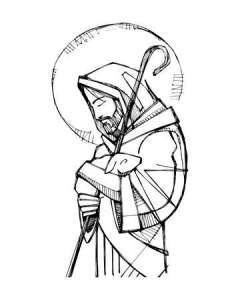 traditionally it is also called as the Good Shepherd Sunday. This is for an obvious reason. The Gospel reading tells us about Jesus who introduces Himself as the gate of the sheepfold and the Good Shepherd. The other readings also point the image of God as the good shepherd, like the world-renown psalm 23, “the Lord is my shepherd.”
 Hari ini adalah hari Minggu Paskah keempat dan secara tradisional juga disebut sebagai Minggu Gembala yang Baik. Bacaan Injil berbicara tentang Yesus yang memperkenalkan diri-Nya sebagai pintu gerbang domba dan juga Gembala yang Baik. Mazmur tanggapan diambil dari mazmur 23 yang menyatakan bahwa “Tuhanlah gembalaku.” St. Petrus dalam Suratnya mengatakan bahwa kita adalah domba-Nya yang hilang, tetapi sekarang telah kembali kepada Yesus sang Gembala [lih. 1 Pet 2:25].
 The two disciples went back home to Emmaus. One of them was Cleopas, and his companion probably was his wife. Perhaps they got afraid of the Roman and Jewish authorities who might go after them after they killed Jesus, the leader. Or maybe, they just got their hope and expectation shattered when Jesus, their expected Messiah, was crucified.
 In Medio Ecclesiae