
Solemnity of the Most Holy Trinity [A]
June 7, 2020
John 3:16-18
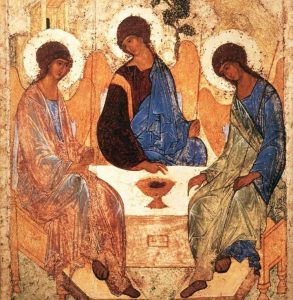 We are re-entering the ordinary season of the Church, and one of the greatest feasts within the ordinary time is the solemnity of the Most Holy Trinity. The Church has placed the celebration of the great feast on Sunday after the Pentecost. The reason may not be that obvious, but if we look at the bigger picture, it is nothing but a natural procession of truth. In Easter, we are celebrating the resurrection of Jesus that cements the divinity of Christ. On the Pentecost, we witness the divinity of the Holy Spirit being affirmed [see last Sunday’s reflection]. Now, we are rejoicing for the Three divine persons in God.
The Trinity Sunday is admittedly the most dreaded by many preachers because many are still at a loss of how to show the beauty of this most profound truth, and others are afraid to explain the Trinity because they may spread erroneous concepts. After all, we are facing the source and summit of all mysteries, the mystery of all mysteries. However, it is not the right excuse not to bring forth the beauty of the Holy Trinity. The preachers have to roll up their sleeves and spend more time in researching and preparing our homilies.
In my reflection, I would like to bring you to the Old Testament. In the Old Testament, the reality of the Trinity is hidden in most parts, and yet the sacred truth comes up in the surprisingly key moments. Let us read Gen 1:1-3, “In the beginning when God created the heavens and the earth, the earth was a formless void and darkness covered the face of the deep, while a wind from God swept over the face of the waters. 3 Then God said, “Let there be light,”; and there was light.” The early Christians like St. Irenaeus of Lyon, immediately saw this as Trinity working as one, God, the Spirit, and the Word. The good news is that the creation is the masterpiece of the Holy Trinity, and to a certain degree, it reflects the perfection of the Trinity.
And wait, something more! In Gen 1:26, when God created the man and the woman, God said, “let us create the man and woman in our image and likeness.” This passage is a bit strange because why God, who is one, suddenly self-refer in plural? The Jewish tradition would interpret that God is addressing His heavenly council, the angels, but again, the Christian tradition instinctively saw them as the three divine persons. The good news is that if we are created in the image of God, and if our God is the Trinity, then we are created in the image of Trinity.
This explains a lot of things. Indeed, we cannot fully comprehend the mystery, but we surprisingly are very close to this mystery. Trinity is both our origin and destiny. As the image of Trinity, we cannot discover real joy by hoarding things to ourselves. We cannot be selfish and truly delighted at the same time. Like the Father and the Son love each other in the Holy Spirit, we are called to give ourselves to others in life.
Why does the Catholic Church fearlessly defend the sacredness of marriage? Because through marriage, the man and woman may give themselves totally to each other in love. Their love is so strong that love can give birth to life. When this new life [children] come to their lives, their love can grow even exponentially. In loving and giving ourselves, we may find the fullness of our identity, the image of Trinity. Indeed, it is tough, but the good news is that we are designed to give love and life. Holy Trinity is our origin, and Holy Trinity is our destiny.
Valentinus Bayuhadi Ruseno, OP
 “Happy Birthday!” today is the feast of Pentecost, and today is the birth of the Church. We should rejoice because our Church is getting older by age, but getting ever stronger by vitality and creativity in preaching the Good News. Yet, the question is why we celebrate the birthday of the Church on the Pentecost Sunday?
 We are aware that prayer is a fundamental part of Jesus’ life. He prays on a regular basis, and especially when He is preparing to embrace decisive events, like Baptism on the Jordan [Luke 3:21], the election of the twelve apostles [Luke 6:12], transfiguration [Luke 9:28], and the Passion [Matt 26:36–44]. However, we seldom hear what Jesus says in His prayers. In the Synoptic Gospels [Matthew, Mark, and Luke], we are fortunate enough to hear Jesus’ compact and emotional prayer in the Garden of Gethsemane before He enters into His Passion. However, John the evangelist makes sure that we are going to discover what Jesus prays, and it is substantially longer than we ever heard before.
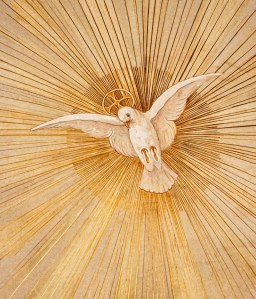 In the last supper, Jesus promised the disciples that He would send another advocate to be with them forever. Who is this other advocate?
 We have closed our churches for public service for weeks. We shifted to livestreaming masses, and we are learning to adjust and to give priority to our health and life, we realize our hearts remain troubled. We long to see Jesus in the Most Blessed Sacrament, we desire to receive Him in the Eucharist, we want to serve Him in the churches, and we miss the sacrament of confession. We are unsure when it is going to end and be back to normal.
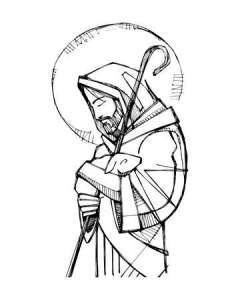 traditionally it is also called as the Good Shepherd Sunday. This is for an obvious reason. The Gospel reading tells us about Jesus who introduces Himself as the gate of the sheepfold and the Good Shepherd. The other readings also point the image of God as the good shepherd, like the world-renown psalm 23, “the Lord is my shepherd.”
 The two disciples went back home to Emmaus. One of them was Cleopas, and his companion probably was his wife. Perhaps they got afraid of the Roman and Jewish authorities who might go after them after they killed Jesus, the leader. Or maybe, they just got their hope and expectation shattered when Jesus, their expected Messiah, was crucified.
 The second Sunday of Easter is also known as the Divine Mercy Sunday. The liturgical celebration of the Divine Mercy Sunday is declared in the year 2000 by Pope St. John Paul II who had a strong devotion to the Divine Mercy revealed to St. Faustina. Though the feast itself is something recent, the truth of divine mercy is fundamental in the Bible and Sacred Tradition. If there is one prevailing character of God, it is not other than mercy. In the Old Testament, there are at least two Hebrew words that can be translated as mercy. One is rāḥam and the other is ḥeṣedh.
 Today is the day of resurrection. Today is the day Jesus has conquered sin and death. Today is the day of our victory. No wonder among the liturgical celebration of the Church, Easter is the grandest, the longest and the most spectacular. It is the time that the churches are flooded with the faithful. It is the time that parishioners got involved in many activities, practices, and services. It is the time when families gather and celebrate. It is the time the priests receive more blessings!
 If there is one thing that unites people from different nations, languages, and religions, that is the experience of suffering. With the ultra-fast spreading coronavirus, covid-19, people with different backgrounds, young and old, rich or poor, and noblemen or commoners, and laypeople or clergy fall in their knees and tremble. Indeed, this microscopic virus has shattered countless lives. People are dying, hospitals are overwhelmed, cities are isolated, families are separated, workers are jobless, governments are at loss, and churches are empty. Pope Francis notes that “we are just one the same boat”, and this boat is sinking. Suffering forces us to admit our human frailty and all that we are proud of, are a mere breath.
 In Medio Ecclesiae