

The Solemnity of Our Lord Jesus Christ, King of the Universe
November 23, 2025
Luke 23:35-43
As the liturgical year draws to a close, the Church proclaims a startling truth: Jesus Christ is King of the Universe. But what can this mean?

Jesus’ life defies every worldly notion of kingship. He is not a king who commands powerful armies or controls vast resources. He possesses neither soldiers nor gold. In fact, He died the most humiliating death, nailed to a cross under the mocking accusation, “This is the King of the Jews.” Most of His disciples had fled, leaving only a few faithful women to witness His tragic end. So, we must ask: what kind of king is this?
The answer is revealed precisely at the cross. Here, in the midst of injustice and mockery, Jesus redefines kingship. Even the two criminals crucified beside Him initially joined in the taunts (Mk 15:32). But then, something extraordinary happens. One of them has a change of heart and turns to Jesus, saying, “Jesus, remember me when you come into your kingdom (Luk 23:42).” In this moment of utter despair, the “good thief” recognizes Jesus as a real king at His throne.
What caused this dramatic shift? The key lies in the thief’s own words to his companion: “Do you not fear God, since you are under the same sentence of condemnation? We have been condemned justly, for we are getting what we deserve for our deeds, but this man has done nothing wrong (23:40-41).” He knew Jesus was innocent.
Yet, more than just His innocence, the good thief saw something more. He witnessed a profound and unsettling grace. Amid the injustice, he heard no curse or bitter word from Jesus. Instead, he heard, “Father, forgive them; for they do not know what they are doing (23:34).” While the world hurled its anger, hatred, and violence at Him, Jesus did not amplify it with revenge. He embraced it, allowing it to stop with Him, and answered with a word of forgiveness.
The good thief realized that true power is not the ability to inflict suffering, to enrich oneself, to gain more power over oneself, but rather the strength to bear suffering and transform it into occasion of love. Jesus, stripped of all earthly power, wielded the greatest weapon of all: self-sacrificing love. He demonstrated that not even the cross could stop Him from loving—even loving those who sought His destruction.
And in that moment of recognition and humble request—“remember me”—the King exercises His true authority. Jesus doesn’t only promise a future reward; He proclaims a present reality: “Today you will be with me in Paradise.” Jesus, the King, transforms the darkest moment of a condemned criminal into the paradise.
This is the power of Christ our King. He invites us, like the good thief, to recognize His authority and embrace the law of love. When we do, He begins the same work of transformation in us, turning our own moments of pain, confusion, and sin into foretastes of His Kingdom.
Surabaya
Valentinus Bayuhadi Ruseno, OP
Questions for Reflection:
- The citizens of God’s Kingdom are peacemakers who seek justice without vengeance. When others hurt us, what is our response? Do we avoid them, wish them harm, or seek to inflict the same pain? Or do we, like our King, pray for their conversion?
- The citizens of the Kingdom are the pure in heart. What fills our inner world? Is it hatred, bitterness, and anger? Or is it forgiveness, compassion, and the things of God?

 Dalam Injil hari ini, Yesus tampaknya menolak semua tradisi. Namun, pernyataan ini terlalu disederhanakan. Alasannya adalah bahwa manusia adalah makhluk tradisi. Tradisi berasal dari kata Latin, “tradere”, yang berarti “menurunkan”. Jadi, secara sederhana, tradisi adalah segala sesuatu yang telah diturunkan atau diwariskan dari para pendahulu kita. Tradisi berkisar dari sesuatu yang berwujud seperti teknologi, hingga sesuatu yang tidak berwujud seperti bahasa, ilmu pengetahuan, dan banyak lagi. Saya ingat bagaimana ibu saya mengajarkan saya doa-doa dasar, seperti Bapa Kami, Salam Maria, dan Rosario, dan bagaimana ayah saya secara teratur membawa kami ke Gereja setiap Minggu. Ini adalah tradisi agama keluarga saya. Sebagai orang Indonesia yang tinggal di Filipina, saya mengapresiasi tradisi “Pano Po” di antara orang Filipina. Ini adalah sikap menghormati orang yang lebih tua dan juga memberi berkat kepada yang lebih muda. Orang Filipina yang lebih muda akan memegang tangan mereka yang lebih tua, dan meletakkannya di dahi mereka.

 Talent is one of the few biblical words that has become part of our modern language. Talent connotes a God-given ability or a natural unique skill, and yet it has not fully developed. Thus, we are called to use and harness our talents in order to achieve our full potentials and contribute to the progress of society. In fact, talents have become well-sought commodity in our society. Companies only hire the talented employees. Schools are marketed as venues of talents development. Our TV channels and social media outlets are filled by shows where we perform, compete and prove that we possess the best talent in singing, dancing, and the like. How our world is now obsessed with talents!
 Talenta adalah satu dari sedikit kata-kata dari Kitab Suci yang telah menjadi bagian dari bahasa kita sehari-hari. Talenta sering diartikan sebagai bakat yang diberikan Tuhan atau keterampilan yang unik seperti memiliki suara yang indah, kemampuan memecahkan persoalan matematika yang rumit, atau kemampuan berolahraga, namun belum sepenuhnya dikembangkan. Dengan demikian, kita dipanggil untuk menggunakan dan memanfaatkan talenta kita untuk mencapai potensi maksimal kita dan memberikan kontribusi pada kemajuan masyarakat.
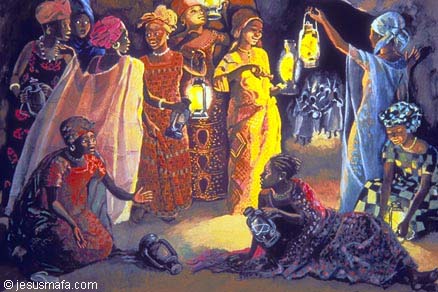 Pada zaman Yesus, seorang perempuan yang belum menikah harus tinggal dengan ayah dan keluarganya. Hanya saat dia menikah, dia akan pindah ke rumah suaminya. Peralihan dari keluarga asalnya ke keluarga barunya ini dilambangkan oleh perarakan pernikahan yang melibatkan hampir semua orang di desa. Pengantin laki-laki akan menjemput sang istri dari rumah ayahnya, dan bersama-sama mereka diarak kembali ke rumah pengantin laki-laki di mana biasanya perayaan pernikahan diadakan. Untuk alasan praktis, perarakan berlangsung setelah matahari terbenam, dan dengan demikian, pria dan wanita yang terlibat dalam perarakan harus membawa obor atau pelita mereka.
 Reading this Sunday’s Gospel, I feel that Jesus is reprimanding His priests and ministers for “preaching and yet not practicing.” Unfortunately, many of us are failing in this matter. We preach forgiveness, but some priests are having prolonged quarrels with other co-priests and some of their parishioners. We teach kindness and friendship of God, yet some of us appear to be aloof and snobbish. We proclaim justice, but sometimes we fail to be just to the simple people working in the parish or convent.
 In Medio Ecclesiae