Mengenal Siapa dan Bagaimana Mengasihi

Minggu ke-15 dalam Masa Biasa [C]

Juli 13, 2025

Lukas 10:25-37

Jika kita berada dalam situasi yang sama dengan perumpamaan yang diceritakan Yesus, apakah yang akan kita lakukan? Apakah kita akan bertindak seperti imam dan orang Lewi yang mengabaikan dan menghindari orang yang terluka itu? Atau apakah kita, seperti orang Samaria yang menunjukkan belas kasih dan menolong orang yang membutuhkan? Ataukah kita akan melakukan sesuatu yang sama sekali berbeda?

Di era digital seperti sekarang ini, dengan adanya gadget berteknologi tinggi, kita bahkan mungkin melakukan hal yang tidak terpikirkan dan tidak terbayangkan, terutama di zaman Yesus. Alih-alih menolong, kita mungkin akan mengeluarkan ponsel kita untuk merekam kejadian tersebut, mengambil foto selfie dengan korban, atau bahkan membuat livestreaming kejadian tersebut! Walaupun kedengarannya aneh, hal ini tidak sepenuhnya mengada-ada.

Kita hidup dua milenium setelah Orang Samaria yang Baik Hati ini, dan kehidupan modern membuat kita semakin sulit untuk berbuat baik dan menolong mereka yang membutuhkan. Sebelum menolong seseorang, kita menghadapi banyak sekali keraguan dan ketidakpastian: Apakah orang ini benar-benar membutuhkan pertolongan, atau hanya penipuan? Apakah saya bisa mendapat masalah karena menolongnya? Apakah saya punya waktu, dengan pekerjaan dan tanggung jawab lainnya? Kerumitan hidup modern sering kali melumpuhkan kita, sehingga sulit untuk mengasihi sesama kita, terutama mereka yang paling membutuhkan. Jadi, bagaimana seharusnya kita menanggapinya?

1. Mengasihi Sesama Adalah Mengasihi Allah

Kita perlu mengingat bahwa mengasihi sesama kita haruslah merupakan ungkapan kasih kita kepada Allah. Injil memanggil kita untuk mengasihi Allah dengan sepenuh hati dalam segala hal yang kita lakukan. Ini berarti bahwa bekerja keras untuk menafkahi keluarga kita adalah tindakan kasih kepada Allah, karena Allah mempercayakan mereka dalam pemeliharaan kita. Membesarkan anak-anak kita dalam hikmat dan iman adalah ungkapan pengabdian kita kepada-Nya karena mereka adalah anugerah Tuhan. Bahkan merawat tubuh kita, melalui makanan sehat dan kebiasaan yang baik, juga merupakan bentuk penghormatan kepada Allah, karena tubuh kita adalah berkat-Nya bagi kita.

2. Ketahuilah Prioritas Kita dalam Kasih

Kita bukanlah superhero! Kita tidak dapat menolong semua orang sekaligus. Tanggung jawab pertama kita adalah mengasihi mereka yang telah Tuhan tempatkan dalam pemeliharaan kita. Sebagai orang tua, tugas utama kita adalah melindungi, menafkahi, dan mendidik anak-anak kita. Jika kita menghabiskan lebih banyak waktu untuk melayani di gereja dan mengabaikan keluarga kita, tentu ada sesuatu yang salah. Hanya setelah kita memenuhi tanggung jawab utama kita, menolong orang lain akan mengalir dengan alamiah, dan bukan sekedar pelarian atau mencari sensasi.

3. Tahu Cara Mengasihi dengan Baik

Setelah mengetahui siapa yang perlu kita kasihi, maka kita perlu tahu bagaimana cara mengasihi mereka. Mengasuh anak, misalnya, menuntut dedikasi total. Mengapa? Tuhan merancang anak-anak untuk membutuhkan lebih dari sekedar makanan, tempat tinggal, dan pakaian. Mereka membutuhkan kehadiran emosional, teladan, dan bimbingan yang konstan. Banyak permasalahan perkembangan dan kesehatan mental pada anak-anak saat ini berasal dari ketidakhadiran orang tua – baik secara fisik maupun emosional – yang menganggap bahwa uang dapat menyelesaikan segalanya.

Menjadi Orang Samaria yang Baik Hati dimulai dari rumah. Jika kita tidak bisa mengasihi orang-orang terdekat kita, bagaimana kita bisa benar-benar mengasihi orang yang kita tidak kenal?

Valentinus Bayuhadi Ruseno, OP

Pertanyaan-pertanyaan panduan:

Bagaimana kita mengasihi diri kita sendiri? Bagaimana kita mengasihi pasangan kita? Bagaimana kita mengasihi anak-anak kita? Bagaimana kita mencintai panggilan kita? Bagaimana kita melihat prioritas cinta kita?

We and Our Popes

6th Sunday of Easter [C]

May 25, 2025

Acts 15:1-2, 22-29

The Catholic Church experiences a profound and historic moment this Easter 2025. Pope Francis, a beloved yet polarizing figure, passed away just a day after delivering his Easter Sunday blessing. His funeral Mass the following Saturday drew hundreds of thousands of mourners, reflecting the deep impact of his papacy. As the cardinals gathered for the conclave, the world watched in anticipation. Then, on May 8, white smoke billowed from the Sistine Chapel. “Habemus Papam!” We have a new pope, and his name is Leo XIV, the first North American pope and the first from the Order of St. Augustine. Thousands of faithful rejoiced in St. Peter’s Square, hopeful for a new chapter in the Church.

Pope Francis’ legacy was marked by both admiration and controversy. Many cherished his compassion for the poor and marginalized, while others struggled with some of his statements and decisions. Now, with Pope Leo XIV’s election, there is hope for unity and peace in the Church. Yet, like any human leader, he would also say or do something that are not according to our wishes. How, then, should we respond to this reality?

The key lies in distinguishing true devotion from fanaticism. Fanaticism is a disorder attraction and it distorts our perception of the papacy, turning admiration into idolatry. It blinds us to the humanity of the pope, making us believe he is infallible in all matters, not just those of faith and morals, and leads us to dismiss or attack those who criticize him. Worse still, it can lead to contempt for other popes simply because they differ from our preferred leader. This extreme attachment often backfires; when our idealized pope falls short of expectations, disillusionment sets in, sometimes even driving people away from the Church entirely.

True devotion, on the other hand, is rooted in love for Christ, who entrusted Peter and his successors with the care of His flock. We honor the pope not primarily because of his personal qualities but because of his sacred role as the Vicar of Christ. In simple term, we love our popes because we love Jesus.

The first reading reminds us of St. Peter’s leadership in the early Church. When the apostles and elders gathered in Jerusalem and debated whether Gentile converts must follow Mosaic law. Some elders wanted that they should be Jewish before Christians, meaning they had to be circumcised and followed Mosaic laws strictly. Others like St. Paul and Barnabas wanted that the Gentile converts be free from Mosaic laws. Finally, Peter stood and made the final decision: they were not bound by such obligations. The council accepted his authority, knowing it came from Christ. Yet Peter himself was not flawless. In another instance, Paul openly corrected him for failing to uphold his own teaching (Gal 2:11-14). Paul’s rebuke was not born of hatred but of love; a desire to strengthen Peter in his God-given mission.

Like Peter, every pope carries the weighty responsibility of shepherding the Church. And like Peter, they remain human, susceptible to weakness and error. Our role is to support them with prayer, especially in times of trial, and to uphold the Church with both faith and discernment.

Rome

Valentinus Bayuhadi Ruseno, OP

Questions for reflection:

How do we see our popes? How do we love our popes? Do we ever struggle to understand our popes? How often do we pray for our popes?

Manusia dan Benih

Minggu ke-11 dalam Masa Biasa [B]
16 Juni 2024
Markus 4:26-34

Ada sesuatu yang ‘tidak biasa’ dalam perumpamaan Yesus kali ini. Saya bukan seorang petani, tetapi saya dapat merasakan bahwa orang dalam perumpamaan ini sepertinya tidak mengerti apa yang sedang ia lakukan. Dia hanya melemparkan benih dan pergi tidur. Apa yang sebenarnya terjadi di sini? Apa yang Yesus ingin ajarkan kepada kita melalui perumpamaan ini?

Meskipun cara pria dalam perumpamaan dapat menjadi cara untuk menanam tanaman, itu bukanlah cara terbaik untuk bertani. Petani yang baik akan memastikan bahwa benih akan tumbuh dengan baik melalui perawatan yang konstan. Mereka akan memilih jenis benih terbaik untuk musim tersebut. Benih untuk musim semi berbeda dengan benih untuk musim gugur. Kemudian, mereka akan menyiapkan tanah dan menebarkan benih, dengan mempertimbangkan jarak yang tepat. Air yang cukup dan juga pupuk sangat penting untuk pertumbuhan tanaman yang sehat. Para petani juga selalu memperhatikan hal-hal yang dapat merusak hasil panen mereka, seperti binatang buas, hama, dan pencuri.

Namun, orang dalam perumpamaan itu hanya menabur benih dan pergi. Ia tidak bertindak seperti seorang petani yang baik. Apa yang sebenarnya terjadi di sini? Untuk menjawabnya, kita harus melihat dengan seksama teks ini. Yesus tidak pernah menggambarkan orang itu sebagai seorang petani. Yesus berkata, ‘seorang manusia’ (Yunani: ἄνθρωπος, Anthropos). Hal lain yang menarik adalah bahwa Yesus tidak menggambarkan orang itu sebagai ‘penabur benih’, melainkan ‘melempar benih’ (bahasa Yunani: βάλλω, ballo). Dari informasi ini, kita dapat menyimpulkan bahwa orang dalam perumpamaan ini tidak bermaksud untuk menanam benih, melainkan membuangnya. Namun, meskipun ditolak, benih itu secara misterius tumbuh dan menghasilkan buah.

Maka, Kerajaan Allah adalah benih yang ditolak yang bertahan dan bahkan menghasilkan panen yang besar. Kerajaan Allah ini dapat merujuk kepada Yesus, sang Raja Kerajaan Allah, yang ditolak oleh para tua-tua dan disalibkan oleh bangsa Romawi, namun bangkit dari kematian dan menjadi sumber keselamatan bagi mereka yang percaya. Kerajaan Allah juga dapat menunjuk kepada Gereja sebagai tubuh Kristus yang pada awalnya dianiaya dengan kejam, dan para pemimpin serta anggotanya disiksa dan menjadi martir. Namun, pada akhirnya, Gereja bertumbuh menjadi komunitas manusia yang paling besar di dunia.

Perumpamaan ini juga berbicara kepada kita, terutama ketika menghadapi penderitaan dan iman kita ditantang. Bagi sebagian orang, dengan menjadi murid-murid Kristus, kita harus menanggung kebencian, diskriminasi, kekerasan, dan bahkan ancaman kematian. Bagi yang lain, sebagai bagian dari Gereja Katolik, iman kita dipertanyakan dan diejek. Namun, bahaya rohani juga mengancam mereka yang beriman dalam situasi damai. Kita mungkin menganggap remeh iman kita ketika segala sesuatunya aman dan mudah. Kita pergi ke Gereja hanya karena semua orang pergi ke Gereja atau karena kita merasa ‘senang’. Pemahaman kita tentang iman kita menjadi sangat dangkal. Bahaya lainnya adalah kita menjadi sombong dan merasa paling benar, memandang rendah orang-orang Kristen lainnya dan dengan demikian gagal untuk mengasihi mereka. Kita berubah menjadi ‘orang’ dalam perumpamaan yang membuang benih.

Bagi kita yang seperti ‘benih yang ditolak’, kita memiliki iman bahwa Allah bekerja dengan cara yang misterius untuk membawa kita bertumbuh dalam penderitaan. Namun, pada saat yang sama, ketika kita bertumbuh dalam iman, kita harus berhati-hati agar tidak menjadi seperti ‘orang yang menolak dan membuang benih’ di dalam perumpamaan.

Roma
Valentinus Bayuhadi Ruseno, OP

Where is Heaven?

The Ascension of Our Lord

May 9, 2024

Mk 16:15-20

The Church is celebrating the Ascension of our Lord, Jesus Christ. After around forty days since His resurrection, Jesus went up into heaven before the eyes of His disciples. Through Ascension, Jesus wanted to show His disciples that the heavens were real, and He was there. Yet, where is heaven? What is heaven?

In the Old Testament, the word heavens in Hebrew is ‘שָׁמַיִם (samayim), and this term primarily refers to the sky, atmosphere, or realm above the earth. Yet, the Bible points out that ‘שָׁמַיִם (samayim) is also the dwelling place of the Lord and His angels. God is often described as ‘going down from heavens’ (Gen 11:5, 19:24), or angels of God moved up to and down from heavens (Gen 28:12). Heavens are also generally restricted to God and His angels, while humans belong to the earth. After death, men were buried and ‘moving down’ to the realm of the dead, the Gehenna (with Elijah as an extremely rare exception, 2 Kg 2:11).

Now, with the advance of science, technology, and theology, we recognize that God does not literally stay in the sky, atmosphere, or outer space. So, where are the heaven? Is it in another universe? Is it in another dimension? Is it in a realm without time and space? With all honesty, we have very little knowledge about heaven’s whereabouts. Yet, this does not change the basic truth: Heaven is the dwelling place of God and His angels. Then, does Jesus’ ascension make any difference?

Jesus’ ascension now bridges the heaven and earth. He is the way to the Father (John 14:6), and as the Good Shepherd (John 10:14), He leads His flock to a green heavenly pasture. Jesus’ ascension creates a significant difference between the heavens of the Old Testament and those of the New Testament. When Isaiah had a vision of the heavens, he saw God and His angels singing ‘holy, holy, holy!’ (Isa 6:1-3). Then, a hundred years later, apostle John saw the same vision of God and His angels singing ‘holy, holy, holy!’ Yet, there is one big difference. In that heaven, John discovered Jesus, the lamb of God, surrounded by holy people!  Heaven is now filled with people. Jesus fulfilled His promise to go to heaven to prepare dwelling places for us (John 14:2-3).

Lastly, what does it feel like to live in the heavens? Again, as long as we are alive here on earth, we may not fully understand the reality of heaven. The Bible often speaks of heaven metaphorically, like a wedding feast (Isa 25:6; Rev 19:9), a new world, a new promised land, and Jerusalem (Isa 66:17-19; Eze 40; Rev 21).  It is where we find perfect happiness because we are in perfect unity with God and His saints (CCC 1024). However, we are not that far from experiencing heaven. Christ, who was able to go up to heaven, has the same power to go down again to the earth, albeit in a different manner. Unlike His first coming in a lowly place in Bethlehem, now He comes down with His heavenly glory in the Eucharist.

Every time we celebrate the holy mass and receive Jesus worthily in the Eucharist, we are experiencing heaven on earth.

Rome

Valentinus Bayuhadi Ruseno, OP

Being Truly Human

Palm Sunday of the Lord’s Passion [B]

March 24, 2024

Mark 14:1 – 15:47

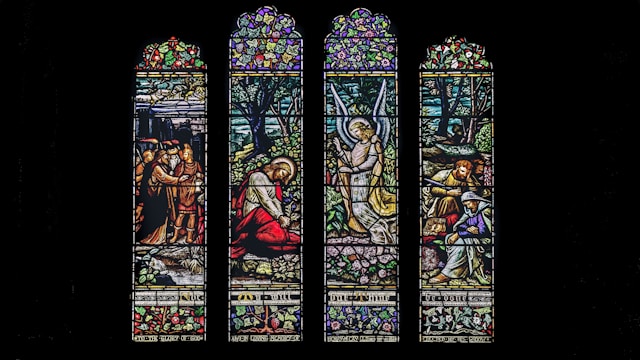
Jesus’ defining moment just before His Passion is His agony in the garden of Gethsemane. This year, we are fortunate to hear from the Gospel of Mark because Mark is not shy to express the inner life of Jesus in this crucial time. For some, this is embarrassing because Jesus was expressing His great sorrow, and thus, Jesus is seen to be too human and weak. However, we believe that God inspired Mark to write God’s words, and thus, we are to learn something precious in Jesus’ desperate moment.

Jesus was aware of what would happen to Him. He would soon face the betrayal of his disciple, a clandestine arrest, unjust trials from His haters, dreadful torture, and humiliating and most painful death. Thus, Jesus who is not only fully divine but also fully human, was experiencing the full weight of human emotions. Mark gave us some important details. Jesus was ‘troubled and distressed’ and then expressed what He felt, “My soul is sorrowful even to the death.”

St. Irenaeus once said, ‘God’s glory is a man truly alive. Here, Jesus teaches us how to be truly human and, thus, become God’s glory. He avoided two dangerous extremes in dealing with His emotions. The first extreme is neglecting or suppressing His emotions. Jesus did not act tough and pretend to be ‘the stoic man’. He did not say, ‘I am okay’, ‘everything will be alright.’ Jesus named the emotions and was frank about it. The second extreme is not to be consumed by emotions. When the emotion is extremely strong, the emotions easily engulf us and, thus, control us. Though recognizing His feelings, Jesus did not yield to them. He stood His ground.

Jesus further gave us two ways to face these overwhelming emotions. The first one is to seek good companions. Jesus invited the three closest disciples in the garden, Peter, James and John. He expressed His grave sorrow and asked them to accompany Him in this crucial moment. Unfortunately, they fell asleep, but the three were there for Jesus in His agony. The second way is to pray. Jesus bent His knees and talked to His Father. Here, we have extremely rare content of Jesus’ prayer.

Jesus said, “Abba, Father, all things are possible to you. Take this cup away from me, but not what I will but what you will (Mk 14:36).” This prayer is short but extraordinarily rich. One can say that this prayer is a short form of Our Father. Here, Jesus expressed and offered His wish that He would have been spared from suffering and violent death, but He also recognized that it is His Father’s will that Jesus would offer Himself up as the sacrifice of love for the world. In this prayer, Jesus reaffirmed His mission and did not allow the emotions to blur His vision.

Gethsemane is the precious moment that Jesus teaches us to fulfil God’s will despite difficulties and, at the same time, to become truly human. It is not God’s will to destroy our humanity but rather to perfect it, and Jesus is our model of a perfect man.

Rome

Valentinus Bayuhadi Ruseno, OP

Rejoice, Pray, and Give Thanks

Gaudete Sunday. 3rd Sunday of Advent [B]

December 17, 2023

John 1:6-8, 19-28

In this Gaudete Sunday, St Paul teaches, “Rejoice always. Pray without ceasing. In all circumstances, give thanks, for this is the will of God for you in Christ Jesus. [1 The 5:16].” St. Paul gives us three fundamental characteristics of Christians: to rejoice always, pray ceaselessly, and give thanks in all things. St. Paul reminds us that these characters are not an option but God’s will for us. Yet, how can we be joyful amid suffering? How can we pray when we are occupied with our duties and work? How can we give thanks in times of trial?

The key is that we cannot rely on our power but on God’s grace that empowers us to do these three impossible tasks. Through God’s grace, we are empowered to rejoice always, even amid difficult times. Rejoice [Greek ‘χαίρω’ – chairo] is neither simply a fleeting emotion nor happiness that comes from externally induced substance. To rejoice is an action we choose to do. This action flows from the realization that God is in control of every event of our lives. Even in the most painful moments, God allows those to occur because He has a good purpose for us. Indeed, God does not tell us in advance His plans, making it complicated. Yet, the Holy Spirit comes and bestows us faith and hope in Him and His providence.

God’s grace also enables us to thank the Lord every moment. To be grateful and to rejoice are, in fact, closely connected, just like two sides of the same coin. We can give thanks in all circumstances because the Holy Spirit helps us to see that everything we do and experience has a purpose. And, when everything we do, we do for the love of God. This act became a blessing and a cause of joy. The word for give thanks in Greek is ‘εὐχαριστέω’ [eucharisteo], and it has the same root as the word Eucharist. Thus, every time we celebrate the Eucharist, we offer our sacrifice of Jesus Christ and our lives as thanksgiving to God.

Lastly, how do we pray without ceasing? To spend a little time for prayer every day is already difficult. Does it mean we have to resign from our jobs, abandon our responsibilities in the family, and enter seclusion to pray? Indeed, there are better things to do than this. To pray unceasingly can be done at least in two ways. Firstly, we pray as a community of believers, the Church, one body of Christ. Thus, when we cannot pray this time, other brothers and sisters in other places will pray for us and on our behalf. Since millions of Catholics pray worldwide, our prayers are unbroken and unstoppable.

Secondly, we rely on the Holy Spirit to pray for us. St. Paul himself told us, “Likewise the Spirit helps us in our weakness; for we do not know how to pray as we ought, but the Spirit himself intercedes for us with sighs too deep for words (Rom 8:26-27).” We ask the Holy Spirit to be present and sanctify every activity of our day, and before we rest, we offer our day to the Lord.

Rejoice always, pray ceaselessly, and give thanks in all things!

Rome

Valentinus Bayuhadi Ruseno, OP

The Third Coming

First Sunday of Advent [B]

December 3, 2023

Mark 13:33-37

We are entering the Advent season, and the new liturgical year of the Church has begun. Advent itself is from the Latin word ‘Adventus,’ and it literally means ‘the coming.’ In light of the Scriptures and Tradition, the Church teaches two arrivals of Christ. His first coming was in Bethlehem around two millennia ago, and the second coming of Jesus will be at the final judgment as the king of kings and the judge of all. This liturgical season reminds and prepares us for both comings of Jesus. However, there is another coming of Christ, also called the third coming of Christ. What does it mean? And, how does the third coming of Christ connect the other two comings?

Before we answer this question, we shall reflect more deeply on the relationship between the first and second coming of Christ because how Jesus came for the first time should give us precious lessons in preparing ourselves for His second coming. How did Jesus come for the first time? He was born of Mary, a humble virgin married to Joseph, a poor carpenter, and neither to the powerful family of Herod nor to the ruling dynasty of Caesar. He was born in the most unworthy place, a dirty cave in Bethlehem, and not in a royal palace or a first-class hospital. He was born as the weakest human being, a baby, and not coming down from the skies like a superhero. The first coming teaches us a precious lesson that Jesus is present in the humblest places, among the simple people, and at the most unexpected moments. As Jesus arrived in Bethlehem most unexpectedly, so also, He will come for the final moment in His second coming.

As many people failed to recognize the first arrival of the Messiah, we might also fail to be ready for this last judgment. Then, how shall we do to anticipate His coming down from the heavens? This truth leads us to “the third coming of Christ.” What is it? The third coming refers to Jesus’ coming and presence among us in our daily lives, albeit in the most unexpected ways. In the Advent season, we prepare ourselves for the second coming of Christ by reflecting on His first coming and, thus, recognizing and welcoming ‘His third coming’ in our lives. The more we can discover Christ in His third coming, the more we are prepared for His final appearance.

Then, what are the manifestations of the third coming of Christ? The first and foremost is the holy Eucharist. Here, Jesus is truly and really present, yet we need great faith to perceive Him, who appears in the forms of bread and wine. He is also present in the words of the Holy Scriptures. The Church firmly believes that the Bible is the Word of God in the written form. By reading and meditating, we encounter Jesus, who speaks to us. St. Paul also teaches us that the Church is the body of Christ. Thus, encountering Christ cannot be done without encountering His body, the Church. However, it is also true that often, it is the most difficult to see Christ in the Church because some members of the Church are far from Christ-like. Yet, this has become an excellent opportunity to perform acts of charity and be Christ-like. Lastly, we encounter Christ in our unfortunate brothers and sisters, as Jesus said, “Amen, I say to you, whatever you did for one of these least brothers of mine, you did for me (Mat 25:40).”

Rome

Valentinus Bayuhadi Ruseno, OP

Berikanlah kepada Allah apa yang menjadi milik Allah

Minggu ke-29 dalam Masa Biasa [A]

22 Oktober 2023

Matius 22:15-21

“Karena itu, berikanlah kepada Kaisar apa yang menjadi milik Kaisar dan kepada Allah apa yang menjadi milik Allah (Mat. 22:21).” Banyak orang memahami perkataan Yesus ini sebagai persetujuan-Nya untuk membayar pajak dan, dengan demikian, untuk mendukung dan menghormati para pemimpin pemerintahan yang telah terpilih secara adil. Meskipun banyak dari kita yang tidak nyaman mengetahui bahwa uang hasil jerih payah kita diambil, kita dapat menghibur diri kita dengan mengetahui bahwa uang kita digunakan untuk mendanai berbagai proyek pemerintah untuk kesejahteraan rakyat. Memang, tidak ada yang salah dengan melihat pernyataan Yesus dalam sudut pandang ini, namun kita tidak boleh mengabaikan bagian kedua dari perkataan Yesus.

Yesus juga berkata bahwa kita harus memberikan kepada Allah apa yang menjadi milik Allah. Apakah ini berarti kita harus membayar ‘pajak’ kepada Tuhan seperti halnya kita membayar pajak kepada negara? Jawabannya adalah ya! Kita harus ingat bahwa kita bukan hanya warga dari kerajaan atau bangsa-bangsa di dunia ini, tetapi juga warga negara Kerajaan Allah. Untuk menjadi warga negara yang baik, kita harus berkontribusi pada pembangunan negara. Biasanya, kita melakukan ini dengan membayar pajak, tetapi kita juga diharapkan untuk menaati hukum negara dan terlibat dalam berbagai praktik bernegara yang baik. Demikian pula halnya dengan warga negara yang baik dari Kerajaan Allah. Kita juga berkontribusi kepada Kerajaan Allah dengan menaati hukum-hukum Kerajaan dan mempersembahkan apa yang menjadi milik Allah. Lalu pertanyaannya adalah, “Apa yang menjadi milik Allah yang harus kita berikan kepada Allah?” Apakah “mata uang” Kerajaan Allah? Untuk menjawabnya, kita harus kembali ke Injil hari ini.

Ketika Yesus berhadapan dengan orang-orang Farisi yang berusaha menjebak-Nya, Dia mengambil sebuah koin Romawi. Dia menunjukkannya kepada orang-orang di sekeliling-Nya dan bertanya, “Gambar dan tulisan siapakah yang ada di sana?” Mereka menjawab, “Kaisar.” Kemudian, Dia berkata, “Berikanlah kepada Kaisar apa yang menjadi milik Kaisar…” Dasar dari kepemilikan adalah adanya “gambar” (dalam bahasa Yunani, εἰκών – eikon). Koin tersebut adalah milik Kaisar karena memiliki gambarnya. Dengan demikian, membayar pajak sama saja dengan mengembalikan koin yang sejak awal adalah milik Kaisar dan Kekaisaran Romawi. Namun, Yesus tidak berhenti sampai di situ. Dia juga mengajarkan, “berikanlah kepada Allah apa yang menjadi milik Allah.” Dan apa yang menjadi milik Allah? Jawabannya adalah mereka yang memiliki gambar Allah. Kembali ke Kejadian 1:26, kita menemukan bahwa manusia diciptakan menurut gambar dan rupa Allah, dan oleh karena itu, kita adalah milik Allah. Satu-satunya “mata uang” Kerajaan Allah adalah jiwa kita, hidup kita.

Namun, kita juga harus ingat bahwa kewajiban kita kepada Tuhan melebihi kewajiban kita kepada manusia. Jika kita tidak membayar pajak dan tidak mematuhi hukum negara, kita mungkin akan mendapat masalah dengan pemerintah. Namun, jika kita tidak memberikan apa yang menjadi milik Allah, kita dapat kehilangan jiwa kita selamanya. Yang pertama berkaitan dengan kelangsungan hidup kita di dunia ini, sedangkan yang kedua berkaitan dengan keselamatan kekal.

Apakah kita menjalani hidup kita sebagai persembahan yang berkenan kepada Allah dengan menghindari gaya hidup yang berdosa? Apakah kita mempersembahkan pekerjaan kita sehari-hari, usaha kita sehari-hari untuk kemuliaan Allah? Apakah kita menyatukan secara rohani tubuh kita dengan Tubuh Kristus di dalam Ekaristi untuk menjadi persembahan yang paling layak? 

Roma

Valentinus Bayuhadi Ruseno, OP

Life is Christ

25th Sunday in Ordinary Time [A]
September 24, 2023
Matthew 20:1-16a
Phil 1:20c-24, 27a

Today, St. Paul wrote a disturbing line, “I long to depart this life and be with Christ, for that is far better [Phil 1:23].” Did the great saint want to end his life?

We must understand the context of St. Paul’s letter to the Philippians to answer this question. The letter to the Christians in Philippi is one of Paul’s prison letters. If we recall the life of this great apostle, we know that Paul was persecuted and arrested by his fellow Jews who opposed his preaching of the Gospel. During his trials, Paul used his privilege as a Roman citizen to appeal his case to Caesar. Thus, he was transported to Rome, the capital of the empire. While he was waiting for Caesar to hear his appeal, he was under house arrest, and he was literally in chains. Yet, he was allowed to continue preaching the Gospel and sending letters to different communities. One of the letters is to the Philippians [see Phil 1:14]. Paul could be proclaimed innocent, but there was also a big possibility that Caesar placed him on death row.

From this context, we recognize that Paul was completing nothing about suicide but rather his martyrdom. While suicide is willfully taking one’s own life, martyrdom is death brought by hatred of faith. However, what is interesting is how St. Paul reacted to his martyrdom. He was not afraid, not overly anxious, and undoubtedly not depressed. On the contrary, he was full of joy. If we read the letter to the Philippians, we quickly feel that the general atmosphere of the letter is joy. Paul even wrote, “Rejoice always in the Lord, I say, Rejoice! [Phil 4:4]. Now, this is highly puzzling. How could St. Paul rejoice when he was persecuted and facing imminent death?

Firstly, we need to recognize that here, Paul did not have a mental problem that made him unable to feel pain or regulate his emotions. If we read his other letters, Paul articulated his emotions well. He was angry when he needed to correct and to grieve when his children did not live according to the Gospel. So, why joy amid suffering and in the face of death?

The answer is that Paul has seen the actual worth of Jesus Christ. Paul wrote, “I regard everything as loss because of the surpassing value of knowing Christ Jesus my Lord. I have suffered the loss of all things for his sake, and I regard them as rubbish [Phil 3:8].” Paul has the correct hierarchy of priorities in his life. Everything, including life itself, should be in Christ and for Christ. Thus, Paul, who has given everything for Christ and lived in Christ, rejoices in the face of death because he knew he could finally be united with Christ.

Paul gives us a life hack to salvation: know the value of Christ, which is eternal. We need to set our priorities right. Yes, material wealth is substantial, food and shelter are essential, and education is necessary, but these are means to live in Christ and for Christ. We may lose money or material belongings, which is okay, but if we lose Christ, we may also lose our salvation and eternal joy despite our earthly success. Thus, rejoice because, for us, life is Christ and death is gain.

Valentinus Bayuhadi Ruseno, OP

Eucharist and Manna

Solemnity of the Body and Blood of Christ (Corpus Christi)
June 11, 2023
John 6:51-58

Today, the Church is celebrating the solemnity of the Body and Blood of Christ, or sometimes also called the Feast of Corpus Christi (Latin for ‘the Body of Christ’). Through this Sunday, the Church invites all the faithful to reflect as well as to celebrate another great mystery and miracle of Catholic faith, that is, the real presence of Jesus Christ in every Eucharist. As we heard from the Gospel of John, Jesus truly gave His Body and Blood as real food, and those who eat His Body and drink His Blood will have eternal life (John 6:51). But, do we really eat the Body and Blood of Jesus? Does it mean we are eating human flesh, and thus, we are committing cannibalism?

Yes, We are eating and drinking the Body and Blood of Christ, but we do not commit any act of cannibalism. Why so? The easiest way to answer this accusation is simply by going to the Church and observe the liturgy of the Eucharist itself. In the celebration of the mass, neither we see people eating raw meat nor vampires sucking fresh blood. Nothing cannibalistic at all in the Eucharist. So, where are the Body and Blood of Christ? The answer may be a bit complex. The bread and the wine that are offered and consecrated by the priest are no longer ordinary bread and wine. Yes, the appearance remains the same, but the nature is transformed into the real Body and Blood of Christ. In this perspective, we partake in Jesus not in cannibalistic manner, but rather in the eucharistic manner.

However, there is even something more fascinating if we carefully read Jesus’ words. When Jesus explains about the reality of His Body and Blood as true food, Jesus makes a typological comparison to the manna that the Israelites received in the desert. What is manna? Many of us assume that Manna is just another type of bread. Yet, if we read closely the Book of Exodus 16, the reaction of the Israelites who saw and took the manna was utter surprise because they never saw that kind of food before. In fact, the word manna comes from the Hebrew words מָן הוּא (read: man hu), and it simply means “what is this?” The Israelites were hesitant, but Moses assured them that this was the bread that came from heaven to sustain them in their journey through the desert.

From this typological comparison, Jesus wants us to liken His Body like the manna of the Old Testament. As manna is a real food from heaven, and so also Jesus’ Body is a real food from heaven. As manna is a food that sustained the Israelites’ journey in desert, so also Jesus’ Body is a food that sustains us in our journey on earth. As Manna appears like ordinary bread, but in reality something that defies the understanding of sons of Israel, and so also the Body of Christ appears like ordinary bread, but in reality, it is the greatest gift that goes beyond our comprehension.

We give thanks the Lord for giving us His Body and Blood, His whole self to us as the bread of life that nourishes and sustains us in this valley of tears. The Eucharist becomes His proof of love, that He will be with us until the end of time.

Rome
Valentinus Bayuhadi Ruseno, OP