Life is Christ

25th Sunday in Ordinary Time [A]
September 24, 2023
Matthew 20:1-16a
Phil 1:20c-24, 27a

Today, St. Paul wrote a disturbing line, “I long to depart this life and be with Christ, for that is far better [Phil 1:23].” Did the great saint want to end his life?

We must understand the context of St. Paul’s letter to the Philippians to answer this question. The letter to the Christians in Philippi is one of Paul’s prison letters. If we recall the life of this great apostle, we know that Paul was persecuted and arrested by his fellow Jews who opposed his preaching of the Gospel. During his trials, Paul used his privilege as a Roman citizen to appeal his case to Caesar. Thus, he was transported to Rome, the capital of the empire. While he was waiting for Caesar to hear his appeal, he was under house arrest, and he was literally in chains. Yet, he was allowed to continue preaching the Gospel and sending letters to different communities. One of the letters is to the Philippians [see Phil 1:14]. Paul could be proclaimed innocent, but there was also a big possibility that Caesar placed him on death row.

From this context, we recognize that Paul was completing nothing about suicide but rather his martyrdom. While suicide is willfully taking one’s own life, martyrdom is death brought by hatred of faith. However, what is interesting is how St. Paul reacted to his martyrdom. He was not afraid, not overly anxious, and undoubtedly not depressed. On the contrary, he was full of joy. If we read the letter to the Philippians, we quickly feel that the general atmosphere of the letter is joy. Paul even wrote, “Rejoice always in the Lord, I say, Rejoice! [Phil 4:4]. Now, this is highly puzzling. How could St. Paul rejoice when he was persecuted and facing imminent death?

Firstly, we need to recognize that here, Paul did not have a mental problem that made him unable to feel pain or regulate his emotions. If we read his other letters, Paul articulated his emotions well. He was angry when he needed to correct and to grieve when his children did not live according to the Gospel. So, why joy amid suffering and in the face of death?

The answer is that Paul has seen the actual worth of Jesus Christ. Paul wrote, “I regard everything as loss because of the surpassing value of knowing Christ Jesus my Lord. I have suffered the loss of all things for his sake, and I regard them as rubbish [Phil 3:8].” Paul has the correct hierarchy of priorities in his life. Everything, including life itself, should be in Christ and for Christ. Thus, Paul, who has given everything for Christ and lived in Christ, rejoices in the face of death because he knew he could finally be united with Christ.

Paul gives us a life hack to salvation: know the value of Christ, which is eternal. We need to set our priorities right. Yes, material wealth is substantial, food and shelter are essential, and education is necessary, but these are means to live in Christ and for Christ. We may lose money or material belongings, which is okay, but if we lose Christ, we may also lose our salvation and eternal joy despite our earthly success. Thus, rejoice because, for us, life is Christ and death is gain.

Valentinus Bayuhadi Ruseno, OP

Myths about Forgiveness

24th Sunday in Ordinary Time [A]

September 17, 2023

Matthew 18:21-35

There are three myths about forgiveness that we often hear. Here, we try to debunk these myths and go deeper into the meanings of genuine forgiveness. 

To forgive is to forget.

This is the most repeated line about forgiveness. We are told that the best way to forgive is to forget about the events that hurt us as well as the persons who offended us. Yet, this is not forgiveness but rather a convenient escape. In fact, the more we try to forget it, the more it hurts us. Violent efforts to suppress our painful memories lead to mental and spiritual problems. True forgiveness is to face and embrace our painful memories and confront people who have hurt us. The path to forgiveness often takes months and even years to find true peace.

To forgive is for the weak people.

Nothing is far from the truth than this statement. Our natural feelings when we are wronged are anger, hatred, and bitterness; because of these feelings, our natural tendency is to take revenge or run away. The bigger the pain, the more powerful is the tendency. This is why to do the opposite (to forgive) needs an enormous force of mind and courage of will. To forgive is only for the strong. Another point is that we need to distinguish between revenge and justice. While revenge seeks to destroy our enemies by inflicting the most extensive damage possible, justice is ‘to give/receive one’s due.’ Justice seeks reparation, repentance, and reconciliation.

To forgive is stupid.

The usual imagination when we forgive is that we allow people to keep abusing us. In short, we become ‘doormat’ of others. Yet, this is not true forgiveness but cowardice. Real forgiveness starts with justice and courage. Forgiveness also includes repentance of those who harm us. Repentance may come in different forms. The best example will be the case of John Paul II and Ali Acka. The Holy Pope forgave Ali, but Ali still needed to serve his sentence in prison. People who hurt us sometimes refuse to change their behaviors, so we must raise the victim’s mentality and not allow ourselves to be abused repeatedly. 

To err is human, but to forgive is divine.

The last part is not a myth but the truth. Humanly speaking, forgiving is extremely difficult because our natural tendency is to take revenge or run away. Thus, we need the help of grace to rise above our human weakness. We remember that “God has forgiven us and that is why we forgive.” Therefore, living in grace is necessary for forgiveness. We ask for graces through our regular participation in the Eucharist and the sacrament of reconciliation. We ask the Lord also for strength in our prayers, as well as we pray for those who hurt us for their repentance. To seek support and advice from our trusted friends and capable professionals is also crucial because God may make them His instruments in helping us. 

Valentinus Bayuhadi Ruseno, OP

Koreksi Persaudaraan: Karya Amal yang terbesar

Minggu ke-23 dalam Masa Biasa [A]

10 September 2023

Matius 18:15-20

Mengoreksi saudara-saudari kita yang tidak hidup sesuai dengan Hukum Allah adalah sebuah tindakan kerahiman dan kasih. Dalam tradisi Katolik, koreksi persaudaraan [latin: Correctio fraterna] merupakan hal yang esensial dalam tujuh karya belas kasih rohani. Mengapa mengoreksi sesama dianggap sebagai tindakan belas kasih? Mengapa hal ini justru sulit untuk dilakukan? Di sini, saya membagikan refleksi saya tentang mengapa correctio fraterna itu penting, tetapi pada saat yang sama juga sangat sulit, serta beberapa kiat untuk melakukan tindakan belas kasih ini.

Mengoreksi saudara-saudari kita adalah sebuah karya belas kasih dan cinta karena kita ingin agar jiwa-jiwa mereka diselamatkan dari api neraka dan menikmati hidup kekal bersama Allah. Dengan demikian, bersama dengan evangelisasi, yaitu membawa orang-orang untuk mengenal dan mendekat kepada Kristus, correctio fraterna dianggap sebagai karya amal yang paling baik. Karena kita mengasihi mereka, kita bersedih ketika saudara dan saudari kita tersesat dari jalan Tuhan. Dengan demikian, kita menunjukkan kasih kita dan mengingatkan mereka untuk kembali kepada Tuhan.

Namun, meskipun mengoreksi saudara-saudari kita adalah sesuatu yang mulia dan penuh belas kasihan, itu adalah salah satu hal yang paling menantang untuk dilakukan. Ada beberapa alasan. Pertama, ketidaktahuan. Kita tidak mengetahui ajaran dasar tentang moralitas. Karena kita tidak tahu, kita dapat mengoreksi orang lain. Ini adalah masalah besar karena banyak dari kita yang belum memiliki pengetahuan yang lengkap tentang Hukum-hukum Allah. Namun, ini juga merupakan masalah yang paling mudah dipecahkan karena pengajaran dan katekese yang tepat akan sangat membantu kita.

 Kedua, rasa takut. Kasih kita tidak cukup kuat, dan rasa takut mendominasi kita. Kita takut menghadapi saudara-saudara kita karena kita tidak mau mengusik ‘ketenangan’ mereka. Kadang-kadang, kita takut bahwa kita akan merusak hubungan persahabatan kita. Kita tidak suka memiliki ‘musuh’. Oleh karena itu, kita membiarkan kesalahan mereka dengan tetap diam. Nah, ini berbahaya karena tidak hanya saudara kita yang akan kehilangan jiwa mereka, tetapi kita juga akan membahayakan keselamatan kita karena sekarang kita menjadi ‘rekan’ mereka. Hal ini sering disebut sebagai tindakan dosa karena kelalaian.

Ketiga, relativisme. Virus relativisme adalah wabah yang tak kentara namun sangat berbahaya bagi Gereja. Orang Kristen percaya pada satu Allah dan satu hukum moral yang berasal dari-Nya, tetapi relativisme mengatakan sebaliknya: tidak ada kebenaran absolut atau standar moral yang universal. Seorang relativis akan berkata, “Tindakan itu mungkin salah menurut standar saya, tetapi mungkin benar menurut standarnya.’ Dengan demikian, kita menolak untuk mengoreksi perilaku berdosa orang lain karena kita ‘menghormati’ sudut pandang mereka. Hal ini bahkan lebih berbahaya karena hal ini merusak pemahaman kita yang benar tentang agama kita dan membingungkan banyak orang lain.

Berikut adalah beberapa tips untuk correctio fraterna. Pertama, kita harus memiliki pengetahuan dasar yang kuat tentang moralitas Katolik. Jika kita ragu, kita dapat membaca katekismus Gereja Katolik atau berkonsultasi dengan para imam yang baik dan cakap di sekitar kita. Kita harus ingat bahwa correctio fraterna terutama berhubungan dengan perilaku-perilaku berdosa dan doktrin-doktrin yang salah. Kedua, kita dapat memulai dengan diri kita sendiri. Jika kita melihat orang yang kita kasihi perlu kita koreksi, kita perlu bertanya apakah saya juga perlu menerima koreksi yang sama. Ketiga, kita melakukannya dengan lemah lembut dan sabar. Seperti yang Yesus katakan, kita melakukannya secara pribadi terlebih dahulu agar tidak terlihat oleh orang lain, dan kita tidak tergoda untuk menjadi sombong. Keempat, jika koreksi kita menghadapi resistansi yang kuat, kita perlu membaca Yehezkiel 33:7-9 (bacaan pertama). Meskipun melihat orang yang kita kasihi jauh dari Allah membuat kita frustrasi, kita juga harus percaya pada pemeliharaan Allah. Rencana-Nya baik dan akan berbuah pada waktunya.

Valentinus Bayuhadi Ruseno, OP

Fraternal Correction: The greatest work of Charity

23rd Sunday in Ordinary Time [A]

September 10, 2023

Matthew

To correct our brothers and sisters who are not living according to the Laws of God is an act of mercy and love. In Catholic tradition, fraternal correction is essential to the seven-spiritual works of mercy. Why correcting others is considered to be an act of mercy and love? Why is it difficult to do? Here, I share my reflection on why a fraternal correction is necessary, but at the same time most challenging, as well as some tips to do this act of charity.

To correct our brothers and sisters is a work of mercy and love because we want their souls to be saved from the fire of hell and to enjoy eternal life with God. Thus, together with evangelization, which is to bring people to know and come closer to Christ, fraternal correction is considered the most excellent work of charity. Because we love them, we grieve when our brothers and sisters go astray from the Lord’s way. Thus, we show our love and remind them to return to the Lord. 

However, though correcting our brothers and sisters is noble and merciful, it is one of the most challenging things to perform. There are several reasons for this. Firstly, ignorance. We are simply ignorant of Christian basic morality. Since we do not know, we can correct others. This is a big problem because many of us do not have the full knowledge yet about the Laws of God. Yet, it is also the easiest to solve because proper instructions and catechesis will significantly help us.

 Secondly, fear. Our love is not strong enough, and fear possesses us. We are afraid to confront our brothers because we hate hurting their ‘feelings.’ Sometimes, we are afraid that we might break our amicable relationship. We do not like to have ‘enemies.’ Thus, we condone their wrongdoings by keeping quiet. Now, this is dangerous because not only will our brothers lose their souls,  but we are also losing our souls because now we become the accomplices. We commit the sin by omission.

Thirdly, relativism. The virus of relativism is a subtle yet very dangerous plague to Christianity. Christians believe in one God and one moral Law coming from Him, but relativism says the opposite: there is neither absolute truth nor universal moral standard. A relativist person will say, ‘That act may be wrong according to my standard, but it may be true according to his.’ Thus, we refuse to correct others’ sinful behaviors because we ‘respect’ their perspective. This is even more dangerous because it destroys our proper understanding of Christianity and confuses many others.

Here are some tips for fraternal correction. Firstly, we must have a solid knowledge of Catholic morality. If we are doubtful, we consult the catechism of the Catholic Church or good and capable priests near you. We must remember that fraternal correction deals primarily with sinful behaviors and false doctrines. Of course, we may correct them in other aspects of their lives. Secondly, we can start with our loved ones, those closest to us. We do it with gentleness and patience. As Jesus said, we do it first privately so as not to be seen by others, and we might become prideful. Thirdly, if our correction faces strong resistance, we read ‘Ezekiel 33’ (our first reading). Though seeing our loved ones far from God is frustrating, we must also trust God’s providence.

Valentinus Bayuhadi Ruseno, OP 

Kurban yang Sempurna

Minggu ke-22 dalam Masa Biasa

3 September 2023

Roma 12:1-2

Matius 16:21-27

Setiap penyembahan yang benar dalam Alkitab datang dalam bentuk persembahan korban. Apakah yang dimaksud dengan korban? Pengorbanan terjadi ketika kita mempersembahkan sesuatu yang berharga kepada Allah, dan dalam masyarakat kuno, ternak dianggap sebagai harta yang berharga yang bisa dikurbankan. Habel mempersembahkan anak-anak sulung dari kawanan ternaknya [lihat Kej. 4:4]. Di kaki Gunung Sinai, Musa menyembelih lembu-lembu sebagai persembahan kepada Tuhan saat perjanjian antara Tuhan dan bangsa Israel ditetapkan [Lihat Kel. 24:4-5]. Namun, terkadang, pengorbanan yang tidak berdarah juga dipersembahkan. Melkisedek membawa roti dan anggur sebagai persembahan [lihat Kej. 14:18]. Bahkan, seluruh kitab Imamat mengatur ibadah kurban bangsa Israel.

Jika Ekaristi adalah ibadah kita, lalu apa yang kita persembahkan sebagai kurban di dalam Ekaristi? Tentu saja, bukan binatang atau benda-benda duniawi. Kurban kita dalam Ekaristi adalah Yesus [lihat 1 Kor 5:7]. Karena Yesus adalah ilahi dan tidak berdosa, Dia menjadi korban yang sempurna, dan akibatnya, Ekaristi adalah penyembahan yang sempurna. 

Namun, jika kita melihat bagian dari Ekaristi dengan seksama, kita akan menemukan kalimat yang diucapkan oleh imam, “berdoalah saudara-saudara, agar kurban yang kupersembahkan dan yang persembahkanmu berkenan kepada Allah, Bapa yang mahakuasa.”  Hal ini menarik karena kalimat ini memberi tahu kita bahwa umat beriman yang menghadiri Ekaristi memiliki persembahan yang berbeda dengan persembahan imam. Jika kurban yang dipersembahkan oleh imam adalah Tubuh dan Darah Kristus, lalu apakah kurban umat?

Paulus membantu kita menjawab pertanyaan ini. Dalam suratnya kepada jemaat di Roma, ia menulis, “Karena itu, saudara-saudara, demi kemurahan Allah aku menasihatkan kamu, supaya kamu mempersembahkan tubuhmu sebagai persembahan yang hidup, yang kudus dan yang berkenan kepada Allah: itu adalah ibadahmu yang sejati [Rm 12:1; bacaan kedua].” Persembahan kita adalah tubuh kita, hidup kita. Dan, kita mempersembahkan hidup kita dalam Ekaristi dan yang kita satukan dengan kurban Yesus Kristus, ini menjadi ibadah rohani kita.

Namun, Paulus juga menasihati agar kita tidak mempersembahkan sembarangan tubuh, tetapi tubuh yang kudus dan berkenan kepada Tuhan. Dengan demikian, adalah tugas kita untuk menjaga hidup kita dari dosa dan segala sesuatu yang tidak berkenan kepada Tuhan. Kita tidak dapat mengatakan bahwa cukup percaya kepada Kristus, tetapi kita tidak menaati hukum-hukum-Nya. Kita tidak dapat mengatakan bahwa pergi ke Gereja setiap hari Minggu saja sudah cukup, tetapi kita melakukan kejahatan di hari-hari lainnya. Setiap hari adalah kesempatan untuk membuat hidup kita berkenan kepada Tuhan.

Terakhir, kita juga perlu mengingat bahwa penderitaan juga merupakan bagian dari hidup kita. Dengan demikian, jika kita menanggung penderitaan yang tak terhindarkan dengan kesabaran, hal ini juga dapat menjadi bagian dari persembahan hidup kita yang berkenan kepada Tuhan. Di dalam Ekaristi, hidup dan penderitaan kita dipersembahkan sebagai persembahan yang berkenan kepada Allah, dan karena itu berkenan kepada Allah, hidup kita berubah menjadi berkat. Sekarang, kita tahu mengapa Allah mengizinkan penderitaan dalam hidup kita. Inilah sebabnya mengapa Yesus menegur Petrus dengan keras karena menghalangi Dia untuk memikul salib dan mati. Di dalam Kristus, pada akhirnya penderitaan bahkan dapat menjadi berkat.

Valentinus Bayuhadi Ruseno, OP

Our Perfect Sacrifice

22nd Sunday in Ordinary Time

September 3, 2023

Roman 12:1-2

Matthew 16:21-27

Any true worship in the Bible comes in the form of offering sacrifice. What is a sacrifice? Sacrifice takes place when we offer something precious to God, and in ancient societies, cattle are considered to be precious possessions. Abel offered the firstlings of his flock, their fat portions [see Gen 4:4]. After the flood, Noah built an altar, and sacrificed animals that were pleasing to the Lord [see Gen 8:20]. At the feet of Sinai, Moses slaughtered oxen as sacrifices to the Lord as the covenant between God and Israelites was established [See Exo 24:4-5]. Yet, at times, non-bloody sacrifices are also offered. Melchizedek brought bread and wine as offerings [see Gen 14:18]. The entire book of Leviticus regulates the sacrificial worship of the Israelites. 

If the Eucharist is our worship, then what do we offer as a sacrifice in the Eucharist? Surely, it is neither animals nor any earthly things. Our sacrifice in the Eucharist is Jesus [see 1 Cor 5:7]. Since Jesus is divine and sinless, He becomes the perfect sacrifice, and consequently, the Eucharist is the perfect worship. 

However, if we see part of the Eucharist carefully, we encounter a sentence that the priest utters, “pray brethren, that my sacrifice and yours, may be acceptable to God, the almighty Father.”  This is intriguing because this sentence tells us that the faithful attending the Eucharist have a different sacrifice from the priest’s offering. If the sacrifice offered by the priest is the Body and Blood of Christ, then what is the sacrifice of the people?

St. Paul helps us answer this question. In his letter to the Romans, he wrote, “I appeal to you therefore, brothers and sisters, by the mercies of God, to present your bodies as a living sacrifice, holy and acceptable to God, which is your spiritual worship [Rom 12:1; second reading].” Our sacrifices are our bodies and our lives. And, we offer our lives in the Eucharist and we unite them to the sacrifice of Jesus Christ, this becomes our spiritual worship. 

Yet, Paul is also appealing that we offer not any kind of body, but holy and pleasing to the Lord. Thus, it is our duty to keep our lives from sins and things that are unpleasant to God. We cannot say that it is enough to believe in Christ, but we are not obeying His laws. We cannot claim that it is enough to go to the Church every Sunday but do evil on the other days. Every day is an opportunity to make our lives pleasing to the Lord.

Lastly, we need to remember that suffering is also part of our lives. Thus, if we endure unavoidable sufferings with patience, this too can be part of our living sacrifice that is pleasing to God. In the Eucharist, our lives and our sufferings are offered as our living sacrifice and since it is pleasing to God, our lives transformed into blessings. Now, we know why God allows suffering in our lives. This is why Jesus rebuked vehemently Peter for preventing Him from bearing the cross and dying. In Christ, eventually, sufferings may even become blessings.

Valentinus Bayuhadi Ruseno, OP

Pope: Leader and Father

21st Sunday in Ordinary Time [A]
August 27, 2023
Matthew 16:13-20

The Catholic Church is known for her distinctive features and teachings, like belief in the Holy Trinity, the real presence of Jesus Christ in the Eucharist, the Bible as the written Word of God, and the veneration of the Blessed Virgin Mary and other saints. Yet, one feature stands out because it is not only teachings, things, or rites but a living person. This is the Pope. Most of the earth’s population arguably recognizes modern-day popes, like St. John Paul II, Benedict XVI, and Francis. What are the roles of the pope? Why is the pope central to the Catholic Church?

Indeed, I cannot do justice here. I want to focus on the pope as our leader and father. Every human community needs leaders, and this includes the Catholic Church. While it is true that the real founder and head of the Catholic Church is Jesus Christ, He entrusted the role of leading and shepherding to man and his successors. This is why Jesus gave Peter the keys to the Kingdom of Heaven. Why keys? Our first reading provides us with the answer [Is 22:19-23]. Here, through the prophet Isaiah, the Lord appointed Eliakim, son of Hilkiah, as the master of the palace. This was the highest position in the Kingdom, just second to the king himself. We can liken him to Prime Minister, who takes charge on the king’s behalf. How do we know that he is the master of the palace? He has the key to the house of David. Thus, like Eliakim, Peter received the keys to the Kingdom. Therefore, he is the master of the palace of Jesus Christ.

Then, why do we call the leader of the Catholic Church as Pope? The word pope comes from the Latin’ Papa,’ meaning ‘father.’ Then, why do we call him ‘father’ or ‘Papa’? Again, the answer goes back to the Old Testament, to Eliakim. As the master of the palace, Eliakim shall be the father to the inhabitants of Jerusalem. Therefore, like Eliakim, Peter shall be the father to the inhabitants of the Kingdom. While the leadership role is often clearly defined, the role of a father is often misunderstood. A father is a head figure in the family. Thus, Catholic Church is not only an organization but fundamentally a family.

A father protects and provides for his family. Thus, the pope is responsible for protecting the faithful from dangers, especially spiritual threats like false doctrines. He also provides for our spiritual needs, like Eucharist, prayers, and exhortations. Father is also a man who educates and disciplines his children. Therefore, the pope is expected to raise us in true faith and correct us if we begin to go astray. Indeed, a pope cannot take care of us individually. Still, he can lead and educate us through his representatives, especially bishops and parish priests.

One more thing that we must never forget is that the pope is also a frail human. We see Peter, who kept failing, then we may encounter some popes who do not meet our expectations. Indeed, it must be a difficult situation for the Church, but all the more, we need to pray for our leader and father.

Valentinus Bayuhadi Ruseno, OP

Yesus, Seorang Wanita, dan Anjing

Minggu ke-20 dalam Masa Biasa [A]
20 Agustus 2023
Matius 15:21-28

Injil hari ini sungguh mencengangkan. Bagaimana mungkin Yesus bertindak begitu keras terhadap seorang perempuan yang sedang kesusahan? Mengapa Yesus harus menyebutnya ‘anjing’? Di manakah belas kasihan Yesus?

Konteks sejarah mungkin dapat membantu kita. Yesus dan murid-murid-Nya sedang dalam perjalanan menuju daerah Tirus dan Sidon. Kedua kota kuno ini berada di luar wilayah Israel di sebelah utara (saat ini di Lebanon). Tujuan utama dari kedatangan Yesus ke daerah ini adalah untuk beristirahat. Pelayanan yang terus menerus di Palestina menguras tenaga, dan mereka membutuhkan istirahat. Jadi, kita dapat membayangkan Yesus dan para pengikut-Nya kelelahan setelah melakukan berbagai pelayanan dan perjalanan yang panjang, tetapi tiba-tiba, seorang wanita Kanaan datang dan mengusik ketenangan mereka.

Reaksi yang umum dilakukan adalah meminta wanita itu untuk pergi, dan inilah yang disarankan oleh para murid kepada Yesus. Namun, Yesus tidak mengusir perempuan itu dan tidak mengabaikannya, melainkan memulai sebuah dialog. Kita menyadari bahwa Yesus memiliki rencana khusus untuk wanita ini. Namun, apakah tujuan-Nya bagi perempuan itu?

Pertama, Yesus mengatakan kepada perempuan itu bahwa Dia datang untuk domba-domba yang hilang dari suku Israel, yang berarti prioritas-Nya adalah bagi bangsa Israel dan bukan orang non-Yahudi. Namun, wanita itu menolak untuk menyerah dan bahkan berlutut di hadapan Yesus. Menariknya, kata Yunani yang digunakan adalah ‘προσκυνέω’ (proskuneo), dan kata ini dapat diterjemahkan sebagai ‘menyembah’. Meskipun ada penolakan, perempuan itu tetap berjuang dan bahkan menyembah Yesus. Melihat reaksi perempuan itu, Yesus pun berkata dengan kata-kata yang lebih keras, “Tidaklah patut mengambil roti anak-anak dan melemparkannya kepada anjing-anjing (Mat. 15:26).” Sekali lagi, perempuan itu menolak untuk menyerah. Di luar dugaan, ia tidak marah atau merasa terhina. Sebaliknya, ia berkata, “Benar, Tuhan, bahkan anjing-anjing pun makan remah-remah yang jatuh dari meja tuannya (Mat. 15:27).” Karena kasihnya yang besar kepada putrinya dan iman kepada Yesus, ia tidak keberatan disamakan dengan ‘anjing’ dan bahkan merasa puas dengan apa yang tersisa. Mendengar jawaban perempuan itu, Yesus menyatakan bahwa ia memiliki iman yang besar dan akan menerima permintaannya.

Namun, ada sebuah pertanyaan yang mengganjal. Apakah benar-benar sebuah penghinaan untuk menyebut wanita itu ‘anjing’? Menarik untuk diperhatikan bahwa kata Yunani yang digunakan adalah ‘κυνάριον’ (kunarion), dan itu bukan sembarang anjing, tetapi seekor anjing kecil yang biasa dipelihara di dalam rumah. Ya, ini adalah seekor anjing, tetapi ia adalah bagian dari keluarga dan sering kali disayangi. Meskipun benar bahwa orang-orang bukan Yahudi belum menjadi prioritas Yesus, namun mereka sangat dekat dengan hati-Nya. Sekarang, dengan menyadari hal ini, ‘kunarion’ dapat menjadi sebuah penghinaan atau sebuah istilah yang menunjukkan kasih sayang. Untungnya, wanita itu memutuskan untuk melihat istilah ini bukan sebagai penghinaan tetapi sebagai kesempatan untuk lebih dekat dengan Yesus.

Kita tahu sekarang bahwa Yesus menjadikan perempuan itu sebagai model iman dalam menghadapi cobaan dan kesulitan. Melalui perempuan itu, Yesus menunjukkan bahwa diamnya Allah terhadap permintaan kita sebenarnya adalah rencana Allah bagi kita. Tanpa ujian iman, kita tidak akan bertumbuh dalam relasi kita dengan Allah. Ujian iman adalah bagian dari pendidikan Allah. Inilah cara Dia melatih orang-orang yang dikasihi-Nya. Dia menguji Abraham, menantang Musa, dan mengizinkan Daud menanggung penganiayaan. Adalah suatu kehormatan bagi kita untuk diuji oleh Tuhan.

Valentinus Bayuhadi Ruseno, OP

A Woman Called Dog

20th Sunday in Ordinary Time [A]

August 20, 2023

Matthew 15:21-28

Today’s gospel is genuinely puzzling. How could Jesus act so harshly toward a woman in distress? Why did Jesus have to call her ’a dog’? Where was Jesus’ compassion and mercy?

A bit of historical context may help us. Jesus and His disciples were going toward the district of Tyre and Sidon. These two ancient cities were outside Israel’s territory to the north (presently in Lebanon). The primary purpose of coming to this area was to rest. The constant ministries in Palestine drained the energy, and they needed rest. So, we can imagine Jesus and His followers were exhausted after the various ministries and long journeys, but suddenly, a Canaanite woman came and disturbed their peace.

The typical reaction would be to ask the woman to leave, and this is precisely what the disciples suggested to Jesus. Yet, Jesus did not send her away nor ignore her but instead started a dialogue. We may recognize that Jesus has a particular plan for this woman. But what is His goal for her?

Firstly, Jesus told her that He came for the lost sheep of the house of Israel, meaning His priority would be the Israelites and not the Gentiles. Yet, the woman refused to give up and even kneel before Jesus. Interestingly, the Greek word used is ‘προσκυνέω’ (proskuneo), and this word can be translated as ‘to worship.’ Despite the apparent rejection, she stepped up her determination and even worshiped Jesus. Looking at her reaction, Jesus also came with stronger words, “It is not fair to take the children’s bread and throw it to the dogs (Mt 15:26)” Again, the woman refused to yield. Unexpectedly, she was neither angry nor insulted. Instead, she said, “Yes, Lord, yet even the dogs eat the crumbs that fall from their masters’ table (Mt 15:27).” Because of her great love for her daughter and her trust in Jesus, it did not bother her to be associated to ‘dogs’ and even content with the leftovers. Hearing her answers, Jesus proclaimed that she had great faith and would receive her request.

Yet, a question lingers. Is it truly an insult to call the woman ’a dog’? It is interesting to notice that the Greek word used is ‘κυνάριον’ (kunarion), and it is not just any dog, but a little household dog. Yes, it is a dog, but it is a part of the family and often well-loved. While it is true that the Gentiles were not Jesus’ priority yet, they were very close to His heart. Now, aware of this, ‘kunarion’ can be either an insult or a term of endearment. Fortunately, the woman decided to see this term not as an insult but as an opportunity to get closer to Jesus.

We recognize now that Jesus was making the woman the model of faith in the face of trials and difficulties. Through her, Jesus demonstrated that God’s apparent silence to our request is, in fact, God’s plan for us. Without the test of faith, we will not grow in our relationship with God. Test of faith is part of God’s pedagogy. It is how He trained His beloved ones. He tested Abraham, challenged Moses, and allowed David to endure persecution. It is our privileged to be tested by God.

Valentinus Bayuhadi Ruseno, OP

Elijah and the Lord God

19th Sunday in Ordinary Time [A]

August 13, 2023

Matthew 14:22-33

1 Kgs 19:9-13a

Elijah is considered one of the greatest prophets of the Old Testament. His name means the Lord is God (a combination of ‘El’ and ‘YHWH’), and this speaks volumes of his mission to defend the worship of the true God, to oppose vehemently idolatry and to constantly remind Israelites of their covenant with their God. He courageously criticized even kings and queens. He was also renowned as a mighty prophet who performed many miracles.

One of his greatest showdowns is the contest on Mount Carmel (see 1 King 18). He challenged the prophets of Baal to call out to their god and ask it to pour down rain because the land had experienced a long drought. This trial is to prove who is the real God, the Lord or Baal. Around 400 prophets of Baal accepted the challenge and performed all sorts of rituals but to no avail. Elijah even mocked them. He said something like, “Your god must be asleep or going on vacation”. Then, when his turn came, he did a simple ritual and called the Lord God. His prayer was answered, and the rain suddenly fell from the sky. Feeling victorious, Elijah slaughtered all the Baal prophets.

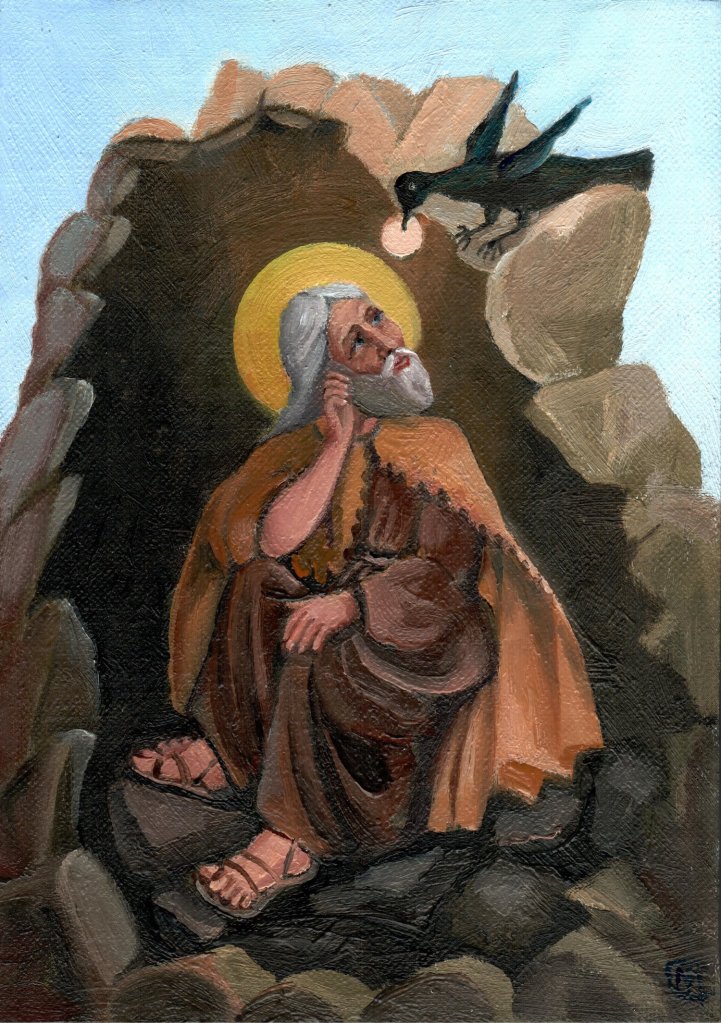
This event enraged Jezebel, wife of Ahab, king of Israel, and as the avid support of Baal, she ordered that Elijah be seized and executed. Unexpectedly, Elijah, the mighty prophet of God and miracle worker, became afraid and ran away. Tired of running, he asked the Lord to take his life. Yet, the Lord sent His angel to feed him. He continued his journey to Mount Horeb in Sinai. There, he encountered the Lord, but not in the way he expected. The Lord was not in the great wind, earthquakes, or powerful fire but the calm whisper sound. Indeed, God was in the least expected place. However, after Elijah realized God’s presence and spoke with Him, Elijah was back on his feet and walked back to Israel to continue his missions.

The life of Elijah teaches us several precious lessons. Often like Elijah, we became afraid, intimidated and unsure of our lives and missions in the face of danger and suffering. We tend to forget the great things the Lord has done through our hands. We have this ‘spiritual amnesia’. We ignore the truth that the Lord who has been with us in the past is also the same Lord who will be with us in the future. Even trials and pains are part of His providence.

The second lesson is also precious. God can often be found in the places and times we do not expect. Surely, God is present in the Eucharist and our prayers. Yet, the Lord is hidden in the ordinary people we meet daily. Jesus is there in simple acts of kindness and love we receive. God is there when we can be faithful to our day-to-day commitment to our spouse and children. Despite our struggles, the Lord is there when we keep doing good things for others.

Valentinus Bayuhadi Ruseno, OP