

5th Sunday of Easter [C]
May 18, 2025
Acts 14:21-27
In the first reading, we heard about the missionary journey of St. Paul and his companion St. Barnabas. Their mission shows us how the early Church fulfilled Jesus’ commandment: “Make all nations my disciples.” So what can we discover from their example?
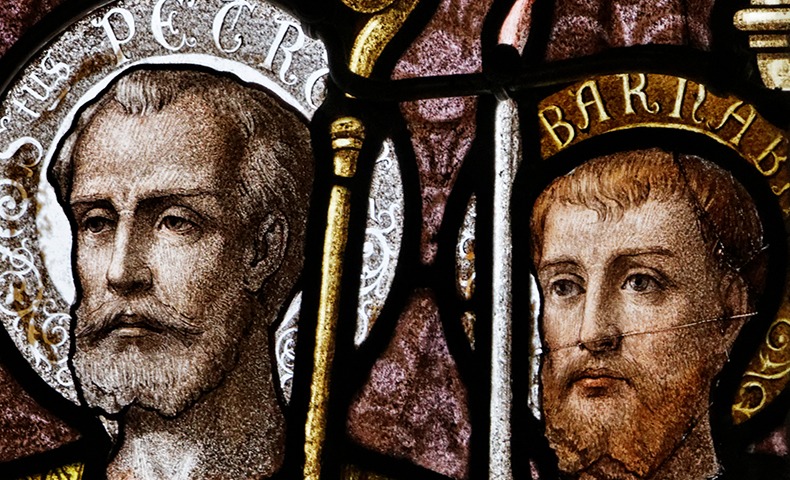
First, let us consider St. Paul’s story in its entirety. After his conversion, Paul remained in Antioch (in present-day Turkey), where he became a respected teacher and prophet. Then the Holy Spirit called Paul and Barnabas to be set apart for God’s work. The Christian community commissioned them to preach in places where the Gospel had not yet been heard. They travelled to various locations including the island of Cyprus and towns in southern Turkey – Pisidian Antioch, Iconium, Derbe, and Lystra.
They proclaimed the Good News to both Jews and Gentiles in these places, bringing many souls to believe in Jesus Christ. Yet Paul and Barnabas knew they were not to remain there permanently, but rather to move on to preach in even more places. To care for the newly established Churches, they appointed “elders” (presbyteroi). These elders became the stable leaders of the communities, responsible for leading worship, proclaiming the Gospel, and maintaining spiritual discipline.
What then can we learn from Paul’s missionary journey? We see at least two essential ways of preaching the Gospel. The first way involves going to preach where the Gospel has not been heard and where faith has not yet taken root. Those who follow this path are typically called missionaries. Missionaries tend to be more mobile, moving from place to place as the need for the Gospel message arises. The second way focuses on deepening the understanding of the Gospel for those who already believe, nourishing and protecting their faith. In the Catholic tradition, this second way is carried out by the “elders” – the bishops assisted by priests and deacons, who remain more stable within the communities they serve.
On the other hand, the distinction between missionaries and elders is not rigid. The same person can be both a missionary and an elder. A simple example is Pope Leo XIV. Before becoming Pope, he was a priest of the Order of St. Augustine of the United States who became a missionary in Peru. Later he became the bishop of Chiclayo, Peru. The identity of missionary and elder merged in him.
However, we must remember that the task of preaching the Gospel is not given only to missionaries or elders, but to all of us. We too can and should practice both of these ancient ways of proclaiming the Gospel. In our modern world, the opportunities to share the Gospel are abundant. We can communicate different aspects of our faith, from its truth to its beauty, through various social media platforms. Personal interactions with friends and colleagues also provide opportunities to introduce our faith. Even if we find it difficult to explain our faith in words, we can always invite our relatives and friends to join us at Mass.
Parents particularly embody both of these approaches simultaneously. They are called to introduce the faith to their children through baptism and basic catechism, teaching them how to pray and sharing the fundamental truths of our faith. Like the Church’s elders, they must then continually nurture their children’s faith through virtuous living, prayer, and guidance. We should also support our catechists who work tirelessly both to introduce and deepen faith despite the many challenges they face.
Rome
Valentinus Bayuhadi Ruseno, OP
Guide questions:
How do we preach the Gospel in our particular circumstances? Who specifically needs us to introduce them to Jesus? Have we helped those close to us grow nearer to God? Do others recognize us as people who bring Jesus with us?
 In Medio Ecclesiae