

Good Friday
April 10, 2020
John 18 – 19
 If there is one thing that unites people from different nations, languages, and religions, that is the experience of suffering. With the ultra-fast spreading coronavirus, covid-19, people with different backgrounds, young and old, rich or poor, and noblemen or commoners, and laypeople or clergy fall in their knees and tremble. Indeed, this microscopic virus has shattered countless lives. People are dying, hospitals are overwhelmed, cities are isolated, families are separated, workers are jobless, governments are at loss, and churches are empty. Pope Francis notes that “we are just one the same boat”, and this boat is sinking. Suffering forces us to admit our human frailty and all that we are proud of, are a mere breath.
I heard more and more questions from some of my friends, “When is it going to end? We miss to do our ordinary routine, when can we go back to the Church? Are we going to survive? Are we going to die? Where is God in this most troubling time?” As a priest working in a parish, it is our duty to strengthen the people of God in this moment of trials, yet I cannot simply offer a consoling yet untrue words. I cannot simply say, “it is going to end soon” though, at the back of their minds, they know that it is not. It is a plain lie when I tell people, “It is fine, don’t worry.” While I am myself struggling with pain and disappointment. This is my first year as a priest, yet, I find myself exiled from the people of I serve. The most painful reality is that I cannot celebrate the Holy Week, the most sacred time with the people I love and care for.
At this moment of confusion, pain, and suffering, I would like to invite all of you to see the cross, and yet before the cross, let us be with Jesus on His agony in the garden. Jesus together with His three disciples, went to the mount of Olivet, and to the part of this mount, the garden called Gethsemane. The name Gethsemane means “olive press” and some of the olive oil needed by the city of Jerusalem came from this place. Olive itself is a basic and yet precious oil. It is used for daily household needs like cooking, seasoning, and burning the lamp. Since it has a therapeutic effect, the oil serves as a medicine. It is also used for sacred purposes. Olive oil is offered as part of daily sacrifice in the Temple [Num 28:5]. And the priests like Aaron and kings like David were anointed with olive oil. With a wide range of utilities, from household to sacred use, no wonder that in ancient Jewish traditions, the olive tree was considered as the tree of life in the middle of the garden of Eden.
However, to produce the oil, the fruits have to be two-step crushing process. Firstly, the fruits shall be ground by a huge millstone. Secondly, the olive pulp shall be squeezed to extract the oil. The fruits of the tree of life have to be crushed to produce life itself. And Jesus understood that He is the new tree of life, and He has to be crushed first to yield the true life.
Jesus is facing the horrifying time in His life and He has all the options to deal with it. Jesus could have run, He could have summoned the legions of angels to defend Him, or He could simply place someone else to be crucified. Yet, Jesus chooses to embrace His cross and death because He knows this is the most fruitful way. Only through suffering and death, He can love us to the end, and we may have life abundantly.
In the face of our suffering, we are called like Jesus to embrace it, and even be crushed by it, so that true life may flow. It is true that in my first year as a priest, God has a different plan for me, and I cannot celebrate the Holy Week with the people I serve, but He gives me even a precious gift to participate in His suffering and death more fully.
Valentinus Bayuhadi Ruseno, OP
 Today, we are celebrating the Palm Sunday of the Lord’s Passion. In many countries, today is a big celebration where people excitedly throng the Church. I remember when I was still studying in the Philippines, the faithful would pack almost all the 11 masses in our Church, Santo Domingo Church. It was a festive celebration as many people were carrying palm branches of a coconut tree.
 Hari ini, kita merayakan Minggu Palma. Di banyak negara, hari ini adalah perayaan besar dan umat dengan penuh semangat memenuhi Gereja. Saya ingat waktu masih kecil saya selalu paling semangat ikut perarakan romo yang memasuki Gereja dan kami mengikutinya dengan membawa daun palma kami masing-masing.
 Dalam menyembuhkan orang buta, Yesus melakukan sesuatu yang agak tidak biasa: Ia meludah ke tanah, membuat tanah liat dengan air liurnya, dan mengolesi tanah liat itu di mata orang buta tersebut. Saat ini kita sedang melawan Covid-19, jenis virus korona yang menyebar dengan cepat, kita dididik bahwa salah satu media kontaminasi adalah tetesan manusia seperti air yang keluar dari mulut kita. Ketika air yang sudah terkontaminasi dengan virus bersentuhan dengan mulut, hidung dan mata, itu menjadi titik awal berjangkitnya si virus di tubuh kita.
 Kita melihat Yesus sebagai beberapa figur. Beberapa orang menganggap Dia sebagai guru, beberapa memanggilnya sebagai sahabat, dan beberapa yang lain hanya akan menyatakan Dia sebagai Tuhan dan Juru Selamat. Namun, sedikit yang kita ketahui bahwa Injil memperkenalkan Dia sebagai mempelai laki-laki.
 The Church has selected the story of Transfiguration as the reading of the second Sunday of Lent. We may ask how this kind of powerful story may fit into the entire season of Lent. The key is that the Transfiguration is fundamentally linked to the Cross of Jesus. In Luke’s version of the transfiguration, Jesus was talking to Moses and Elijah about His “exodus.” This reminds the ancient Israelites who exited Egypt, walked through the desert, and entered the Promised Land. Yet, the real end of the exodus is the city of Jerusalem, and eventually the holy Temple where God dwelled among His people. Just like the ancient Israelites, Jesus’ exodus has to end in Jerusalem.
 Gereja telah memilih kisah Transfigurasi sebagai Injil Minggu Prapaskah kedua. Kita mungkin bertanya bagaimana kisah kemuliaan semacam ini dapat masuk ke dalam seluruh konteks Prapaskah. Kuncinya adalah bahwa Transfigurasi secara mendasar terkait dengan Salib Yesus. Dalam versi transfigurasi dari Lukas, Yesus berbicara kepada Musa dan Elia tentang “eksodus” -nya. Ini mengingatkan kita akan bangsa Israel kuno yang keluar dari Mesir, berjalan melewati padang pasir, dan memasuki Tanah Perjanjian. Namun, akhir eksodus yang sebenarnya adalah kota Yerusalem, dan akhirnya Bait suci tempat Allah tinggal di antara umat-Nya. Sama seperti bangsa Israel kuno, eksodus Yesus harus berakhir di Yerusalem.
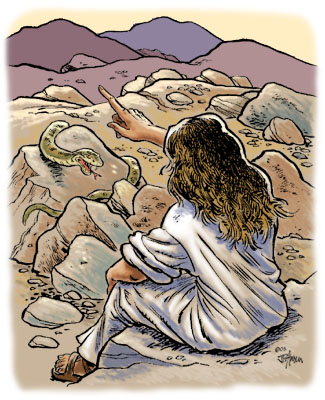 Hari Minggu Prapaskah pertama dimulai dengan kisah Yesus di padang gurun, berpuasa dan dicobai oleh iblis. Matius memberi kita lebih banyak perincian dalam kisah pencobaan, dan dari Matius, kita menemukan tiga pencobaan Kristus. Mengapa Setan menggoda Yesus? Kenapa tiga godaan?
 In Medio Ecclesiae