
We are the Magi

The Epiphany of the Lord

January 3, 2021

Matthew 2:1-12

The Christmas season ends with the feast of Epiphany of the Lord or the Feast of the Three Kings. However, if we read the Gospel carefully, we will discover that one who visited Jesus is magi, and the word “king” is not used to describe them. The Gospel of Matthew also reveals neither their number nor names. St. Matthew only speaks of three gifts offered: gold, frankincense and myrrh.

Magi is coming from the Greek word ‘magos’, and it is the same root word for magic. In his book ‘Jesus of Nazareth: The Infancy Narratives,’ Pope Benedict XVI explains that Magi has a wide range of meanings. In one sense, it may point to a black magician like Simon the Magician [see Acts 8:9-24], but in another sense, the magi may refer to the philosophers of noble birth coming from the land of Persia. Ancient philosophers are educated people who devoted themselves to the pursuit of wisdom. This is the reason why we call the magi also the wise men. It seems that the wise men have eventually discovered through their careful study, that the great king who is the embodiment of wisdom herself has been born in the land of Judea.

Are they kings? The Church recognizes that the magi who brought three particular gifts are the fulfillment of ancient prophecy. Isaiah said, “Nations shall walk by your light,

and kings by your shining radiance. Raise your eyes and look about; they all gather and come to you… bearing gold and frankincense, and proclaiming the praises of the LORD [Isa 60:3-4,6; which is our first reading].” In short, Isaiah prophesized that the light will guide kings, and they will come and bring gifts of gold and frankincense, and praise the Lord. The magi match the description of Isaiah’s prophecy, and from here, we can also say that the magi are also kings who were guided by the light of the star and offered precious gifts to Jesus. They might be indeed kings of small nations or perhaps, members of royalty, otherwise Herod the great would not have received them in his palace and welcome them cordially.

What about their names? Writing from the 8th century, ‘Excerpta Latina barbari,’ introduces them as Balthasar, Melchior and Gaspar. Whether these are their real name or not, we are never sure. However, we are invited to have the spirit and character of these wise men.

To find Jesus, they left their homes’ comfort and embarked into a long and challenging journey. They also learned to open their hearts as they discovered that the great king is not in Herod’s palace, but a poor home of Joseph and Mary. Ultimately, they humbled themselves before Jesus as they worshipped Him and offered the best gifts representing their lives. Then, they may go home with great joy.

Epiphany means God’s manifestation to the nations, yet this manifestation requires the magi to get up, search, and be humble. We are the magi. We are invited to look diligently for Jesus. To be baptized, catholic is undoubtedly excellent, but it is just the first step of our incredible journey. We are called to go deeper into the beauty of our faith. We are challenged to see Jesus in even the most unexpected places. Unless we go out and seek, we never find. It is because we are the magi.

Valentinus Bayuhadi Ruseno, OP

Kita adalah Orang Majus

Hari Raya Epifani

3 Januari 2021

Matius 2: 1-12

Masa Natal diakhiri dengan hari raya Penampakan Tuhan Yesus atau juga dikenal sebagai Pesta Tiga Raja. Namun, jika kita membaca Injil dengan cermat, kita akan menemukan bahwa orang yang mengunjungi Yesus adalah orang majus, dan kata ‘raja’ tidak digunakan untuk mendeskripsikan mereka. Injil Matius juga tidak menyebutkan berapa atau nama mereka. St. Matius hanya berbicara tentang tiga hadiah yang dipersembahkan: emas, kemenyan dan mur.

Majus berasal dari kata Yunani ‘magos’ dan ini adalah akar kata yang sama untuk ‘magic’. Dalam bukunya ‘Jesus of Nazareth: The Infancy Narratives’, Paus Benediktus XVI menjelaskan bahwa kata ‘magos’ memiliki arti yang cukup luas. Di satu sisi, kata ‘magos’ menunjuk pada seorang penyihir seperti Simon yang mencoba membeli rahmat dari Petrus [lihat Kisah Para Rasul 8: 9-24], tetapi dalam arti lain, ‘magos’ merujuk pada para filsuf dari keluarga bangsawan yang datang dari tanah Persia. Filsuf kuno adalah orang-orang terpelajar yang mengabdikan diri untuk mencari kebijaksanaan. Inilah alasan mengapa kita menyebut orang majus sebagai orang bijak. Mereka tidak berhenti sampai menemukan sang Kebijaksanaan itu sendiri.

Apakah mereka raja? Gereja melihat bahwa orang majus yang membawa tiga hadiah ini adalah penggenapan nubuat kuno. Yesaya berkata, “Bangsa-bangsa berduyun-duyun datang kepada terangmu, dan raja-raja kepada cahaya yang terbit bagimu. Angkatlah mukamu dan lihatlah ke sekeliling, mereka semua datang berhimpun kepadamu… akan membawa emas dan kemenyan,  serta memberitakan perbuatan masyhur Tuhan. [Yes 60: 3-4,6; yang merupakan bacaan pertama kita].”

Singkatnya, Yesaya menubuatkan bahwa raja-raja akan dibimbing oleh cahaya dan mereka akan datang membawa persembahan emas dan kemenyan, dan memuji Tuhan. Dari sini, kita juga bisa mengatakan bahwa orang majus juga adalah raja yang dibimbing oleh cahaya bintang dan mempersembahkan hadiah berharga kepada Yesus. Mereka mungkin sungguh raja dari kerajaan kecil di timur atau anggota keluarga kerajaan, jika tidak Herodes Agung tidak akan menerima mereka di istananya dan menyambut mereka dengan hormat.

Bagaimana dengan nama mereka? Sebuah tulisan yang berasal dari abad ke-8, ‘Excerpta latina barbari,’ memperkenalkan mereka sebagai Balthasar, Melchior dan Gaspar. Apakah ini nama asli mereka? Kita tidak pernah tahu dengan pasti. Namun, kita diajak untuk memiliki semangat dan karakter orang majus tersebut.

Untuk menemukan Yesus, mereka meninggalkan kenyamanan tempat tinggal mereka, dan memulai perjalanan yang panjang dan sulit. Mereka belajar juga untuk membuka hati mereka ketika mereka menemukan bahwa raja agung tidak ada di istana Herodes, tetapi ada di keluarga miskin Yusuf dan Maria. Akhirnya, mereka merendahkan diri di hadapan Yesus saat mereka menyembah Dia dan mempersembahkan hadiah terbaik yang mewakili hidup mereka. Hanya dengan demikian, mereka bisa pulang dengan penuh sukacita.

Epifani berarti penampakan Tuhan kepada bangsa-bangsa, namun hal ini menuntut orang majus untuk bangkit, mencari dan menjadi rendah hati. Kita adalah orang majus. Kita diundang untuk mencari Yesus dengan tekun. Dibaptis menjadi katolik memang rahmat yang luar biasa, tetapi ini adalah langkah awal dari perjalanan besar kita. Kita dipanggil untuk masuk lebih dalam lagi untuk menemukan keindahan iman kita. Kita ditantang untuk melihat Yesus bahkan di tempat yang paling tidak terduga. Jika kita tidak mau pergi dan mencari, kita tidak pernah menemukan-Nya. Ingat bahwa kita adalah orang majus.

Valentinus Bayuhadi Ruseno, OP

photocredit: jeff jewiss

Caesar or God?

29th Sunday in Ordinary Time

October 18, 2020

Matthew 22:15-21

To understand today’s Gospel, we need to make time travel to the time of Jesus. The Jewish people in the first century AD Palestine were not free people, and they were subject to the Roman empire. Being subjects, they were required to submit heavy taxes. This money would eventually use to pay the army that maintained “the security” of Palestine. Naturally, paying taxes was one of the most irritating and politically charged issues. “Why should I pay for my own oppression?”
The issue of paying taxes is even more sensitive since the coin used for the transaction is bearing the image of Caesar. Not only having the graven face of Caesar, around the image, but there was also an inscription that said “Tiberivs Caesar Divi Avgvsti Filivs Avgvstvs (Caesar Augustus Tiberius, son of the Divine Augustus).” The coin was simply blasphemous for the Jews who recognized that there is no god, but the Lord God.

With this background, the Pharisees were plotting to trap Jesus with an extremely dilemmatic question: “should we pay tax to Caesar?” If Jesus nodded, He would be considered a traitor for many Jewish nationalists and an idol-worshipper to pious Israelites. But, if Jesus voted negatively, He would be immediately labeled as a rebel and face the wrath of the Romans. However, it was never wise to test Jesus, because it would never be successful. Again, Jesus did not only escape the dilemma wisely but also taught a profound lesson for everyone.

He took a Roman coin and showed that it has an image of Caesar. Then, He said, “render to Caesar what belongs to Caesar…” The basis of ownership is the presence of “image.” The coin belongs to Caesar because it has his image. Thus, paying tax is simply giving back to the coins that since the beginning belongs to Caesar and the Roman Empire.  Yet, Jesus did not stop there. He taught also, “render to God what belongs to God.” And what belongs to God? The answer is those who possess the image of God. Going back to the Genesis 1:26, we discover that we were created in the image of God, and therefore, we belong to God.

Here, Jesus was not dodging the Pharisees’ bullet, but teaching a fundamental truth about who we are and where we are going. We were created in the image of God, not in the image of cellular phone, not of money, not of trophies. While they may offer instant pleasure, not of these things will ever grant us true happiness. Only God can truly fulfill our deepest longing. While these things are naturally good and can be beneficial, they are mere means to achieve our true end, God Himself. We might be preoccupied with pursuing wealth, popularity, or influence, but what is the point when we lose our final purpose?

St. Ignatius of Loyola in his Spiritual Exercises reminds us that, “Man is created to praise, reverence, and serve God our Lord, and by this means to save his soul. The other things on the face of the earth are created for man to help him in attaining the end for which he is created…Therefore, we must make ourselves indifferent [detached] to all created things… Our one desire and choice should be what is more conducive to the end for which we are created”


Valentinus Bayuhadi Ruseno, OP


Stumbling Stone

22nd Sunday in Ordinary Time [A]

August 30, 2020

Matthew 16:21-27

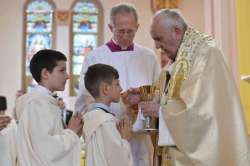
first communion 1Last Sunday, we listen to the confession of Peter on the true identity of Jesus. Here, Simon received a new name, the keys of the kingdom and the authority to bind and to loosen. He became the prime minister of the kingdom, the first pope. However, today, we witness the dramatic turn around. When Jesus foretold about His incoming passion, Simon reactively put his Master aside, and rebuked Him. As a response, Jesus expressed harshly,
“Get away behind me, Satan! You are a stumbling stone to me!”

Last episode, Simon was Peter, and today, Simon is “Satan.” Last week, Simon was the foundational rock, and today, Simon is the stumbling stone. Previous story, Simon was inspired by the Holy Spirit, and now, he is thinking his self-interest.

To call Simon that he was “Satan” is unexpected, but not uncalled-for. Perhaps Jesus would like to point out that Peter’s action was influenced by the devil himself.  Often, we think that the evil spirits influence us in the case of diabolic possessions, but in reality, diabolic possessions are an extraordinary way of attacking us. There is an ordinary way: it is through temptations and inducing ideas that oppose to the plan of God. The real battle takes place not so much in the possession of our bodies, but of our minds and souls.

Peter is also called as the stumbling stone, and in Greek, it is “scandalon.” Last Sunday, he was given a new identity, Peter, the foundation rock, but now, he turns to be a stumbling stone. Both are stone, but two opposing purposes. The foundation rock is to support the Church and God’s will, but the stumbling stone is to stop or at least, to obstruct and slow down God’s will. Jesus has set his eyes on Jerusalem, to offer His life as sacrifice on the cross and gloriously rise from the death. Yet, Simon, the stumbling stone, tried to oppose and prevent Jesus from fulfilling His Father’s will. Interesting enough, the word “Satanas” in Greek, may mean ‘the adversary.’  Simon becomes the adversary against Jesus’ mission.

Last week, I reflect on the mission of Simon Peter and how we become little Peters as God calls us for particular vocation and service despite our unworthiness. However, Jesus tells us that the real hindrance to our mission is not our weakness and unworthiness, but our selfish interest and agenda. Instead saying, “Your will be done,” we shout, “My will be done.” This is the devil’s game plan, that we put ourselves first, rather than God. Some of us are ordained priests, yet instead serving the people with dedication, we are busy to seek comfort and amass fortune for ourselves. Some of us are parents, yet instead bringing our children to God, we are preoccupied in chasing our own ambitions and careers.

Thus, Jesus makes a bold reminder, “what is the point of gaining the whole world and yet losing our souls?” At the gate of heaven, St. Simon Peter will ask us, “Have you been a stumbling stone to God’s will or have your been a foundation rock to His plan?”

Valentinus Bayuhadi Ruseno, OP

Batu Sandungan

Minggu ke-22 di Waktu Biasa [A]

30 Agustus 2020

Matius 16: 21-27

FILE PHOTO POPE FRANCIS BAPTIZES BABY VATICAN
 (CNS photo/Vatican Media)

Minggu lalu, kita mendengarkan pengakuan Petrus tentang identitas Yesus sebagai Kristus, Putra Allah yang hidup. Simon menerima nama baru dan kunci kerajaan surga. Ia menjadi perdana menteri kerajaan Allah, dan paus pertama. Namun, hari ini, kita menyaksikan perubahan dramatis. Ketika Yesus menubuatkan tentang sengsara-Nya, Simon secara reaktif menarik gurunya ke samping, dan menegur-Nya. Sebagai tanggapan, Yesus menyatakan dengan keras, “Enyahlah Setan. Engkau suatu batu sandungan bagi-Ku…! ”

Minggu lalu, Simon adalah Petrus, dan hari ini, Simon adalah “Setan”. Minggu lalu, Simon adalah batu fondasi, dan hari ini, Simon adalah batu sandungan. Minggu lalu, Simon diilhami oleh Roh Kudus, dan sekarang, dia memikirkan kepentingan dirinya sendiri.

Menyebut Simon  sebagai “Setan” adalah hal yang tidak terduga, tetapi juga sesuatu hal yang menarik di dalami. Mungkin Yesus ingin menunjukkan bahwa tindakan Petrus dipengaruhi oleh setan itu sendiri. Sering kali, kita berpikir bahwa roh jahat mempengaruhi kita dalam bentuk-bentuk kerasukan setan, tetapi kenyataannya, kerasukan setan adalah cara yang luar biasa untuk menyerang kita. Ada cara yang biasa: melalui godaan dan mendorong ide-ide yang bertentangan dengan rencana Tuhan. Pertempuran yang sebenarnya terjadi bukan dalam hal kepemilikan tubuh kita, tetapi dalam pikiran dan jiwa kita.

Petrus juga disebut sebagai batu sandungan, dan dalam bahasa Yunani “skandalon”. Minggu lalu, dia diberi identitas baru, Petrus, batu fondasi, tetapi sekarang, dia berubah menjadi batu sandungan. Keduanya adalah batu, tetapi dua tujuan yang berlawanan. Batu karang fondasi adalah untuk mendukung Gereja dan kehendak Tuhan, tetapi batu sandungan adalah untuk menghentikan atau setidaknya, untuk menghalangi dan memperlambat kehendak Tuhan. Yesus telah mengarahkan pandangannya pada Yerusalem, untuk mempersembahkan hidup-Nya sebagai korban di kayu salib dan dengan mulia, bangkit dari kematian. Namun, Simon, sang batu sandungan, mencoba melawan dan mencegah Yesus memenuhi kehendak Bapa-Nya. Kata “Satanas” dalam bahasa Yunani, dapat berarti ‘musuh’. Simon menjadi musuh yang melawan misi Yesus.

Minggu lalu, kita merenungkan misi Simon Petrus dan bagaimana kita menjadi Petrus-Petrus kecil saat Tuhan memanggil kita untuk sebuah panggilan dan pelayanan tertentu meskipun kita tidak layak. Namun, Yesus menyatakan bahwa hambatan sejati untuk misi kita bukanlah kelemahan dan ketidaklayakan kita, tetapi kepentingan dan agenda egois kita. Alih-alih berkata, “Terjadilah menurut kehendakmu,” kita berteriak, “terjadilah seturut kehendakku.” Ini adalah taktik besar setan, bahwa kita diajak mengutamakan diri kita sendiri, daripada Tuhan. Mungkin ada imam-imam yang tergoda dan sibuk mencari kenyamanan hidup dan mengumpulkan kekayaan untuk diri kita sendiri, daripada melayani umat dengan dedikasi. Mungkin ada orangtua-orangtua, yang alih-alih membawa anak-anak kita kepada Tuhan, malah disibukkan dengan mengejar ambisi dan karier kita pribadi.

Karena itu, Yesus mengingatkan dengan lantang, “apa gunanya mendapatkan seluruh dunia namun kehilangan jiwa kita?” Di gerbang surga, St. Simon Petrus akan bertanya kepada kita, “Apakah selama hidup, kamu menjadi batu sandungan bagi kehendak Tuhan atau telah menjadi batu fondasi bagi rencana-Nya?”


Valentinus Bayuhadi Ruseno, OP

Jesus the King

Solemnity of Christ the King – November 24, 2019 – Luke 23:35-43

crossOften we take for granted the name Jesus Christ, without realizing the meaning behind it. The word “Christ” is neither part of the personal name of Jesus nor the family name of Jesus. Jesus earns the name Christ not because of His foster father, Joseph, otherwise, we also call him Joseph Christ and his wife, Mary Christ.

Christ is coming from the Greek word “Christos” meaning “the anointed one”. In Hebrew, the title is even more pronounced, “the Messiah”. For us, the title does not ring us a bell, but for the Jewish people living in the time of Jesus, the Messiah is the fulfillment of God’s promise. In the Old Testament, the title Messiah was given to one of the greatest figures in Israel, King David. He was the Christ because he was anointed by Prophet Samuel, and he was personally chosen by God Himself to rule Israel. During his reign, the kingdom of Israel reached the pick of glory.

Unfortunately, after David’s death, the kingdom was declining and eventually destroyed. In the time of Jesus, almost one millennium after David, Palestine was under the Roman Empire, and lives were awful. No wonder, people were expecting the coming of the Messiah, the new king, that would restore the glory of Israel.

We believe that Jesus is Christ, meaning we believe that Jesus is the expected a king that will fulfill God’s promise. Yet, in today’s Gospel, we discover that Jesus was crucified. He had no army, except disbanded and coward disciples. He had not a palace except a small and poor house in Nazareth. He was insulted, spat upon, and tortured. He bore the greatest human humiliation. Even the criminal who was punished together with Him, mocked Jesus as a good-for-nothing king.

If we focus only on this cross and humiliation, we shall fail to see Jesus as king. For Jesus, being a king is not about gold, guns, and glory. It is neither about force nor control. Jesus is not a war-freak Messiah. So, what does it mean to be a King for Jesus?

 When one of the repented criminals asked Jesus to remember him when Jesus comes into His Kingdom, Jesus said that he would be in Paradise. The word Paradise is a Greek word for “garden”, it originally refers to the garden of Eden. That is what Jesus does as a king: He brings men and women who acknowledge Him as a king to Paradise. And no other kings in the world possess such power to bring us to paradise.

If then we confess that Jesus is the Christ, and now we understand that Jesus is our King, do we honor Him as our King? If Jesus is our King, do we allow Jesus to control us or we control Jesus? If Jesus is our leader, do we align our lives and priorities to His missions, or Jesus has to follow us? When our King summons us for a mission, do we gladly embrace it, or we rather choose our own plans and design?

Valentinus Bayuhadi Ruseno, OP

Yesus sang Raja

Hari Raya Kristus Raja [C] – 24 November 2019 – Lukas 23: 35-43

crossesSeringkali kita menerima begitu saja nama Yesus Kristus, tanpa menyadari makna mendalam di baliknya. Kata “Kristus” bukan bagian dari nama pribadi Yesus atau nama keluarga Yesus. Yesus mendapat nama Kristus bukan karena ayah angkatnya, Yusuf, tetapi senyatanya “Kristus” adalah sebuah gelar yang sangat penting bagi umat Yahudi dan Kristiani pada abad pertama masehi.

Kristus datang dari kata Yunani “Christos” yang berarti “yang diurapi”. Dalam bahasa Ibrani, kata yang digunakan adalah “Mesias”. Bagi kita yang hidup dua ribu tahun setelah Yesus, gelar ini tidak begitu berarti, tetapi bagi orang-orang Yahudi yang hidup di zaman Yesus, Mesias atau Kristus adalah penggenapan dari janji Allah. Dalam Perjanjian Lama, gelar Mesias diberikan kepada salah satu tokoh terbesar di Israel, Raja Daud. Dia adalah Kristus karena dia diurapi oleh Nabi Samuel, dan dia secara pribadi dipilih oleh Allah sendiri untuk memerintah Israel. Selama masa pemerintahannya, Kerajaan Israel mencapai puncak kejayaannya.

Sayangnya, setelah kematian David, kerajaannya terus menurun, dan akhirnya dihancurkan. Pada masa Yesus, hampir satu milenium setelah David, Palestina berada di bawah penjajahan Kekaisaran Romawi, dan kehidupan menjadi sangat buruk. Tidak heran, hampir semua orang Israel mengharapkan kedatangan Mesias, raja baru, yang akan mengembalikan kejayaan Israel.

Kita percaya bahwa Yesus adalah Kristus, artinya kita percaya bahwa Yesus adalah Raja yang telah memenuhi janji Allah. Namun, dalam Injil hari ini, kita menemukan bahwa Yesus disalibkan. Sebagai raja, Dia tidak memiliki pasukan, kecuali para lelaki yang bernyali kecil yang mengaku sebagai murid-murid-Nya. Sebagai raja, Dia tidak memiliki istana kecuali gubuk kecil dan miskin di Nazareth. Dia dihina, diludahi, dan disiksa. Dia menanggung penghinaan manusia terbesar. Bahkan penjahat yang dihukum bersama-sama dengan Dia, mengejek Yesus sebagai raja yang tidak berguna.

Jika kita hanya berfokus pada salib dan penghinaan ini, kita akan gagal melihat Yesus sebagai raja. Bagi Yesus, menjadi raja bukanlah tentang mengumpulkan kekayaan, memiliki senjata paling canggih, dan ketenaran. Ini bukan tentang kemampuan menguasai atau kontrol. Yesus bukanlah Mesias yang hobinya berperang. Jadi, apa artinya menjadi Raja bagi Yesus?

 Ketika salah satu penjahat yang bertobat meminta Yesus untuk mengingatnya ketika Yesus kembali ke Kerajaan-Nya, Yesus berkata bahwa hari itu juga, ia akan berada di Firdaus. Kata Firdaus sebenarnya berasal kata Yunani “paradesos” yang berarti “taman.” Sejatinya, taman ini merujuk pada taman Eden di Kitab Kejadian. Itulah yang dilakukan Yesus sebagai raja: Dia membawa semua orang yang mengakui Dia sebagai raja ke Firdaus. Dan tidak ada raja lain di dunia yang memiliki kekuatan seperti itu untuk membawa kita ke Firdaus.

Jika kemudian kita mengakui bahwa Yesus adalah Kristus, dan sekarang kita mengerti bahwa Yesus adalah Raja kita, apakah kita menghormati Dia sebagai Raja kita? Jika Yesus adalah Raja kita, apakah kita mengizinkan Yesus mengendalikan hidup kita atau malah kita yang mengendalikan Yesus? Jika Yesus adalah pemimpin kita, apakah kita menyelaraskan hidup dan prioritas kita dengan misi-Nya, atau Yesus harus mengikuti kita? Ketika Raja kita memanggil kita untuk sebuah misi, apakah kita dengan senang hati menerimanya, atau kita lebih suka memilih rencana dan desain kita sendiri?

Valentinus Bayuhadi Ruseno, OP

Martha, Martha

16th Sunday in Ordinary Time [C] – July 21, 2019 – Luke 10:38-42

To perform works to serve the Lord is certainly good and praiseworthy. And these works are numerous and varied. These acts may directly serve Him in the Church, especially during the liturgy. We may participate in the worship as the choir members, lectors, altar servers, ministers of the Holy Communion, or even as the presiders of the Eucharist itself, the priest. Yet, we may also serve Him through others as we involve in charitable initiatives to help the poor, to fight for justice and peace and integrity of creation. We have many ways, but the goal is one: to honor and glorify Him.

In today’s Gospel, we encounter Martha and Mary of Bethania. They both are serving Jesus, and they perform it according to their unique characters. Mary, more reserved and perhaps an introvert, chooses to stay close to the Master and listen to Him. While Marta, predominantly active and perhaps extrovert, prefers to provide Jesus with the best accommodation. Both want to make Jesus feel welcome in their way. However, there is a little problem. It seems that Jesus is playing little favoritism. He favors Mary over Martha and tells Martha that Mary has chosen a better part.

Surely Jesus does not play favoritism, and surely it is not because Mary is more beautiful than Martha!  Yet, we still have to explain Jesus’ choice. First, we need to see that both are good, but one is just happened to be better than the other. Is it the act of listening better than the act of giving hospitality? In an ancient Jewish context, to provide the hospitality to a guest is one of the prime values. We remember how Lot was offering even his daughters to protect his guests [see Gen 19]! By this standard, Martha is doing a better thing, but Jesus insists that it is not hers. Why?

Again, we need to understand better our Scriptures. The act of listening is fundamental in both Old and New Testament. Every devout Jew in the time of Jesus as well as in our time, daily prays a creedal prayer they call as “Shema Israel” – it was taken straight from Deu 6:4-5 “Hear, O Israel! The LORD is our God, the LORD alone! Therefore, you shall love the LORD, your God, with your whole heart, and with your whole being, and with your whole strength.” Acts of listening do not only mean to hear voices and receive information, but it is also to obey what one has heard. Jesus Himself says, “Everyone who listens to these words of mine and acts on them will be like a wise man who built his house on the rock. (Mat 7:24)” Mary is taking a better part because she has listened to Jesus, who is the LORD, and she listens because she loves her LORD.

Martha has a little problem with her service because she imposes her ways to Mary, perhaps thinking her way of service is the best one. But more than that, Martha becomes overburdened in her serving, and Jesus points out that Martha is anxious and worried with many things. Martha is losing the purpose of her service; she is losing Jesus in the process of serving. What a loss!

Learning from Mary and Martha, we may ask ourselves, “What is the point of our services? Where are we going with many activities we have in the Church? Do we hear the voice of Christ in our ministries? Do we love Jesus in our serving or we discover ourselves in the end?”

Deacon Valentinus Bayuhadi Ruseno, OP

Marta, Marta

Minggu Biasa ke-16 [C] – 21 Juli 2019 – Lukas 10:38-42

martha-and-mary-1Melakukan sesuatu untuk melayani Tuhan tentu baik dan terpuji. Dan karya-karya ini sangat banyak dan beragam. Tindakan-tindakan ini dapat secara langsung melayani Dia di Gereja, terutama dalam liturgi. Kita dapat berpartisipasi dalam ibadat sebagai anggota paduan suara, lektor, putra altar, asisten imam, atau bahkan sebagai imam yang mempersembahkan Ekaristi itu sendiri. Namun, kita juga dapat melayani Dia melalui sesama ketika kita terlibat dalam inisiatif amal untuk membantu orang miskin, untuk memperjuangkan keadilan dan perdamaian dan integritas ciptaan. Kita memiliki banyak cara, tetapi tujuannya adalah satu dan itu adalah untuk memuliakan Dia.

Dalam Injil hari ini, kita bertemu Marta dan Maria dari Bethania. Mereka berdua melayani Yesus dan mereka melakukannya sesuai dengan karakter unik mereka sendiri. Maria lebih pendiam dan mungkin seorang introvert, memilih untuk tetap dekat dengan Tuan dan mendengarkan-Nya. Sementara Marta, yang sebagian besar aktif dan mungkin ekstrovert, lebih suka memberi Yesus akomodasi terbaik. Keduanya ingin membuat Yesus merasa disambut dengan cara mereka sendiri. Namun, ada sedikit masalah. Tampaknya Yesus pilih kasih. Dia lebih menyukai Maria daripada Marta dan memberi tahu Marta bahwa Maria telah memilih bagian yang lebih baik.

Tentunya Yesus tidak pilih kasih, dan tentu saja itu bukan karena Maria lebih cantik dari Marta! Namun, kita masih harus menjelaskan pilihan Yesus. Pertama, kita perlu melihat bahwa keduanya baik, tetapi yang satu lebih baik dari yang lain karena sebuah alasan. Apakah tindakan mendengarkan lebih baik daripada memberi keramahan? Dalam konteks Yahudi kuno, memberikan keramahan pada seorang tamu adalah salah satu nilai utama. Kita ingat bagaimana Lot menawarkan bahkan putrinya sendiri untuk melindungi tamunya [lihat Kejadian 19]! Dengan standar ini, Marta melakukan hal yang lebih baik, tetapi Yesus berpendapat lain. Mengapa?

Sekali lagi, kita perlu lebih memahami Kitab Suci kita. Tindakan mendengarkan adalah tindakan mendasar baik dalam Perjanjian Lama maupun Baru. Setiap orang Yahudi yang saleh di zaman Yesus maupun di zaman sekarang, setiap hari mendaraskan doa syahadat yang mereka sebut sebagai “Shema Israel” – itu diambil langsung dari Ul 6: 4-5 “Dengarlah, hai orang Israel: TUHAN itu Allah kita, TUHAN itu esa! Kasihilah TUHAN, Allahmu, dengan segenap hatimu dan dengan segenap jiwamu dan dengan segenap kekuatanmu.” Tindakan mendengarkan tidak hanya berarti mendengar suara dan menerima informasi, tetapi juga untuk mematuhi apa telah didengarkan. Yesus sendiri berkata, “Setiap orang yang mendengar perkataan-Ku ini dan melakukannya, ia sama dengan orang yang bijaksana, yang mendirikan rumahnya di atas batu. (Mat 7:24)” Maria mengambil bagian yang lebih baik karena dia telah mendengarkan Yesus yang adalah TUHAN, dan dia mendengarkan karena dia mengasihi TUHAN.

Marta memiliki sedikit masalah dengan pelayanannya karena dia memaksakan jalannya kepada Maria, mungkin dia berpikir cara pelayanannya adalah yang terbaik. Tetapi lebih dari itu, Marta menjadi terlalu terbebani dalam pelayanannya, dan Yesus menunjukkan bahwa Marta sendiri penuh kecemasan dan khawatir dengan banyak hal. Marta kehilangan tujuan pelayanannya; dia kehilangan Yesus dalam proses melayani. Betapa malang ya!

Belajar dari Maria dan Marta, kita dapat bertanya pada diri sendiri, “Apa gunanya pelayanan kita? Kemana kita akan pergi dengan banyak kegiatan yang kita miliki di Gereja? Apakah kita mendengar suara Kristus dalam pelayanan kita? Apakah kita benar-benar mencintai Yesus dalam pelayanan kita atau pada akhirnya kita melayani diri kita sendiri?”

Diakon Valentinus Bayuhadi Ruseno, OP

No Excuse

Thirteenth Sunday of the Ordinary Time [C] – June 30, 2019 – Luke 9:51-62

carrying cross 2Today we listen to one of the most demanding and perhaps harsh teachings of Jesus. For those who follow Him, He demands total allegiance, and He shall become no less than their top priority in life. In both Jewish and Christian tradition, to honor our parents is one of the highest commandments. In fact, it is not a mere honoring, but it is to glorify [Hebrew word used is “kabad”] our parents. But, when a man asks Jesus to bury his father, Jesus tells him, “Let the dead bury the dead.” To one who requests to say goodbye to his family, Jesus says, “No one who sets a hand to the plow and looks to what was left behind is fit for the kingdom of God.” Very harsh. Is this truly Jesus whose heart is moved with pity towards the poor people? Is Jesus no longer observing the Ten Commandments?

We may uncover the reason at the beginning of the Gospel reading. Jesus knows the time has come for Him to go to Jerusalem, and He has set His face toward this city that will persecute, torture, and kill Him. The way of the cross has begun, and for those who wish to follow Him, it is no longer the time to be amused by His miracles or to be inspired by His preaching. They who desire to follow Jesus, shall also carry their cross with Jesus, and to walk with Jesus to His Calvary, one cannot but surrender his life to Jesus and make Jesus’s mission as his utmost concern.

However, we need to clarify also Jesus’ remarks that may sound too harsh. When Jesus says, “Let the dead bury the dead,” most probably the parent of that man is still very much alive, and he wishes to follow Jesus after his parent passes away. A subtle excuse not to follow Jesus. When Jesus says, “No one who sets a hand to the plow and looks to what was left behind is fit for the kingdom of God,” Jesus is alluding to the story of Elijah who called Elisha to follow him [1 Kgs 19:19-21]. When a prophet calls, the one summoned must respond immediately. Otherwise, the opportunity is gone for good. Jesus also points to the story of Lot’s wife. When the city of Sodom and Gomorrah were destroyed by God, the angel instructed Lot and his family to run and not to look back, and yet, his wife looked back. She became the pillar of salt [Gen 19:26]. Someone cannot effectively follow God’s words and new life in Christ if he always looks back and attaches himself to the past. Jewish farmers also know well the irony that when one plows the soil and keeps looking back at the result, he will just ruin the entire field. It is when one is focused and determined in his goal and decision, he will get the best result.

There is a story of an angel who appears to John. The angel said, “John, God calls you to serve Him.” John said, “Not now, I am still 18, and I want to focus on my study.” Then, the angel came again after some years. John said, “Not now, I am just 30, and I have my career.” Then, the angel appeared again after some year. John said, “Not now. I am just 40, and I have my family.” Then, the angel returned for the last time when John was 70. John said, “Now, I am ready to answer God’s calling.” The angel responded, “Yes, God calls you, but not to serve Him, but to see Him!”

A Christian who has a lot of excuses for Jesus is not a real Christian. It is only when we follow Him with determination, walk on His way of the cross without excuse, make Him as our top priority, we can humbly say that we are His disciples.

Deacon Valentinus Bayuhadi Ruseno, OP