

Minggu di Biasa ke-3 [21 Januari 2018] Markus 1:14-20
“Mari, ikutlah Aku dan kamu akan Kujadikan penjala manusia.(Mar 1:17)”

Yesus memulai pelayanan publik-Nya dengan memanggil empat murid yang pertama untuk mengikuti Dia. Di Palestina zaman Yesus, untuk menjadi murid berarti mengikutinya ke mana pun sang guru pergi. Bahkan, kata-kata Yunani yang digunakan adalah “deute hopiso”, itu berarti “Ikutilah di belakangku” karena para murid benar-benar berjalan beberapa langkah di belakang Yesus, sang Guru. Tidak mengherankan, bahwa ketika empat murid pertama, Petrus, Andreas, Yakobus dan Yohanes, dipanggil, mereka harus meninggalkan segala sesuatu, pekerjaan, keluarga dan kampung halaman. Jadi, untuk menjadi murid Yesus adalah sebuah komitmen radikal yang memerlukan pengorbanan besar.
Namun, jika kita mengaplikasikan kehidupan para murid pertama Yesus ke zaman kita, siapa di antara kita yang bisa mengikuti panggilan ini? Siapa di antara kita bersedia meninggalkan pekerjaan, keluarga dan tempat tinggal kita demi Kristus? Jawabannya tidak banyak. Hanya sedikit orang yang memasuki pertapaan atau biara. Bahkan, mereka yang sudah menjadi anggota kongregasi religius pun, diijinkan untuk tetap berhubungan dengan keluarga mereka. Saya sendiri sebagai seorang biarawan bisa berlibur setiap tahun dan mengunjungi keluarga saya di Bandung. Tampaknya kehidupan sebagai murid yang total tetap menjadi ideal yang jauh bagi kita.
Meskipun memang benar bahwa kehidupan seperti ini benar-benar sulit dan langka, namun kita percaya bahwa kehidupan murid sejati juga mungkin bagi kita semua. Injil mengatakan kepada kita bahwa murid pertama meninggalkan banyak hal, namun sebenarnya para murid juga membawa sesuatu bersama mereka ketika mereka memutuskan untuk berjalan dengan Yesus. Mereka sebenarnya membawa “diri mereka sendiri.” Di dalam totalitas pribadi ini ada karakter, pengetahuan, keterampilan, cita-cita, dan impian mereka. Singkatnya, mereka juga membawa serta profesi mereka, keluarga dan tanah air mereka. Inilah sebabnya mengapa Yesus tidak hanya memanggil Simon, Andreas, Yakobus dan Yohanes untuk mengikut Dia, tetapi Dia juga akan menjadikan mereka “penjala manusia.” Yesus tahu bahwa orang-orang ini adalah salah satu nelayan terbaik di Galilea, dan sekarang Yesus mengundang mereka untuk mempersembahkan yang terbaik yang mereka miliki bagi Allah. Mengikuti Yesus tidak berarti meninggalkan segalanya, tetapi mempersembahkan diri kita kepada Tuhan.
Ketika St. Dominikus de Guzman berkhotbah menentang ajaran sesat di Prancis Selatan, dia meninggalkan kenyamanan hidupnya di gereja di Osma, Spanyol. Namun, ketika dia berkhotbah, dia membawa semua keterampilan dan pengetahuan yang dia dapat sebagai kanon di Osma, dan sebagai mahasiswa di universitas Valencia. Dia meninggalkan segalanya, tetapi dia membawa semuanya saat dia mendirikan Ordo religius pertama yang didedikasikan untuk berkhotbah di Gereja. Sungguh sebuah paradoks!
Kita mungkin tidak dapat meninggalkan keluarga, profesi dan tempat tinggal kita karena kita bertanggung jawab atas kehidupan keluarga dan saudara-saudari kita, namun dengan semangat yang sama, kita dapat secara radikal mengikuti Yesus. Bagaimana? dengan mempersembahkan diri kita bagi Allah dan rencana-Nya. Sebagai orang tua, apa yang kita berikan kepada Tuhan, yang bisa mendidik anak-anak kita dan membangun keluarga Kristiani yang baik? Sebagai bagian dari Gereja, apa yang kita serahkan kepada Yesus, yang dapat membantu pertumbuhan Gereja di dunia ini? Sebagai anggota masyarakat, apa yang kita persembahkan kepada Tuhan, yang dapat memberikan kontribusi pada masyarakat yang adil dan makmur?
Frater. Valentinus Bayuhadi Ruseno, OP




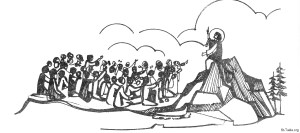 Matthew chapters 5 to 7 are well known as the Jesus’ sermons in the Mount. The section contains classic teachings and parables of Jesus like Beatitudes, the love for one’s enemy and the golden rule. Before Jesus began his sermon, He was sitting down. This gesture actually symbolizes the teaching authority of Jesus. On the Mount, Jesus was the teacher, and as a good teacher, He would expect people to listen attentively to His words. Thus, before Jesus commenced His sermon, He went up to the Mount to separate Himself from the crowd. Jesus knew that being part of the crowd was practically effortless and usually motivated selfishly: to be cured, to be fed and to be entertained. It could turn out to be very superficial, as a mass of people is drawn to one charismatic and powerful leader like Jesus, yet the moment its need is served or its leader is no longer satisfactory, it would be naturally disbanded.
 Injil Matius bab 5 sampai 7 dikenal sebagai khotbah Yesus di Bukit. Bagian ini berisi ajaran-ajaran dan perumpamaan Yesus yang sangat terkenal seperti 8 Sabda Bahagia, dan tentang mengasihi musuh kita. Sebelum Yesus memulai ajaran-Nya, Diapun duduk. Posisi ini sebenarnya melambangkan otoritas Yesus untuk mengajar. Di Bukit, Yesus adalah guru, dan sebagai guru yang baik, Dia akan mengharapkan mereka yang datang kepada-Nya untuk mendengarkan-Nya dengan penuh perhatian. Maka, sebelum Yesus memulai ajaran-Nya, Diapun naik ke bukit untuk memisahkan diri dari kerumunan. Yesus tahu bahwa menjadi bagian dari kerumunan adalah sangat mudah dan biasanya terdorong oleh motif-motif egois seperti ingin segera disembuhkan, untuk diberi makan dan dihibur. Alasannya sangat dangkal, mereka menjadi kerumunan karena tertarik dengan pemimpin karismatik seperti Yesus, namun saat kebutuhan mereka terpenuhi atau sang pemimpin tidak lagi memuaskan, kerumunan pun akan secara alami membubarkan diri.
 In Medio Ecclesiae