

10th Sunday in Ordinary Time [June 10, 2018] Mark 3:20-35
“For whoever does the will of God is my brother and sister and mother (Mrk 3:35).”
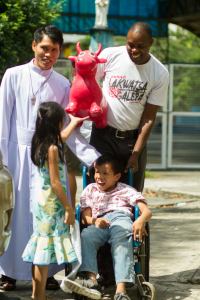
In ancient Israel as well as in many Asian and African cultures, family and kinship are core to one’s identity. The family is practically everything. A person is born, growing, getting old and dying within a family and clan. In traditional Filipino and Indonesian settings, a house is meant for an extended and expanded family. Several generations are living in one house. When I ask some of my Filipino friends, “If your house is burning, what are the first things you will save?” Their answer is not money, important documents or jewelry, but family pictures! In 1977, the Tanzanian President Julius Nyerere, one of the most prominent African figures during that time, visited the US and talked before the African students who studied there. Before them, he criticized those Africans who received much support from their families and clan, yet refused to go back after their studies. It was an act of cowardice and betrayal to Africa.
However, closely reading today’s Gospel from Mark, a good family-oriented and devoted Catholic will be startled. Naturally, we would expect Jesus to welcome Mary, his mother, and his relatives who come and look for Him. Surprisingly, Jesus does not do what is expected, but rather He takes that occasion to show His new family, “looking around at those seated in the circle he said, ‘Here are my mother and my brothers. For whoever does the will of God is my brother and sister and mother.’” (Mk. 3:34-35) Jesus’ words seem to be harsh since Jesus appears to exclude Mary and Jesus’ relatives from the composition of His new family. Does it mean Jesus disrespect Mary, His parent? Does it mean that for Jesus, the biological and traditional family have no value?
The answer is plain no. Certainly, Jesus respects and loves His mother as He fulfills the fourth commandment of the Law, “Thou shall honor thy parents.” Jesus also upholds and teaches the sanctity of both marriage and family life (see Mat 5:31-32; Mat 19:19). The early Christians also follow Jesus’ teaching on the integrity of marriage and family life, as reflected in various letters of St. Paul and other apostles (see 1 Cor 7:1-17; Eph 6:1-5). We are sure that for Jesus, marriage and family are good, but the point of our Gospel is Jesus is calling all of us to go beyond this natural relationship. The new family of Jesus is not based on blood but rooted in following Jesus and doing the will of God. This is also the call that Jesus addresses to Mary and His relatives. Surely, Mary becomes the model of faith as she obeys the will of God in the Annunciation (Lk 2:26-38), follows Jesus even to the cross (Jn 19:25-26) and stays and prays together with the early Church (Acts 1:14). St. Augustine says about Mary in his homily, “It means more for her, an altogether greater blessing, to have been Christ’s disciple than to have been Christ’s mother.”
The family as a natural institution is good, but Jesus teaches that we need to be the good disciples of Jesus first before we become a good family member. Otherwise, the family will be exposed to evil and destruction. Corruption, nepotism, and cronyism are evil practices rooted in the natural family. Another extreme is when brothers fight, even kill, each other over inheritance as if they are not coming from the same womb. It is the will of God that we are faithful to one another, that we do justice, that we are merciful especially to the weak and poor. Without Christian values, the family will not become the source of goodness. Echoing the words of St. Augustine, it is a blessing to be part of a family, but it is an altogether a greater blessing to become Christ’s disciple.
Br. Valentinus Bayuhadi Ruseno, OP
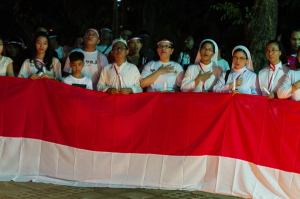
 We normally do not want to part away from the people we love. The emotional bond that has grown makes it difficult and painful for us to be away from the persons whom we love. Parents do not want to be separated from their children. Couple hates when they have to be far from each other. Friends cry when they have to go separate ways.
 Kita biasanya tidak ingin berpisah dari orang-orang yang kita cintai. Ikatan emosional yang telah terbangun membuat kita sulit untuk menjauh dari mereka yang kita cintai. Orang tua tidak ingin terpisahkan dari anak-anak mereka. Sepasang kekasih benci ketika mereka harus jauh dari satu sama lain. Kita sedih ketika mereka harus berpisah dengan sahabat kita.
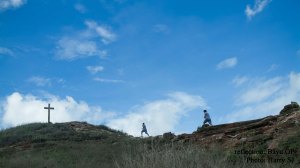 If Jesus is a carpenter, why does He speak about the vine in today’s Gospel? Does He have the competency to draw wisdom from a field that is not His expertise? We recall that Jesus grows and lives in Galilee, and in this northern region of Israel, the land is relatively fertile and agricultural industry is thriving. Some archeological findings suggest that in Nazareth, despite being a small village, the community members are engaged in small time farming, grapes press, and winemaking. A young Jesus must have been involved with this farming activities and perhaps even helped in a nearby vineyard. Thus, Jesus does not hesitate to teach wisdom using the imageries coming from the agricultural settings, like parables related to the vineyard (Mat 20:1-16), planting seeds (Mat 13:1-9), wheat and weed (Mat 13:24-30), and harvest (Mat 9:35).
 Jika Yesus adalah seorang tukang kayu, mengapa Ia berbicara tentang pokok anggur? Apakah Dia memiliki kompetensi untuk mengajar dari bidang yang bukan keahlian-Nya? Kita ingat bahwa Yesus tumbuh dan hidup di Galilea, dan di wilayah utara Israel ini, tanahnya relatif subur dan industri agrikultur cukup berkembang. Beberapa temuan arkeologi menunjukkan bahwa di Nazaret, meskipun adalah desa kecil, penduduknya terlibat dalam pertanian skala kecil, dan juga pembuatan anggur. Sebagai penduduk Nazaret, Yesus muda sedikit banyak terlibat dengan kegiatan pertanian ini, dan mungkin pernah membantu di kebun anggur terdekat. Karena pengalaman hidup ini, Yesus tidak ragu untuk mengajarkan kebijaksanaan menggunakan citra-citra yang berasal dari dunia agrikultur, seperti perumpamaan yang berhubungan dengan kebun anggur (Mat 20: 1-16), menanam benih (Mat 13: 1-9), gandum dan lalang (Mat 13: 24-30), dan panenan (Mat 9:35).



 In Medio Ecclesiae