

Second Sunday in the Ordinary Time [January 14, 2018] John 1:35-42
They said to him, “Rabbi, where are you staying?” He said to them, “Come and see.” (Jn 1:38-39)

In the Gospel of John, we will not discover the word “apostle” or one who is sent to preach the Gospel. John the Evangelist consistently calls those who faithfully gather around Jesus as the disciples. Why so? Perhaps, John the Evangelist wants to show us that the most important and fundamental aspect of being a follower of Jesus is truly to be a disciple.
What is a disciple in the time of Jesus? We usually understand a student as one who studies at a particular school with its buildings, facilities and system of learning. Like Br. Bayu is a student of the University of Santo Tomas, and every Monday to Friday, he has to attend classes at the Manila campus. I am expected to learn particular knowledge, like the theology of St. Paul or master certain skills like preaching. At the end of the semester, I need to pass the exams in order to prove that I have learned those set of knowledge or skills. If I fail, I have to take a remedial or retake the subject all over again. Surely, this is a simplistic way of imagining learning in our time, but if we want to be a disciple in the time of Jesus, we have to enter a different world.
When Andrew and Peter become the disciples of Jesus, it does not mean that they will attend lectures of Jesus. They literally follow Jesus wherever Jesus goes. That is why the first question Andrew asks is not how much the tuition fee is or what lesson Jesus will impart, but rather “Rabbi, where are you staying?” because it is clear in the mind of Andrew that if he wants to become a disciple, he has to follow Jesus literally for 24 hours a day, seven days a week. He is going to walk where Jesus goes, eat what Jesus eats, to sleep where Jesus lays His head, to experience what Jesus experiences, the joy, sadness, the suffering, and resurrection! Learning then is not simply about gaining knowledge or skills, but it is about sharing life, giving and receiving life.
It is interesting also to note that Jesus’ response to Andrew is oft-quoted “come and see”, yet in some ancient Greek manuscripts the words used are “erkesthe kai opheste ”. If they are translated literally, it sounds like “come and experience!” To become a disciple is to experience the life of Jesus, to experience Jesus Himself. Surely, it is a total experience of Jesus. Thus, the end of learning is not the grades, but a new life in the likeness of Jesus, the Master. It is the imitation of Christ in the real sense.
However, to become this kind of disciple, the price is also extremely high. To follow and experience Jesus’ life, we need to give up our lives. A life for life. We cannot be the disciples of Jesus only 8 AM to 3 PM, but the rest of the day, we are free. We cannot say that we are disciples of Jesus when we are at the Church only, but not in the workplaces and homes. We become like Jesus both in good times and bad times. The questions now are: Are we willing to sacrifice our old lives? Are we ready to follow Jesus day and night? Are we making our full effort to become like Christ?
Br. Valentinus Bayuhadi Ruseno , OP
 In the Fourth Gospel, John the Baptist has an important role. It is not only to baptize, but to become a witness. He is to witness to the light, to the true Messiah, to Jesus Christ. When the priests, Levites, and Pharisees from Jerusalem, come to him , and interrogate him to clarify his identity, he makes it clear that he is not the Messiah, not even the prophet, but rather enigmatically saying “a voice that cries in the desert.” It seems it is an easy thing to do for John. Questions are thrown at him, and he simply gives straight and confident answers. Yet, looking deeper into the reality, it is actually the opposite.
 Dalam Injil Keempat, Yohanes Pembaptis memiliki peran penting: bukan hanya untuk membaptis, tapi untuk menjadi saksi. Dia bersaksi tentang sang Terang, sang Mesias sejati, Yesus Kristus. Ketika para imam dan orang-orang Farisi dari Yerusalem datang kepadanya dan menginterogasinya untuk mengklarifikasi identitasnya, dia menjelaskan bahwa dia bukanlah Mesias, bahkan bukan seorang nabi, namun dia berseru, “Akulah suara orang yang berseru-seru di padang gurun: Luruskanlah jalan Tuhan! (Yoh 1:23)” Sepertinya hal ini adalah hal mudah untuk Yohanes lakukan. Pertanyaan diajukan kepadanya, dan dia memberikan jawaban secara lugas dan percaya diri. Namun, melihat lebih dalam pada realitas zamannya, hal yang dilakukannya tidaklah semudah yang kita bayangkan.
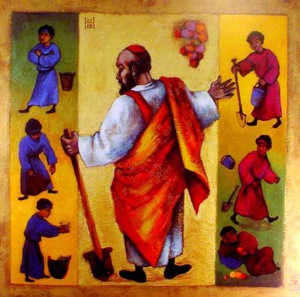 The road to hell is paved with good intentions. This old proverb attributed to St. Bernard of Clairvaux may sound rather morbid and threatening, but the truth remains. If we have only good intentions, marvelous plans, or great designs, but we never lift a finger to begin the first step, nothing will happen. We want to focus on our study, yet we are distracted by Facebook’s status and newsfeeds, our online chatting, or endless videos in YouTube, we will not make any progress. We wish to accomplish a lot of works, but our attentions and energy are consumed by so many other concerns. Then, our wish stays a wish.
 St. Bernardus dari Clarivaux pernah berpendapat bahwa Jalan menuju neraka dibuat dengan niat baik. Ucapannya mungkin terdengar agak mengerikan, tapi dia berbicara sebuah kebenaran. Jika kita hanya memiliki niat baik atau rencana yang luar, tapi kita tidak pernah bergerak untuk memulai langkah pertama, tidak akan terjadi apa-apa. Kita ingin fokus pada pendidikan kita, namun kita terus terganggu oleh status di Facebook, Online chat, atau menonton ribuan video di YouTube, maka kita tidak akan membuat kemajuan. Kita ingin menyelesaikan banyak pekerjaan di tempat kerja, tapi perhatian dan energi kita terkonsumsi oleh begitu banyak hal-hal lain. Maka, niat baik kita tetaplah sebuah niat.
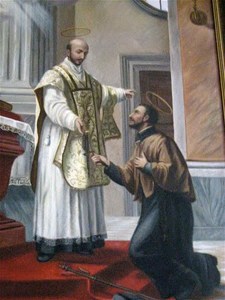 We come to one of the most heated exchange of words in the Gospel, and this occurs no less than between Jesus and Simon Peter. The apostle rebukes Jesus for revealing to the disciples that he has to go Jerusalem, suffer and die, but be raised on third day. In return, Jesus reproofs him and calls him Satan. Why does this harsh quarrel take place between Jesus, the most merciful Lord, and his trusted disciple, Simon whom he has just declared as the Rock?
 Kita mendengar sebuah pertukaran kata-kata yang paling panas dalam Injil, dan ini tidak tanggung-tanggung karena melibatkan Yesus dan Simon Petrus. Sang Rasul menegur Yesus karena telah menyatakan kepada murid-murid bahwa Ia harus pergi ke Yerusalem, menderita dan dibunuh, tetapi bangkit pada hari ketiga. Sebaliknya, Yesus menegur Petrus dan memanggilnya “Setan”. Mengapa pertengkaran yang hebat ini terjadi antara Yesus, yang adalah Tuhan yang maha pengasih, dan muridnya yang terpuji, Simon yang baru saja dinyatakan sebagai batu karang Gereja?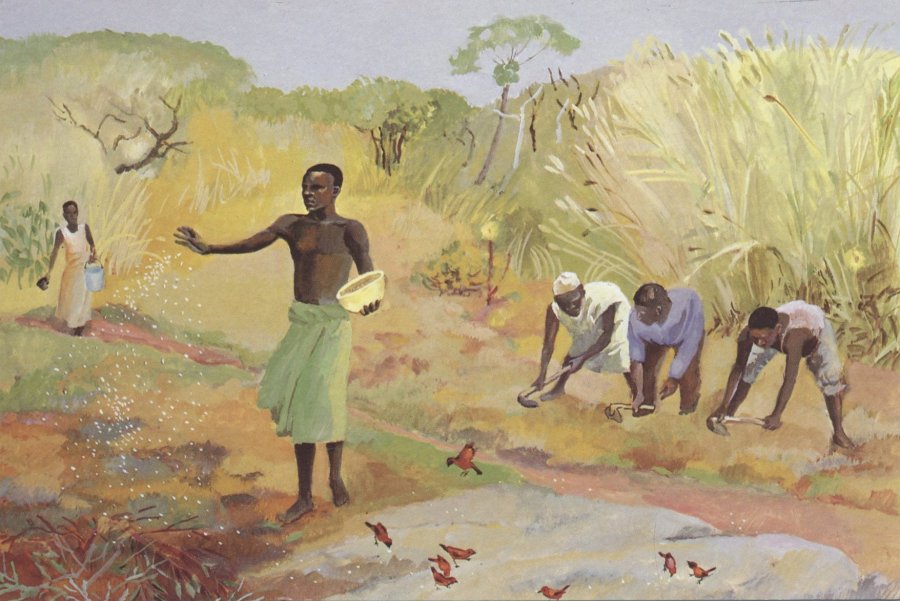
 Looking carefully into the parable, we find something strange. The agrarian land in Palestine was not as fertile and arable like many other countries like Indonesia and Philippines. It was expected that some seeds would fall into stony grounds, or be outgrown by the thorny plans. Yet, the Israelite farmers knew very well that seeds were their lifeline and wasting three-quarter of their seeds was just unthinkable. To add to this oddity, Jesus assured that this waste of seeds would be compensated with super abundant result of thirty to hundredfold harvest. A seasoned farmer recognized that an ordinary wheat seed planted in the Palestinian soil would yield just enough for the family. Thus, many of Jesus’ listeners would wonder, “What is he talking about? He is just a carpenter, and now he is talking to us from a boat about agriculture?” Even His disciples were puzzled and approached Him for clarification.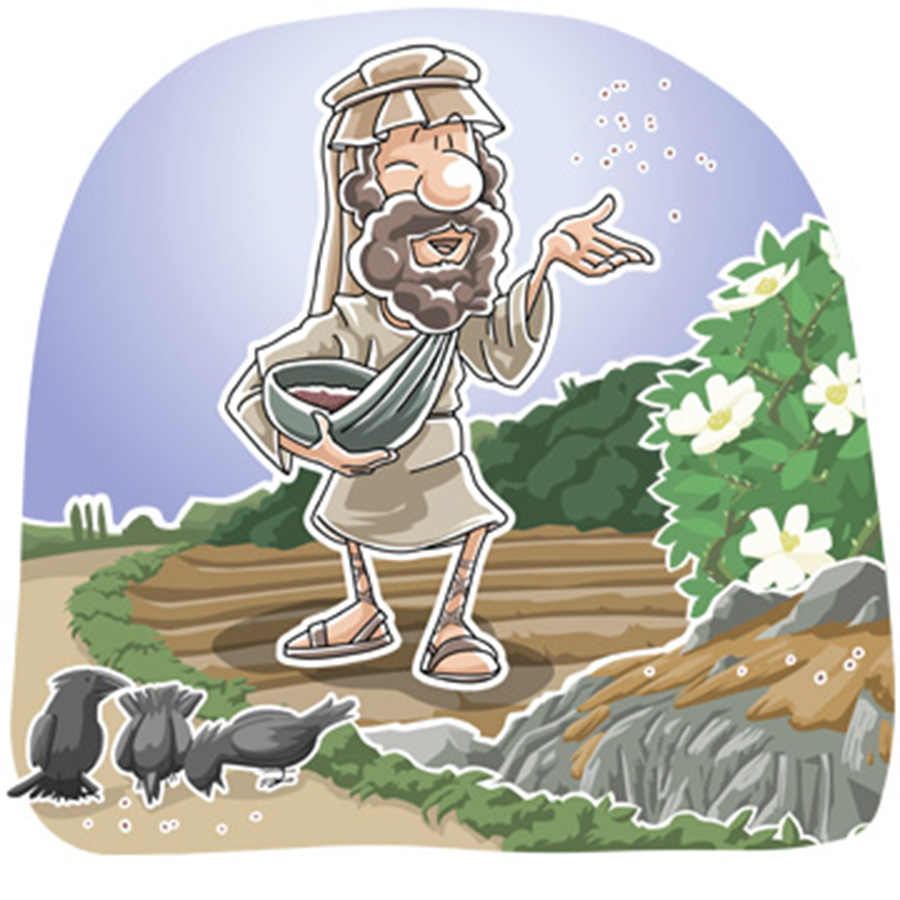
 In Medio Ecclesiae