

Palm Sunday of the Lord’s Passion [B]
March 28, 2021
Mark 11:1-10; Mark 14 – 15
Palm Sunday marks the beginning of the Holy Week, a most sacred week in our liturgical year. This year’s celebration may be different from other years because of the pandemic, but this does not stop us from having a solemn and meaningful celebration. One of the usual questions people ask about the celebration of Palm Sunday: “Why did Jesus ride a donkey?” Jokingly I replied, “well, an online taxi was not yet available during that time!”
The standard answer to this question is that Jesus would like to show Himself as a meek and humble king, rather than a power-lust and war freak general who rides a stallion. This answer is correct, but it does not give us a complete picture. If we try to go deeper into Mark gospel alone, we will unearth the Old Testaments’ fulfillments.

The choice of the colt is deliberate on the part of Jesus because He is fulfilling the prophecy of Zachariah. In essence, the prophet Zechariah foretold that someday a gentle, yet victorious king will enter Jerusalem, riding a colt [see Zec 9:9]. Yet, there are more!
If we go back to the Old Testament, we will find a king of Israel who indeed rode this humble animal. He was Salomon, David’s son when he was ascending to his throne [1 Kings 1:33]. By riding a colt, He signifies that He is the new Salomon ascending to His new throne, the cross.
Mark is telling us also that people are spreading their clothes also before Jesus. Going back to the Old Testament, we also discover a king of Judah whose ascension to the throne received this kind of gesture also from the people. His name is Jehu [2 Kings 9:12]. Aside from that, Mark is informing us that people welcome Jesus with leafy branches. Again, if we go back to the old testament, green branches were used to receive Judas Maccabeus, who retook Jerusalem from the enemy’s hands [2 Mac 10:7]. Jesus is indeed a gentle king, but He is also a victorious conqueror of His enemies. One more thing is that Mark added the expression ‘… our Father David…” David is undoubtedly not one of the Israelites patriarchs [Abraham, Isaac, and Jacob]. Still, the people of Israel recognized king David as the nation’s father, a king that protects and provides for his people.
From here, we can draw a stunning conclusion on this Palm Sunday. Jesus is riding on the unridden colt to show that He is Messiah King in the line of David, in the likeness of Salomon and Jehu, as well as a victorious king who will conquer His enemies. Yet, there is something even remarkable. Mark gives us a unique detail: this colt is untamed and untrained. Jesus’ choice to ride this wild animal shows His mastery over wild beasts and nature. He is not just the king of Israel, the king of humankind, but He is a king of all nature. Indeed, a colt is a good ride for the king of the universe.
However, we must not be happy too soon. There are more secrets to be opened and more prophesies to be fulfilled as we enter the drama of Holy Week.
Valentinus Bayuhadi Ruseno, OP
 Traditionally, the Gospel of John is divided into two major divisions: the Book of Sign [chapter 1-12] and the Book of Glory [Chapter 13-21]. The book of Sign focuses on the public ministry of Jesus and presents the seven signs of Jesus. In John’s Gospel, Sign is a technical term for a miracle. Jesus’ signs begin with changing water into wine in Cana and reaching its culmination in raising Lazarus from the dead. Meanwhile, the book of Glory tells us how Jesus is glorified. The second part starts with Jesus and his disciples in the Upperroom and culminates in His Passion, death, and resurrection.
 Today’s Gospel presents us with one of the most cryptic sayings of Jesus, “Just as Moses lifted up the serpent in the desert, so must the Son of Man be lifted up, so that everyone who believes in him may have eternal life.” To unpack this, we cannot but go back to the Old Testament, especially the Book of Numbers.
 We, modern readers, often misunderstand today’s Gospel. This particular Jesus’ story becomes a basis for some to refuse the church building and parish vicinities for non-religious activities, however good its intention is. I personally agree that the inside of the Church’s building is a place set aside for worship and prayer. This is the sacred ground for people to encounter God and experience heaven.
 Mountain is a special place in the Bible. It is a place where God meets His people. In the Old Testament, there are many instances where mountains become a pivotal point of salvation history. After the great flood that cleansed the world, the Ark of Noah landed on Mount Ararat, and there, Noah offered sacrifice to God [see Gen 8:4]. Abraham was asked by God to offer his son Isaac on Mount Moriah. Just right before the sacrifice, the angel of God prevented Abraham and God recognized Abraham’s faith [see Gen 22]. When Moses was tending the flock of his father-in-law, Moses saw a burning bush yet was not consumed, and there, on the mount of Horeb, God called Moses to save Israelites from the Egyptians [see Exo 3]. After the liberation from Egypt, Moses and the Israelites the Law and established a covenant with God on the mount of Sinai [see Exo 24:18].
 Why did Jesus have to stay in the wilderness for 40 days? The answer is not difficult. He was reperforming what the Israelites did when they were liberated from Egypt. The Israelites stayed for 40 years in the wilderness before they entered the promised land. Yet, there is one more thing! Mark gives us a small, however important detail: in the wilderness, Jesus was staying with the beasts. Why so? If there is one man closely connected to the beasts in the scriptures, he is no other than Adam. Jesus is the new Israel who endured the harsh conditions of the desert and the new Adam who faced the onslaught of the devil.
 Leprosy in the time of Jesus is not only physically and mentally deadly, but also spiritually incapacitating. Leprosy or currently known as the Hansen’s disease is horrifying sickness because it does not kill the person slowly, but it gradually deforms and incapacitates the person. The bacteria cause terrible damage in peripheral nervous to the point that the person is no longer feeling the sensation, especially pain. Without this sensation, the person fails to recognize and avoid bodily injuries. Losing limbs is shared among the victims with advanced stages of leprosy.
 Jesus cannot be separated from His healing ministries. Some of the healings are remarkable, like the healing of a woman with the hemorrhage and Jarius’ daughter [Mark 5:321-43]. They are astonishing because these are practically impossible cases. The woman has suffered for twelve years without sign of hope, and Jarius’ daughter is as good as dead. Yet, Jesus does heal not only those with grave illness but also those with curable sickness.
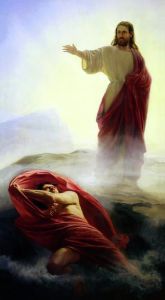 Jesus performed His first exorcism in the Gospel of Mark. Reading the context, we discover that Jesus was teaching in the synagogue, and the people recognized Him teaching with authority. When Jesus taught with authority, it does not merely mean He preached with eloquence and chrism, but His teachings manifested in powerful signs, like healings and exorcism.
 We once again listen to the story of the calling of the first disciples: Simon and Andrew, as well as James and John, the sons of Zebedee. Jesus called them, and He would make them ‘the fishers of men.’ Yet, from countless possibilities of professions and occupations, why did they have to be ‘the fishers of men’? Why not merely Jesus’ promotion team? Why not Jesus’ soldiers?
 In Medio Ecclesiae