

21st Sunday in Ordinary Time
August 23, 2020
Matthew 16:13-20
 Today’s Gospel speaks volume about the new identity and roles of St. Simon Peter as the leader of the college of the apostles, and thus, the leader of the Church. He is the chosen foundation rock upon which Jesus built His Church. He is the prime minister who holds the keys of the kingdom of God. He is the chief priest who is responsible for the Temple of God. He is the chief Rabbi whose teachings binds the entire faithful. These are the bigger-than-life privileges and one may wonder, “Among the disciples, why was he chosen? Did Jesus know that he would deny Him three times?”
Jesus’ choice is a huge mystery, yet in the final analysis, nobody is worthy to be the first pope. If we scan the Bible and try to see many vocation stories of the great leaders of Israel, we are going to see the same pattern: most of them are not worthy and great sinner. Abraham was a coward who hid behind his wife. Moses was involved in killing an Egyptian. David was committing adultery and plotting a murder of Uriah. God seems to have a penchant to choose unworthy sinner!
Yet, that is only half of the story. These great leaders possess their remarkable quality in relation to God’s mercy and love. Despite their weakness, they never lose hope in God’s grace working in them. When they fall, they learn to rise once again and allow God sustains them. This particular quality also that Simon has.
Through his life, Peter was struggling to love Jesus and to become a leader for Christ’s Church. He made few step on water, but doubted and distracted, he began to sink. He made divinely inspired statement on Jesus divinity, but right after, he prevented Jesus to accomplish His mission on the cross. Thus, Jesus called him “Satan!” He promised Jesus that he would lay down his life for Jesus, but less than twenty-four hour, he denied Jesus with curse, and ran away! Yet, despite so grave a sin, he repented, but does not despair. Compare to Judas who lost hope and killed himself in the process, Peter knew too well that there is nothing impossible for God. Indeed, the risen Christ restored his place as the leader and the shepherd of His flocks, after asking Simon’s confession of love thrice. Yet, that was not the end of the story. A tradition says that during the persecution of emperor Niro, Peter was trying to escape Rome. In his way out of the city, Peter encountered Jesus going to the opposite direction. He then asked Jesus, “Quo vadis, Domine? [where are you going, Lord?]” Jesus responded, “I am going to Rome, to be crucified again!” Hearing this, Peter ran back to Rome. True enough, he was arrested and crucified upside down.
The choice of Peter is a mystery, but also good news. We are like Simon Peter, we are chosen to be God’s people, chosen into particular role and mission, but deep in our hearts, we are not worthy and full of weaknesses. Why did God choose me to be His priest? Why did God want me to raise children for the kingdom? Why did God elect me to become His ministers? We are not sure the exact reason, but like Peter, we are also called to trust His providence, and never lose hope in midst of trials and failures, and to love even more.
Valentinus Bayuhadi Ruseno, OP
 Often, we, Catholics, are accused of overemphasizing Mary in our faith, liturgy, and even our daily lives. The usual objections are: “Why do we should see Mary if we can go directly to Jesus? Why should there be Mary between you and Jesus?”
 The story of Jesus walking on water is a well-known account being shared by three gospels: Matthew 14:22-33, Mark 6:45–52 and John 6:15–21. However, unique to Matthew is the part of Peter who also walked on water, but sank after a few steps. Let us focus our attention on this unique moment in the life of Simon Peter.
 The miracle of the multiplication of the bread is one of the few stories that appear in the four Gospels. This may point to the veracity of the miracle itself that impressed and impacted the lives of the apostles. Though the general plot is the same, every Evangelist has presented their own emphasis. Today we are zeroing in the Gospel of Matthew and his particular emphases.
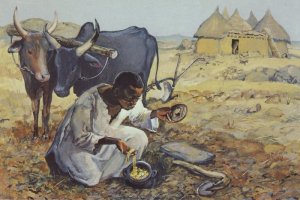 The parables of the hidden treasure and of fine pearl are among the shortest yet loveliest parables of Jesus. Finding a fine pearl or a hidden treasure is surely an exciting discovery. We can naturally share the joyful experience. Yet, the key to unlock the secrets of the parables is to spot the surprising twists. If we find a treasure, we instinctively grab it and bring it home. If the treasure is exceedingly huge and many, we can grab some and use them to buy the land. It is a bit reckless to sell everything first and then buy the land. What if the owner of the land suddenly refused to give up the land? The same goes for the purchase of the fine pearl. Sometimes a businessman would make a risky investment to gain more profit. Yet, to throw everything for a pearl is a bit of foolishness. The merchant still needs money to sustain his daily life and business, and what if the investment fails?
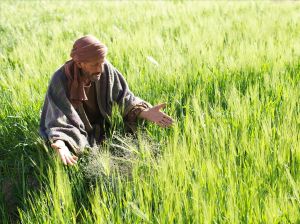 The parable of the wheat and weed is one of a kind. If we survey the details, we are supposed to raise our eyebrows. Firstly, if you become a person who will destroy your opponent’s field of wheat, you know that there are several other effective ways to accomplish that. We can simply set a small fire on the wheat, and the entire field will eventually turn to be an inferno. But, the enemy chose unorthodox tactic: to sow seeds of weed during the planting period. While the weed may disturb the growth of the wheat, they will not sufficiently damage and stop the harvest. So, what is the purpose? What is surprising is that the decision of the field’s owner. When he was notified about the presence of the weed, he immediately knew the culprit, and instead to act promptly and protect their wheat, he decided to allow the weeds to thrive among his wheat.
 From the previous two Sundays, we learn that Jesus lays down the cost of following Him, how to become His disciples. And they are extremely tough. One has to follow Jesus wherever He goes. One must love Jesus above anyone else. One must be ready to suffer persecutions and hardships, carry his cross, and give up his life for Jesus. It is Jesus or nothing at all. However, following Jesus is not all about hardship and sacrifice. Today we hear that to walking with Him, we receive certain “perks” that others cannot even dare to offer.
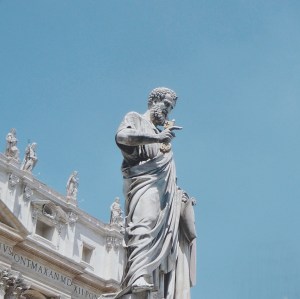 Jesus never promises that the disciple will have easy and prosperous lives. Jesus demands the opposite. After being chosen, the twelve disciples are sent to preach that the Kingdom is at hand, and yet they will not go like any royal emissaries with their military escort. No! They will travel as simple men going on foot and carrying minimal provision. They will rely on the generosity of their hosts, and the worst part is that they are going to face rejection.
 In Medio Ecclesiae