

Sixth Sunday in Ordinary Time [February 17, 2019] Luke 6:17.20-26
“But woe to you who are rich, for you have received your consolation. (Lk. 6:24)”
 We listen today the Beatitude, but unlike the famous Beatitude from the Gospel of Matthew, we have today from the Gospel of Luke. Unlike from Matthew who has eight sayings of blessedness, Luke has four blessedness and for four “woes”. The most striking difference is while Matthew seems to emphasize “the poor in spirit”, Luke wants us to understand poverty in a more literal sense.
We want to have a happy life, and we do not like to have a difficult and poor life. It is just basic in our human nature. If we study diligently, we expect that we have a good result in our education. If we work hard and labor honestly every day, we wish that we will be rewarded with success. If we live our lives with passion and dedication, we look forward to acquire a fulfilling life.
However, in today’s Gospel, we listen that Jesus is telling us that the blessed one are the poor, the hungry, the weeping, and the persecuted, and for those who are rich, filled, and laughing, “woe” is their lot. Is Jesus pro-poor and anti-rich? Does Jesus want us to suffer, famish, and become malnourished? Does Jesus like that we are justly rewarded for our hard work and labor? Is Jesus hyper melancholic man, who sulk in sadness, and does not know how to enjoy life?
These are tough yet valid questions, and to answer these, we need to go back to the time of Jesus and discover the context behind the saying of Jesus. In the first century A.D. Palestine, the majority of the people, including Jesus Himself, were poor, hungry and oppressed. They were poor not because they were lazy but because they were living under a terrible time to live. Palestine was colonized by the Romans, and it was a common practice to levy a heavy tax on ordinary Israelites. Only some nobilities, few landowners, a handful of rich businessmen and Israelites who were working for the Romans, like the tax collectors, were enjoying a better life. Ordinary Israelites did not only have to face the Romans, but they had to suffer from the abuses from their fellow yet greedy and opportunistic Israelites who wished nothing but enrich themselves. It was a terrible time to live.
The message of Beatitude was more making sense now. Jesus promises hope and consolation for those who are poor and suffering due to injustice, and He woes those who are rich through dishonest and oppressive means. Thus, we know now that by His Beatitudes and Woes, Jesus does not hate all the rich guys, but greed and injustice that poison people’s hearts both the rich and the poor. When we have a good life because of our hard work and honest effort, then we praise the Lord. It is a blessing! Yet, Jesus is also reminding us that in good time, we must not be greedy, but remain humble and even to have concern for our brothers and sisters who are poor, hungry, and weeping because of injustice.
Deacon Valentinus Bayuhadi Ruseno, OP
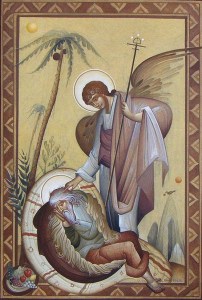
 This Sunday, we listen to the vocation stories of great men in the Bible. From the first reading, we learn how Isaiah was called by God to be His prophet to Judah. In the Temple of Jerusalem, he saw the Lord God surrounded by His seraphim. Isaiah was terrified and said that he had unclean lips. An angel then placed a burning ember on his tongue to remove his wickedness. God, then said, “Whom shall I send?” Isaiah replied with confidence, “Here I am, send me!”
 In today’s Gospel, Jesus compares Himself with the Israelite greatest prophets, Elijah and Elisha. But, who are these two prophets? For many Catholics, we are not familiar with these two prominent figures in the Old Testament, and thus, we often do not appreciate why Jesus deliberately cites their names.
 The synagogue is the place of prayer for the Jews. On the center during the service in the synagogue is the reading of the Hebrew Bible (or what we call the Old Testament) and the explanation of those readings. In the Gospel, we learn that Jesus stands as the leader of the service. First, He stands and reads the Scriptures, and the chosen portion is from the Prophet Isaiah. Then, He sits down, assuming the position of teacher. The Jews in the synagogue are eager to listen to Jesus. However, there is something different in Jesus’ teaching from other Jewish Rabbis. Jesus neither simply expounds the reading from Isaiah, nor makes commentaries on the text. He neither simply discusses the meaning of the readings, nor explains the context of the text. He fulfills what is written in the Scriptures. He says, “Today this scripture passage is fulfilled in your hearing.” (Lk. 4:14)
 Today we are celebrating the feast of the conversion of St. Paul, the Apostle. St. Paul is one of the greatest names in our Church. Many churches are named after him, like one of the major Basilica in Rome, St. Paul outside the Wall. Not only churches but also many Christians are named after him, including our brothers in the house of formation, Bro. John Paul Sontillano, Bro. Paulus Gabriel Rambang Ngawan, and our former formator, Fr. Pablo Tiong.
 Mary who was once a bride and has passed through the tiny-gritty of a Jewish wedding can sense immediately something goes wrong. The wine is running out. In the Jewish context, wine is an essential ingredient in every joyous occasion, as it is ordained by God to “gladden men’s hearts” (Ps 104:15) The lack of it can spell a disastrous result. It is the source of shame, and even a family dispute.
 One of the greatest joys of being a deacon is to baptize babies and little children. The joy is not simply springing from touching the cheeks of a cute little baby or be part of festive parents, but it is something deeper. In fact, my experiences with baptism are not always pleasant. I remember at my first baptism in Sto. Domingo Parish, Metro Manila, when I began pouring water upon the baby’s forehead, the little girl suddenly burst in tears and cried aloud. I realized the water has touched the baby girl’s eyes. I was shocked and almost paralyzed not knowing what to do next. The good thing is the parents were able to handle the situation well. As the little baby calmed down, I apologized and continued the rite. Traumatizing!
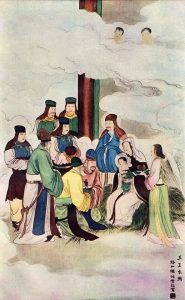 The third question Archbishop Socrates Villegas asked me during my ordination was “Are you afraid enough? Just like the first two questions, this one is also counterintuitive. One of my favorite phrases in the Bible is “Do not be afraid!” In many occasions in the Scriptures, this statement does not simply convey encouragement, but also a life-changing mission. When Abram was getting old and he was childless, he doubted to enter the convent with the Lord who promised him descendants like the stars in heaven, God said, “do not fear!” (Gen 15) Then, Abraham became the father of all nations. When God called Jeremiah to prophesy to Judah, he found an excuse in his young age, but God said, “do not be afraid!” (Jer 1:8) Then, Jeremiah became one of the greatest prophets of Israel. When Joseph felt betrayed and yet in his mercy, planned to divorce Mary in secret, the angel said to him, “Joseph, son of David, do not be afraid to take Mary your wife into your home.” (Mat 1:20) Then, Joseph became the foster father of the Son of God. When Mary received the Good News from the angel Gabriel, she did not understand what was happening, Gabriel said to her, “Do not be afraid, Mary, for you have found favor with God.” (Luk. 1:30) Then, she became the Mother of God.
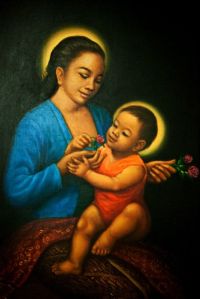 Some of us may wonder why the Church places the celebration of the solemnity of Mary, the Mother of God on January 1, or on the New Year. One may guess that the Church wants us to attend mass on the first day of the year, so as to start the year right. For those who wish to have a long holiday, it might be pretty a killjoy, but for some of us who wish to be blessed for the entire year, it is a nice thought. Yet, surely there is something deeper than that.
 We are celebrating the feast of the Holy Family of Nazareth, the feast day of Jesus, Mary, and Joseph. The last event in the Bible that presents the Homily Family together is the Finding of the Child Jesus in the Temple. After this event, Joseph no longer appeared in the Bible, and according to the tradition, he passed away even before he was able to see Jesus in His public ministry. Since this is the last episode where Joseph gets involved in the narrative, we shall reflect more about him.
 In Medio Ecclesiae