

32nd Sunday in Ordinary Time. November 12, 2017 [Matthew 25:1-13]
“The foolish ones, when taking their lamps, brought no oil with them, but the wise brought flasks of oil with their lamps. (Mat 25:3-4)”
In the Jewish patriarchal society, an unmarried woman has to stay with her father. Then, when she gets married, she will move to her husband’s house. This transition from her family of origin to her new family is ritualized by an elaborate wedding procession. The groom will fetch the bride from her father’s house, and together they march back to the groom’s house where usually the wedding celebration is held. For practical reason, the procession takes place after sunset, and thus, men and women who are involved in the procession shall bring their torch or lamp.
Within this context, the presence of the ten virgins have to be understood. They are assigned to welcome the groom and the bride, and join community in the procession of light. Since there are no means communications like cellular phone with GPS, they are not able to track the location of the couple, and yet, they need to be ready with their lamps anytime the procession comes. There is element of surprise and expectation, and the virgins have to prepare themselves well for this.
Jesus compares the five wise virgins and the five foolish virgins. The wisdom of the five virgins manifests in their ability to foresee some practical considerations like the estimated distance between the house of the groom and bride, the possible delay, and the expected slow-pacing procession. Thus, bringing along extra oil for the lamp is something sensible, and in fact, necessary. Extra oil might be just a simple thing compare to the entire wedding celebration, but its absence proves to be costly for the five virgins. It is just “foolish” to miss the entire celebration just because they fail to bring simple thing like an oil. Jesus likens this to the preparation for the Kingdom of Heavens. It begins with practicality of life, to prepare apparently simple things in life and yet proved to be important for those who are welcoming Jesus and His Kingdom.
Many great saints are those who are most humble. What basically Mother Teresa of Calcutta did was to serve the poorest of the poor in India. Sometimes, she and her sisters had something to give, but often they only had themselves to share. Yet, for the lonely, sick and dying, Mo. Teresa’s loving company was what mattered most. Then, she advised us, “Not all of us can do great things. But we can do small things with great love.” When sister Breda Carroll, a Dominican nun from Drogheda, Ireland, was asked by a journalist, “Isn’t life in the monastery is completely useless? And how do you become a preacher if you never go out and preach?” She replied, “The greatest preaching is to make people think of God, and our mere presence and constant prayer cannot but disturb people and make them think of God.” For all we know, their simple ways of life and constant prayer have saved countless souls in purgatory.
We are invited to act like this practical and wise virgins. We prepare ourselves for Jesus by faithfully doing seemingly simple and ordinary things in our lives. Preparing breakfast every morning seems nothing special, but for a mother of five children, that is her share in the Kingdom. Working hard every day looks to be normal for a young man aiming for a bright future, but for a poor and old man who needs to support his family, it is his share in the Kingdom. What are our share in the Kingdom? Are we faithfully doing simple things with love? Are we ready to welcome Christ?
Br. Valentinus Bayuhadi Ruseno, OP
 Reading this Sunday’s Gospel, I feel that Jesus is reprimanding His priests and ministers for “preaching and yet not practicing.” Unfortunately, many of us are failing in this matter. We preach forgiveness, but some priests are having prolonged quarrels with other co-priests and some of their parishioners. We teach kindness and friendship of God, yet some of us appear to be aloof and snobbish. We proclaim justice, but sometimes we fail to be just to the simple people working in the parish or convent.
 What is love? If we ask young couple who are in love, love means more time together and be connected online even up to late hours of the night. For young priests, love may mean patiently listening to confessions for hours, and attending to sick calls. For a couple who have their newly-born baby, love is changing the baby’s diapers even at middle of the night. Love is passion, dedication and sacrifice.
 “In this world nothing can be said to be certain, except death and taxes.” Benjamin Franklin once said. Indeed, tax is an unpleasant and unavoidable fact in our lives as ordinary citizen. A portion of our hard-earned wage is suddenly taken away from us, and only God knows where it goes. In modern society, almost all we have, we gain, and we use are taxed. The practice of taxing people goes back to first known organized human societies. The basic idea is that tax will provide a common resource for the improvement of the community, like building roads, free education and quality health care. Yet, the ideal is often met with abuses. In olden time, the kings and chieftains taxed people so they could build their grand palaces and feed their wives. Unfortunately, the situation does not change much in our time.
 Jesus is already in Jerusalem. The confrontations between Jesus and the Jewish authorities have turned bitter, and Jesus is approaching His final days on earth. With this context, the parable may be understood easily. The invited guests stand for some elite Israelites who refuse Jesus, and thus, reject God Himself. The burning of their towns and cities may point to the invasion of the Roman Empire and the destruction of Jerusalem in 70 AD. The commoners who are later invited represent the people from all nations who accept Christ. Yet, some people who are already at the Wedding banquet do not wear the expected wedding garment. This proper dress decorum is a basic sign that the guests are honoring the host, and also becomes the symbol of our faith, our good works and our holy lives. For those who fail to honor the King through their garment are thrown out from the banquet.
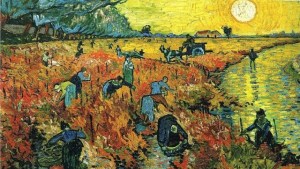 The image of a vineyard is close to Israelites’ hearts because this springs from their prophetic tradition. Isaiah uses this metaphor to describe Israel and God (see Isa 5:1-8). Consistent with this great prophet, Jesus crafts His parable of the vineyard to describe the relation between God and His people. God is the just and generous vineyard owner, and we are His workers. Now, it is up to us to work hard for the Lord in His vineyard and receive abundant harvest, or be lazy, and expelled from the vineyard.
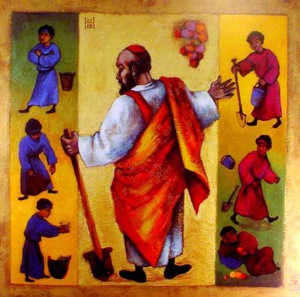 The road to hell is paved with good intentions. This old proverb attributed to St. Bernard of Clairvaux may sound rather morbid and threatening, but the truth remains. If we have only good intentions, marvelous plans, or great designs, but we never lift a finger to begin the first step, nothing will happen. We want to focus on our study, yet we are distracted by Facebook’s status and newsfeeds, our online chatting, or endless videos in YouTube, we will not make any progress. We wish to accomplish a lot of works, but our attentions and energy are consumed by so many other concerns. Then, our wish stays a wish.
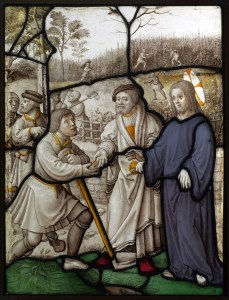 Jesus is the storyteller genius. The parable he shares to us today does not only surprise us with its unexpected ending, but it also creates a sense of puzzlement and wonder. We expect that the workers who labored the whole day would get the better wage compared to those who came late. Yet, it did not happen. All got the same wage regardless of their working hours. The vineyard owner was right to explain that he did not violate the agreement with his laborers, but deep inside us, there is something quite off. If we were militant enough, we would stage a rally to protest the vineyard owner’s decision.
 Why is it difficult to forgive? One of the reasons is that after we are wronged, the immediate reaction is to seek justice or even revenge. We want that the pain and the loss we experienced are also felt by those who inflicted them on us. We want “a tooth for a tooth, an eye for an eye”. Unfortunately, consumed by anger and hatred, our cry for justice can easily turn into an intense desire of revenge. If justice seeks to balance scale, revenge seeks to inflict a greater punishment, or even to destroy those who have harmed us. Unless we get what is due, unless they receive what they deserve, there is no forgiveness.
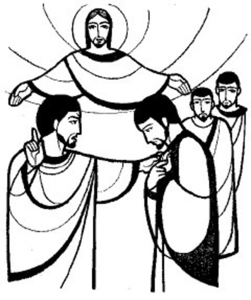 Jesus understands that in any human community, including His own community of disciples, or the Church, there are always members affected by human weakness and sinfulness. Even in the Christ-oriented communities like the religious convents, the parishes, and various ministries and groups in the Church, inevitably we are hurting each other. Thus, Jesus, the Just God and merciful man, outlines a procedure or ‘fraternal correction’ to deal with misunderstanding, quarrels, and conflicts. It begins with the individual and personal encounter, then when it does not work, we ask the help of a witness or mediator, and lastly it goes up to the community level.
 In Medio Ecclesiae