

Nineteenth Sunday in Ordinary Time [August 12, 2018] John 6:41-51
Amen, amen, I say to you, whoever believes has eternal life. I am the bread of life. (Jn 6:47-48)
I am currently having my pastoral clinical education in one of the hospitals in the Metro Manila. Aside from visiting the patients and attending to their spiritual needs, we also have processing sessions guided by our supervisor. During one of the sessions, our supervisor asked me, “Where is the ultimate source of your preaching?” As a member of the Order of Preachers, I was caught off guard. My initial reaction was to say our deeply revered motto, “Contemplare, at contemplata aliis tradere (to contemplate, and to share the fruits of one’s contemplation).” He pressed further and asked what is behind this contemplation. I began scrambling for answers. “Is it study? Community? Or prayer? He said that those were right answers, but there is something more basic. I admitted I am clueless. While he was smiling, he said “It is faith.”
His answer is very simple and yet makes a lot of sense. We pray because we have faith in God. We go to the Church because we have faith in the merciful God who calls us to be His chosen people. As for myself, I entered the Dominican Order because I have faith that generous God invites me to this kind of life. We preach because we trust in the loving God and we want to share this God with others.
I have spent years studying philosophy and theology at one of the top universities in the Philippines, but when I meet the patients with so much pain and problems, I realize that all my achievements, knowledge and pride are coming to naught. How am I going to help patients having troubles to settle hospital bills with astronomical amount? How am I going to help persons in their dying moments? How am I going to help patients who are angry with God or disappointed with their lives? However, as a chaplain, I need to be there for them, and the best preaching is in fact, the most basic one. It is not preaching in the forms of theological discourse, philosophical discussion, and a long sermon or advice. To preach here is to sharing my faith and to receive their faith. I am there to be with them, to listen to their stories and struggles, to share a little humor and laughter, and to pray together with them. To pray for them is the rare moments that I pray with all my faith because I know that only my faith I can offer to them.
In our Gospel today, we read that some Jews are murmuring because they have no faith in Jesus. Yet, Jesus does not only call them to simply trust in Him, but also to literally eat Him because He is the Bread of Life. The faith in the Eucharist is indeed a tipping point. It is either the craziest of the crazy or the greatest faith that can move even a mountain. As Christians who believe in the Eucharist and receive Jesus in every Mass, we are tremendously privilege and challenged to have and express this faith. However, when we fail to appreciate this meaning and beauty of this faith, and only receive the Bread of Life in a routinely and mechanical fashion, we may lose altogether this faith.
As people who go to Church every Sunday and receive the Eucharist on a regular basis, do we truly believe in Jesus the Bread of Life? Does our faith empower us to see God in the midst of our daily struggles and challenges? Do we have faith that we can share when it matters most?
Br. Valentinus Bayuhadi Ruseno, OP
 Saat ini saya sedang menjalani pelayanan pastoral di salah satu rumah sakit di Metro Manila. Selain mengunjungi pasien dan melayani kebutuhan rohani mereka, kami juga mengikuti sesi pengolahan yang dipandu oleh seorang pengawas. Dalam salah satu sesi, pengawas kami bertanya kepada saya, “Di mana sumber utama pewartaanmu?” Sebagai anggota Ordo Pengkhotbah, saya terperangah. Reaksi awal saya adalah mengucapkan motto kami, “Contemplare, di contemplata aliis tradere (untuk berkontemplasi dan membagikan buah dari kontemplasi).”
 To say “Amen” is something usually we do in prayer. Commonly it is used to end a prayer. Our biblical prayers like Our Father and Hail Mary are usually concluded by amen. In several occasions, amen is mentioned more often. One of my duties as a hospital chaplain is to lead a prayer of healing for the sick. I always ask the family and friends who accompany the patients to pray together. Sometimes, they will say amen at the end of the prayer. However, some others will utter several amens within the prayer, and in fact, some people will say more amens than my prayer! In several occasions, amen is utilized outside the context of prayer. Preachers with a charismatic gift will invite their listeners to say amen. Surely, it is a good technique to keep the listeners awake!
 Mengatakan “Amin” adalah sesuatu yang biasanya kita lakukan dalam doa. Kata ini biasanya digunakan untuk mengakhiri doa. Doa alkitabiah seperti Bapa Kami dan Salam Maria biasanya disimpulkan oleh kata amin. Namun, dalam beberapa kesempatan, amin disebut lebih sering. Salah satu tugas pastoral saya di rumah sakit adalah memimpin doa penyembuhan bagi yang sakit. Saya selalu meminta keluarga dan mereka yang menemani pasien untuk berdoa bersama. Biasanya, mereka akan mengatakan amin di akhir doa. Namun, ada juga beberapa orang akan mengucapkan beberapa amin dalam doa, dan bahkan, ada beberapa orang mengucapkan lebih banyak amin dari pada doa yang saya ucapkan! Dalam beberapa kesempatan, amin digunakan di luar konteks doa. Pengkhotbah karismatik akan mengajak pendengar mereka untuk mengatakan amin sebagai bentuk penegasan. Tentunya, ini adalah juga teknik yang bagus untuk membuat pendengar tidak tertidur!
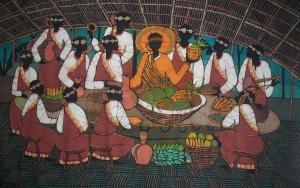
 Unlike the other Gospels, the Gospel of John does not have the story of the Institution of the Eucharist on the Last Supper. However, it does not mean John the evangelist does not write anything about the Eucharist. In fact, John includes the most sublime discourse on the bread of life in his chapter 6. The chapter itself is relatively long, and the Church has distributed it into several Sunday Gospel readings (from today up to August 26). This discourse on the Bread of Life begins with the lovely story of Jesus feeding the multitude.
 Tidak seperti Injil lainnya, Injil Yohanes tidak memiliki kisah tentang penetapan Ekaristi dalam Perjamuan Terakhir. Namun, ini tidak berarti Yohanes penginjil tidak menulis apa pun tentang Ekaristi. Nyatanya, Yohanes menulis tulisan yang paling luhur tentang roti hidup dalam bab 6 Injilnya. Bab itu sendiri relatif panjang, dan Gereja telah distribusikannya ke beberapa bacaan Injil hari Minggu (dari hari ini hingga 26 Agustus). Penjelasan tentang Roti Hidup ini dimulai dengan kisah Yesus yang memberi makan banyak orang.
 We often take for granted that we are created as a bodily creature. Our body is integral to our humanity and created by God as something good; we receive our body as a gift. We freely receive our body from our parents, and our parents from their parents and this goes on till we discover God as the source of this gift. Because our body is a gift from God, we are called to honor our body as we honor the Giver of the gift Himself.
 Tubuh kita adalah bagian integral dari kemanusiaan kita dan diciptakan oleh Tuhan sebagai sesuatu yang baik. Tubuh kita adalah sebuah karunia. Dengan cuma-cuma, kita menerima tubuh kita dari orang tua kita, dan orang tua kita dari orang tua mereka dan ini berlangsung terus sampai kita menemukan Tuhan sebagai sumber dari karunia ini. Karena tubuh kita adalah karunia dari Tuhan, kita dipanggil untuk menghormati tubuh kita sebagaimana kita menghormati Sang pemberi karunia.
 In Medio Ecclesiae