

Easter Sunday [B]
April 4, 2021
John 20:1-9

Jesus has risen! Alleluia! He is indeed alive, and we have reason to celebrate and rejoice exultantly. From Palm Sunday till Good Friday, we have witnessed the most excellent drama at the center of our faith. Jesus was received as a king by his people, who would eventually condemn Him. He gave up His body and blood to His disciples and brothers, who ultimately sold, betrayed, denied, and abandoned Him. He was innocent, yet He was condemned as a criminal and suffer horrible death on the cross. He is God, but He was buried just like any man. Yet, these dreadful things are not the end of the story. There is a marvelous twist! He rose from the dead and conquered death—his love triumphs over hatred and sin.
The good news is that Jesus’ story is real. His story is radically different from the box-office-hit movies like the Marvel series. The Avengers may dramatically defeat Thanos and resurrected the missing half of humanity, but they remain the great work of fiction. Jesus is real, as even more real than all of us. And because He has risen, our faith in Him is not in vain. We are saved, and we are redeemed. This is the unshakable foundation of our joy! Blaise Paschal, a Catholic French Philosopher, once commented, “Nobody is as happy as a real Christian.”
Yet, what does it mean to be joyful in our world now? Many of us are still struggling with pandemic covid-19, and we are not sure when this will end. Some of us are losing our beloved ones, and others must face an uncertain future due to economic meltdown. We are becoming more unsure of our lives. What should be joyful? We need to see that joy of redeemed people is not simply fleeting good feelings or outbursts of emotions. If we know this kind of sensation in the Church, we may get disappointed.
To have faith in Jesus means we believe that our lives will eventually make sense in Jesus. Thus, our joy is coming from following Jesus, participating in His drama of love and redemption, including in His cross and death. Jesus’ suffering is not the suffering of a helpless victim but a courageously loving man. Jesus’s death is not the death of a sore loser but a total sacrifice of the lover. Jesus loves us to the fullness, and absolute love demands death. In Christ, our suffering is not a sign of our weakness but our radical love. Our joy is following from the truth that we discover that in Christ, we are created beyond ourselves, but for the infinite love, for God Himself.
In this time of crisis, we may endure more uncertainties, but we may have this moment to die to our illusion that wealth, position, and power can save us. In this time of trials, we may face more hardship, but we can turn this opportunity to love deeply and even to offer ourselves in Christ.
On March 27, 1996, seven Trappist monks were kidnapped from the monastery of Tribhirine, Algeria, by the extremist group. All eventually murdered. They had been warned to leave the monastery as Algeria’s situation worsened, but they refused to go because they wanted to be with the people they served. Brother Christian, the leader, wrote in a letter, “I am certain that God loves the Algerians and that He has chosen to prove it by giving them our lives. So then, do we truly love them? Do we love them enough? This is a moment of truth for each one of us and a heavy responsibility in these times when our friends feel so little loved.”
Happy and Blessed Easter to all of you!
Valentinus Bayuhadi Ruseno, OP

 We are entering a joyful season of Advent. The first Sunday of Advent is also the beginning of the liturgical year of the Catholic Church. Advent is from the Latin word “adventus” meaning “the coming.” From this name alone, we can already deduce the purposes of this lovely season. It is to prepare us for the coming of Jesus, yet we must not forget that the Church teaches us that there are two comings. The first coming is two thousand years ago in Bethlehem, as a baby at Mary’s hands. The second coming is Jesus’ arrival at the end of time as the glorious king and the judge.
 Kita memasuki masa Adven. Minggu pertama Adven juga merupakan awal tahun liturgi Gereja Katolik. Adven sendiri berasal dari kata Latin “adventus” yang berarti “kedatangan”. Dari nama ini saja kita sudah bisa menyimpulkan tujuan dari masa liturgi yang satu ini. Masa Adven mempersiapkan kita bagi kedatangan Yesus, namun kita tidak boleh lupa bahwa Gereja mengajarkan kita bahwa ada dua kedatangan Yesus. Kedatangan pertama terjadi dua ribu tahun yang lalu di Bethlehem, sebagai bayi kecil di tangan Maria. Kedatangan kedua adalah kedatangan Yesus di akhir zaman sebagai raja dan hakim yang mulia.
 Dalam menyembuhkan orang buta, Yesus melakukan sesuatu yang agak tidak biasa: Ia meludah ke tanah, membuat tanah liat dengan air liurnya, dan mengolesi tanah liat itu di mata orang buta tersebut. Saat ini kita sedang melawan Covid-19, jenis virus korona yang menyebar dengan cepat, kita dididik bahwa salah satu media kontaminasi adalah tetesan manusia seperti air yang keluar dari mulut kita. Ketika air yang sudah terkontaminasi dengan virus bersentuhan dengan mulut, hidung dan mata, itu menjadi titik awal berjangkitnya si virus di tubuh kita.
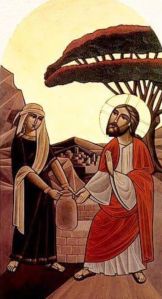 Kita melihat Yesus sebagai beberapa figur. Beberapa orang menganggap Dia sebagai guru, beberapa memanggilnya sebagai sahabat, dan beberapa yang lain hanya akan menyatakan Dia sebagai Tuhan dan Juru Selamat. Namun, sedikit yang kita ketahui bahwa Injil memperkenalkan Dia sebagai mempelai laki-laki.
 Chapter 15 of the Gospel of Luke contains three of the most heartwarming as well as powerful parables in the entire Bible. These three parables are known as the parable of the lost sheep, the parable of the lost coin, and the parable of the prodigal son. If we look closer into these three parables, what is so stunning and astonishing is how Jesus bends, twists and stretches human logic and natural tendency to nail His point.
 Bab 15 dari Injil Lukas berisi tiga perumpamaan yang paling mengharukan dan indah di seluruh Alkitab. Tiga perumpamaan ini dikenal sebagai perumpamaan tentang domba yang hilang, perumpamaan tentang koin yang hilang, dan juga perumpamaan tentang anak yang hilang. Jika kita melihat lebih dekat ke dalam ketiga perumpamaan ini, apa yang begitu menakjubkan dan mencengangkan adalah bagaimana Yesus membengkokkan, memutar dan merentangkan logika manusia dan budaya Israel untuk menyampaikan poin terdalam-Nya.
 One time, during a Bible class I facilitated, one of the participants asked me, “how was Peter able to recognize that it was Moses who stood beside Jesus during the Transfiguration?” It was a valid question, and yet I personally never thought of it. I thought of with several possible answers. Perhaps, Moses appeared bringing two stone tables of the Law. Perhaps, as Jesus was conversing with Moses and Elijah, Peter was able to pick up the names. Perhaps, the divine inspiration enlightened Peter’s mind on the identity of Moses. Eventually, I have to answer, “When you go to heaven, don’t forget to ask both Peter and Moses.”
 In Medio Ecclesiae