

First Sunday of Advent [B]
December 3, 2023
Mark 13:33-37
We are entering the Advent season, and the new liturgical year of the Church has begun. Advent itself is from the Latin word ‘Adventus,’ and it literally means ‘the coming.’ In light of the Scriptures and Tradition, the Church teaches two arrivals of Christ. His first coming was in Bethlehem around two millennia ago, and the second coming of Jesus will be at the final judgment as the king of kings and the judge of all. This liturgical season reminds and prepares us for both comings of Jesus. However, there is another coming of Christ, also called the third coming of Christ. What does it mean? And, how does the third coming of Christ connect the other two comings?

Before we answer this question, we shall reflect more deeply on the relationship between the first and second coming of Christ because how Jesus came for the first time should give us precious lessons in preparing ourselves for His second coming. How did Jesus come for the first time? He was born of Mary, a humble virgin married to Joseph, a poor carpenter, and neither to the powerful family of Herod nor to the ruling dynasty of Caesar. He was born in the most unworthy place, a dirty cave in Bethlehem, and not in a royal palace or a first-class hospital. He was born as the weakest human being, a baby, and not coming down from the skies like a superhero. The first coming teaches us a precious lesson that Jesus is present in the humblest places, among the simple people, and at the most unexpected moments. As Jesus arrived in Bethlehem most unexpectedly, so also, He will come for the final moment in His second coming.
As many people failed to recognize the first arrival of the Messiah, we might also fail to be ready for this last judgment. Then, how shall we do to anticipate His coming down from the heavens? This truth leads us to “the third coming of Christ.” What is it? The third coming refers to Jesus’ coming and presence among us in our daily lives, albeit in the most unexpected ways. In the Advent season, we prepare ourselves for the second coming of Christ by reflecting on His first coming and, thus, recognizing and welcoming ‘His third coming’ in our lives. The more we can discover Christ in His third coming, the more we are prepared for His final appearance.
Then, what are the manifestations of the third coming of Christ? The first and foremost is the holy Eucharist. Here, Jesus is truly and really present, yet we need great faith to perceive Him, who appears in the forms of bread and wine. He is also present in the words of the Holy Scriptures. The Church firmly believes that the Bible is the Word of God in the written form. By reading and meditating, we encounter Jesus, who speaks to us. St. Paul also teaches us that the Church is the body of Christ. Thus, encountering Christ cannot be done without encountering His body, the Church. However, it is also true that often, it is the most difficult to see Christ in the Church because some members of the Church are far from Christ-like. Yet, this has become an excellent opportunity to perform acts of charity and be Christ-like. Lastly, we encounter Christ in our unfortunate brothers and sisters, as Jesus said, “Amen, I say to you, whatever you did for one of these least brothers of mine, you did for me (Mat 25:40).”
Rome
Valentinus Bayuhadi Ruseno, OP
 During the reign of Herod the Great, the Temple of Jerusalem was refurbished, adorned by gold and other precious metals, and expanded, and thus making it the crown jewel of the Jewish nation. However, the Temple was not merely a magnificent building, but primarily the center of Jewish religious worship and religion. Every morning and evening, sacrifices were offered, and every year, Jewish men from all over the world made their pilgrimage, and paid their homage the Lord God. It was the place where God chose to stay, the place where the Israelites meet their God, and the house of God.
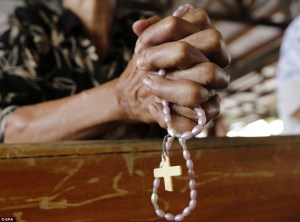 October is the month of the rosary. Allow me to reflect on this ancient yet ever new form of prayer. Why October? It all started when Pope Pius V, a Dominican, dedicated October 7 as the feast of Mary Our Lady of the Rosary after the battle of Lepanto. In this naval battle of October 7, 1571, the smaller Christian army fought the much larger and powerful Ottoman Turks’ forces that planned to invade Europe at the Gulf of Lepanto in Greece. While the battle was being waged, the Holy Pontiff and all Christians prayed the rosary asking the intercession of Our Lady. After hours of confrontation, the enemy’s fleet was roundly defeated.
 Oktober adalah bulan rosario. Izinkan saya untuk menulis tentang doa yang sebenarnya kuno tetapi selalu baru. Mengapa Oktober adalah bulan rosario? Semuanya berawal ketika Paus Pius V, seorang Dominikan, mendedikasikan 7 Oktober sebagai pesta Maria Ratu Rosario setelah pertempuran Lepanto. Pada 7 Oktober, 1571, di Teluk Lepanto di Yunani, tentara Eropa berjuang melawan armada laut Ottoman Turki yang jauh lebih besar dan kuat, yang merencanakan untuk menyerang Eropa. Sementara pertempuran sedang berlangsung, sang Paus dan semua umat berdoa rosario meminta perantaraan Bunda Maria. Setelah berjam-jam konfrontasi, armada musuh pun dikalahkan.
 In Medio Ecclesiae