

Fourth Sunday of Advent [A] – December 21, 2019 – Matthew 1:18-24
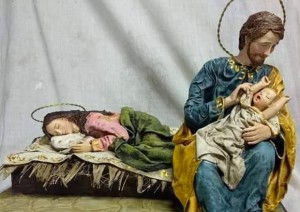 A few days ago, a nativity scene went viral. The image is called “Let Mom Rest”. The prominent character of this scene is that Joseph is taking care of the baby Jesus while Mary is resting. This image presents to us untouched yet powerful aspects of Jesus’ birth and thus, Christmas. Often, we focus our attention on Jesus with Mary, His mother. We honor Mary because of her willingness to carry Jesus on her womb despite so many dangers and difficulties and to remain a faithful disciple of Jesus till the end. However, the image brings us to another important character that we often overlook, St. Joseph, as the man of faith.
If God has chosen and prepared the most fitting woman in human history to become the mother of His Son, the same logic governs also the choice of the foster father of Jesus. The most suitable man is chosen for this massive yet wonderful task.
Unfortunately, we do not know much about Joseph. Matthew only gave us very little information, but from this little knowledge, we can extract some important truths. Firstly, Joseph is from the house of David. This means that any child that he begets or accepts legally shall be part of the house of David as well. Joseph is the link that connects between Jesus and David, and thus, Jesus’ birth shall fulfill the prophecy that the Messiah shall come from the line of David.
Secondly, he is a carpenter, and being a carpenter is not a promising job to survive first-century Palestine. Yet, Joseph well knows that hard-work, precision, and perfection are parts of his trade. A tough life is nothing but a daily routine for Joseph. God knows to raise His Son will require a tremendous amount of sacrifice, and Joseph, the carpenter, is up to the challenge.
To accept and to raise a child who is not his own, is certainly a tough call, but Joseph obeyed the will of God that has been expressed in his dream, “Do not be afraid to take Mary as your wife.” Yet, more than that, Joseph made sure that this mission would be brought to completion. From the image of “Let Mom Rest”, it seems that Mary just gave birth to Jesus and giving birth is certainly a draining and tough process. Mary was exhausted. Joseph takes over the responsibility to care for the baby Jesus, while Mary received her most-needed rest. This is just one small concrete example of who Joseph exercised the God-given mission to raise the Child of God. Certainly, his duty is not only manifested in that event. He protected Mary and her Child from dangers, especially from the threat from Herod the Great who would kill Jesus. For the rest of his life, Joseph would work hard to provide, educate and raise Jesus as a man who is ready to give His life for all.
Like Mary, Joseph did not understand also why he had to be a father who someone else’s child, why he had to put his life and future on the line for a son who is not his own? Yet, like Mary, Joseph had faith and accepted the will of God in his life. Not only simply accepting God’s will, but he also made sure that he gave his best and made God’s plan come to fulfillment.
We often do not understand why God’s plan for us. We do know where God will bring us. Yet, like Mary and Joseph, we are called to be the men and women of faith, to receive God’s plan as our own and bring His will into fruitful completion.
Valentinus Bayuhadi Ruseno, OP
 We are entering the season of Advent. This time marks the beginning of the new liturgical year of the Church. The season itself is a preparation for us to welcome the Christmas, the coming of Jesus Christ. The word Advent is coming from the Latin word “Adventus” that simply means “arrival.” The dominant liturgical color will be purple that signifies hope and joyful expectation of the coming of our Savior.
 Kita memasuki masa Adven. Waktu ini menandai awal tahun liturgi Gereja yang baru. Masa itu sendiri adalah persiapan bagi kita untuk menyambut Natal, kedatangan Yesus Kristus. Kata Adven berasal dari kata Latin “Adventus” yang berarti “kedatangan.” Warna liturgi yang dominan adalah ungu yang menandakan harapan penuh sukacita akan kedatangan Juruselamat kita.
 Salvation is one of the burning topics of discussion in Christian circles. In several discussions I facilitated, I often encountered some participants asked: Who will be saved? By what means are we going to be saved? When will be saved? Do we need to believe in Jesus to be saved? The answers can be as simple as yes or no, but often, the audience with critical minds demand more comprehensive and sensible answers. Yet, I always bring the listeners to see salvation from a different and deeper angle.
 Keselamatan adalah salah satu topik diskusi yang membakar. Dalam beberapa diskusi yang saya fasilitasi, saya sering menemui beberapa peserta yang bertanya: Siapa yang akan diselamatkan? Dengan cara apa kita akan diselamatkan? Kapan akan diselamatkan? Apakah kita perlu percaya kepada Yesus untuk diselamatkan? Jawabannya bisa sesederhana ya atau tidak, tetapi seringkali, peserta dengan pikiran kritis menuntut jawaban yang lebih komprehensif dan masuk akal. Namun, saya selalu membawa pendengar untuk melihat keselamatan dari sudut yang berbeda dan lebih dalam.
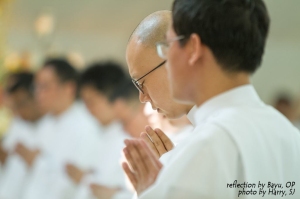
 Pertanyaan ketiga yang diajukan Uskup Agung Socrates Villegas kepada saya saat saya ditahbiskan adalah, “Apakah kamu takut? Sama seperti dua pertanyaan sebelumnya, pertanyaan ini juga berlawanan dengan intuisi dasar. Salah satu ungkapan favorit saya dalam Alkitab adalah “Jangan takut!” Dalam banyak kesempatan dalam Kitab Suci, pernyataan ini tidak hanya menyampaikan dorongan semangat, tetapi juga sebuah misi yang mengubah hidup. Ketika Abram menjadi tua dan tidak memiliki anak, dia ragu dengan janji Tuhan yang menjanjikan keturunan seperti bintang-bintang di langit, Allah berkata, “Jangan takut!” (Kej 15) Akhirnya, Abraham menjadi bapak dari bangsa-bangsa. Ketika Allah memanggil Yeremia untuk bernubuat kepada Yehuda, ia ragu dan beralasan bahwa usianya yang masih muda, tetapi Tuhan berkata, “Jangan takut!” (Yer 1:8) Lalu, Yeremia menjadi salah satu nabi terbesar Israel. Ketika Yusuf merasa dikhianati saat dia mengetahui Maria mengandung diluar nikah, namun dalam belas kasihannya, ia berencana untuk menceraikan Maria secara rahasia, malaikat pun berkata kepadanya, “Yusuf, anak Daud, jangan takut untuk mengambil Maria sebagai istrimu.” (Mat 1:20) Kemudian, Yusuf menjadi ayah angkat Putra Allah. Ketika Maria menerima Kabar Baik dari malaikat Gabriel, dia tidak mengerti apa yang sedang terjadi, Gabriel pun berkata kepadanya, “Jangan takut, Maria sebab engkau beroleh kasih karunia di hadapan Allah.” (Luk. 1:30) Lalu, dia menjadi Bunda Allah.
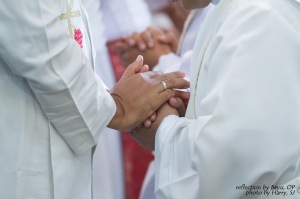 While I was reflecting on this Sunday’s Gospel, I was able to discover some news about our Church. Good News! The Catholic Church in the Philippines is preparing herself for the 500 years of the arrival of Christianity in this archipelago. The first baptism and Eucharist were taking place in 1521 as the Spanish missionaries began their evangelization mission. As part of this grand preparation, the Bishops of the Philippines have decided to celebrate this year as the year of the clergy and the consecrated persons. The major theme of this year is the renewed servant-leaders for the new evangelization. In view of this, many programs and activities are organized to help both the ordained ministers and the religious brothers and sisters to deepen their commitment to God and their service to the people.
 Ketika saya merenungkan Injil hari Minggu ini, saya membaca beberapa berita tentang Gereja. Ada Kabar baik. Gereja Katolik di Filipina mempersiapkan diri untuk perayaan 500 tahun kedatangan iman Kristiani di negara ini. Baptisan dan Ekaristi pertama terjadi pada tahun 1521 sewaktu para misionaris Spanyol memulai misi evangelisasi mereka. Sebagai bagian dari persiapan besar ini, para Uskup Filipina memutuskan untuk merayakan tahun ini sebagai tahun para klerus [daikon, imam, dan uskup] dan rohaniwan. Dengan demikian, banyak program dan kegiatan diselenggarakan di berbagai keuskupan di Filipina untuk membantu para klerus dan biarawan untuk memperdalam komitmen mereka pada Allah dan pelayanan mereka kepada umat dan bangsa.
 “In this world nothing can be said to be certain, except death and taxes.” Benjamin Franklin once said. Indeed, tax is an unpleasant and unavoidable fact in our lives as ordinary citizen. A portion of our hard-earned wage is suddenly taken away from us, and only God knows where it goes. In modern society, almost all we have, we gain, and we use are taxed. The practice of taxing people goes back to first known organized human societies. The basic idea is that tax will provide a common resource for the improvement of the community, like building roads, free education and quality health care. Yet, the ideal is often met with abuses. In olden time, the kings and chieftains taxed people so they could build their grand palaces and feed their wives. Unfortunately, the situation does not change much in our time.
 In Medio Ecclesiae