

Palm Sunday of the Lord’s Passion (A)
March 29, 2026
Matthew 21:1-11 and Matthew 26:14 – 27:66
Palm Sunday is a unique moment in the Catholic liturgy where we hear two readings from the Gospel. The first is the story of Jesus’ triumphant entrance into the city of Jerusalem, and the second is the Passion Narrative. Both accounts come from Matthew. We often hear that these two stories are connected by the “crowd.” It is frequently assumed that the people who initially welcome and cheer Jesus as king are the very same people who later shout, “Crucify Him!” Yet, is this true? Or is it just an unrealistic drama to spice up Jesus’ story?
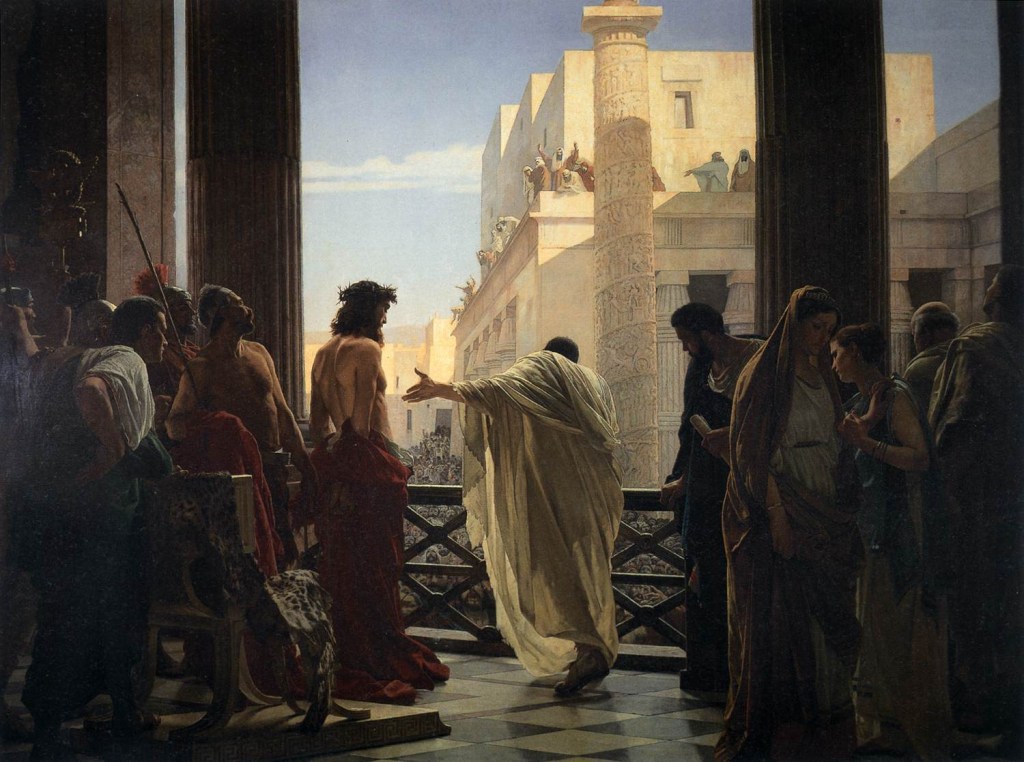
To answer this question, we need to look back at the time of Jesus and understand what was happening in Jerusalem. In first-century Israel, the Jewish people were living under Roman occupation, and life was very difficult for ordinary citizens. The desire for liberation from Roman rule was incredibly strong, drawing inspiration from the Old Testament where God promised a Messiah (the anointed one) to lead them to freedom.
When Jesus appeared, He came as one possessing divine power. He taught the truth with authority and performed unprecedented miracles. Naturally, this raised the excitement of many Israelites, and people started to follow Him, hoping He was the long-awaited Messiah. As Jesus marched toward Jerusalem for His Passion, the Jewish festival of Passover was also approaching. This feast commemorates Israel’s liberation from Egypt (Exodus 12), and during this time, Jews from all over traveled to Jerusalem on pilgrimage.
We can imagine that as Jesus drew closer, more and more pilgrims recognized Him and joined His followers. The people’s expectations were further fueled by Jesus’ unmatched miracle of restoring sight to two blind men in Jericho, not far from Jerusalem (Matthew 20:29-34). As Jesus entered the city riding a donkey, the throng of people who had been following Him began to shout, “Hosanna to the Son of David.”
So, were the people who welcomed Jesus the same ones who demanded His death? I believe these were two different groups. Those who supported Jesus were fellow pilgrims, mostly from outside Jerusalem. In contrast, those who demanded Jesus’ execution were likely Jerusalem elites and some locals whose businesses had been disrupted by Jesus and His followers. In fact, the trial was conducted hastily in the early morning, suggesting it was well-orchestrated. Matthew also notes that the chief priests and elders persuaded the crowd to ask for Barabbas’s release (Matthew 27:20), indicating that this specific crowd was manipulated to follow the Jewish leaders’ plan.
However, despite the existence of two distinct groups, the possibility of individuals switching sides remains. Some of those who initially supported Jesus may have eventually caved and condemned Him. Yet, some of those who approved of Jesus’ crucifixion may have ultimately returned to His side. A good example is Peter, Jesus’ core disciple, who denied Him when He was arrested but returned to Him after the resurrection.
As we enter Holy Week, we follow Jesus in our own lives. When are we like the people who shouted, “Hosanna”? What are those moments when we ardently follow Jesus? When are we like those who shouted, “Crucify Him”? When are the times we fail Him and even rebel against Him? When are we like the weak Peter, running from God or hiding? And when are we like the renewed Peter? What are those moments when we allow God to restore us again?
Rome
Valentinus Bayuhadi Ruseno, OP
 In Medio Ecclesiae