

Palm Sunday of the Lord’s Passion
April 5, 2020
Matthew 21:1-11 and Matthew 26:14—27:66
 Today, we are celebrating the Palm Sunday of the Lord’s Passion. In many countries, today is a big celebration where people excitedly throng the Church. I remember when I was still studying in the Philippines, the faithful would pack almost all the 11 masses in our Church, Santo Domingo Church. It was a festive celebration as many people were carrying palm branches of a coconut tree.
However, something bizarre takes place this year. The churches in many countries are temporarily closed, the faithful are asked to avoid gathering, including the Holy Eucharist, and people are confused about what to do with the Celebration of the Holy Week. A parishioner once painfully asked me, “Father, since the Church is closed, what shall I do with the palm branches I have?” Surely, there is always a pastoral solution to any problem that the faithful have. Yet, the real issue is not so much about how to clear up the confusion, but how to deal with the deep pain of losing what makes us Catholics. No palm in our hands, no kissing of the crucifix, and no Body of Christ.
Reflecting on our Gospels’ today, we are somehow like the people of Jerusalem who welcomed Jesus and shouted, “Hosanna!” The Hebrew word “Hosanna” literally means “save us!” or “give us salvation!” It is a cry of hop `e and expectation. We need to remember that the people of Israel during this time was were under the Roman Empire’s occupations. Commonly, lives were hard and many people endured heavy taxation under severe punishment. Many faithful Jews were anticipating the promised Messiah, who like David, would restore the lost twelve tribes of Israel, deliver them from the grip of the Romans and bring them into a glorious kingdom. They saw Jesus as a charismatic preacher, miraculous healer, and nature conqueror, and surely, Jesus could be the king that would turn the Roman legions upside down. We need to remember also the context of the Gospel that in few days, the Jewish people would celebrate the great feast of Passover, and thousands of people were gathered in Jerusalem. With so much energy and euphoria, a small incident could ignite a full-scale rebellion. And Jesus was at the center of this whirlpool.
Jesus is indeed a king and savior, but He is not the kind of king that many people would expect. He is a peaceful king, rather than a warmonger, that is why He chose a gentle ass rather than a strong horse. His crown is not shining gold and diamond, but piercing thorns. His robe is not purple and fine-linen, but skin full of scars. His throne is neither majestic nor desirable, but a cross.
We may be like people of Jerusalem, and we shout “Hosanna!” to Jesus, expecting Him to save us from this terrible pandemic, to bring our liturgical celebrations back, and to solve all our problems. However, like people of Jerusalem, we may get it wrong. Jesus is our Savior, but He may save us in the way that we do not even like.
The challenge is whether we lose patience and dismiss Jesus as a preacher of fake news, rather than good news, or endure the humiliation with Him; whether we get discouraged and begin to shout, “Crucify Him!” or we stand by His cross. The challenge is whether we get bitter and start mocking the church authorities for their incompetence handling the crisis or we continue to support them in time of trial; whether we are cursing the grim situations or we begin to spread the light however small it is.
Why does God allow us to endure this terrible experience, or to be more precise, why does God allow Himself to endure this terrible experience? Let us wait at the Good Friday.
Valentinus Bayuhadi Ruseno, OP
 Hari ini, kita merayakan Minggu Palma. Di banyak negara, hari ini adalah perayaan besar dan umat dengan penuh semangat memenuhi Gereja. Saya ingat waktu masih kecil saya selalu paling semangat ikut perarakan romo yang memasuki Gereja dan kami mengikutinya dengan membawa daun palma kami masing-masing.
 Among the five human senses, the sense of touch is the most basic and foundation to other senses. The sense of sight needs to be in touch with the light spectrum. The sense of taste requires to be in contact with the chemical in the food. The sense of hearing must receive air vibration or sound waves. This sense makes us a human being, a bodily being. No wonder that many traumatic experiences [even mental problems] are rooted in the lack (or excess) of touch.
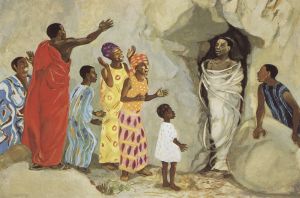 Di antara lima indra manusia, indra peraba [sentuhan] adalah yang paling dasar dan fondasi bagi indra yang lainnya. Indra penglihatan perlu bersentuhan dengan spektrum cahaya. Indra perasa perlu bersentuhan dengan bahan kimia dalam makanan. Indra pendengaran harus menerima getaran suara di udara. Sentuhan menjadikan kita manusia, makhluk yang bertubuh. Tidak mengheran jika banyak pengalaman traumatis [bahkan masalah mental] berakar pada sentuhan yang kurang diterima atau tidak seharusnya diterima.
 Kita melihat Yesus sebagai beberapa figur. Beberapa orang menganggap Dia sebagai guru, beberapa memanggilnya sebagai sahabat, dan beberapa yang lain hanya akan menyatakan Dia sebagai Tuhan dan Juru Selamat. Namun, sedikit yang kita ketahui bahwa Injil memperkenalkan Dia sebagai mempelai laki-laki.
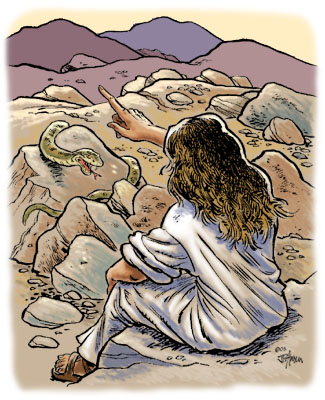 Hari Minggu Prapaskah pertama dimulai dengan kisah Yesus di padang gurun, berpuasa dan dicobai oleh iblis. Matius memberi kita lebih banyak perincian dalam kisah pencobaan, dan dari Matius, kita menemukan tiga pencobaan Kristus. Mengapa Setan menggoda Yesus? Kenapa tiga godaan?
 Reading carefully, we may wonder, “Is it possible if the salt loses it, saltiness?” In everyday experience, we never experience tasteless salt. However, when we go back to the time of Jesus, we will be surprised that a salt losing its taste is a daily reality. In ancient Israel, the people would go to the Dead Sea, the saltiest body of water on earth, and gathered the “pillar of salt” formed surrounding the lake. Then, they would put inside a small bag, like a teabag”, and when it was needed for seasoning, the bag would be dipped into the water or soup. After some repeated use, the salt would lose its saltiness due to the chemical impurities. It turned to be nothing but an ordinary pebble, and shall be thrown away and trampled underfoot.
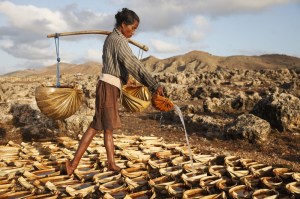 Membaca dengan teliti, kita mungkin bertanya-tanya, “Apakah mungkin jika garam kehilangan rasa asinnya?” Dalam pengalaman sehari-hari, kita tidak pernah menemukan garam yang hambar. Namun, ketika kita kembali ke zaman Yesus, kita akan terkejut bahwa garam yang kehilangan rasanya adalah kenyataan sehari-hari. Di Israel kuno, orang-orang akan pergi ke Laut Mati, laut yang memiliki kadar garam paling tinggi di bumi, dan mengambil bongkahan-bongkahan garam yang terbentuk di sekitar danau. Kemudian, mereka akan dimasukkan ke dalam kantong kecil, seperti kantong teh, dan ketika dibutuhkan untuk bumbu, kantong itu akan dicelupkan ke dalam air atau sup. Setelah digunakan berulang-ulang, garam akan kehilangan rasa asinnya karena kandungan kimia yang tidak sempurna. Bongkahan garam pun berubah menjadi batu biasa, dan akan dibuang dan diinjak-injak.
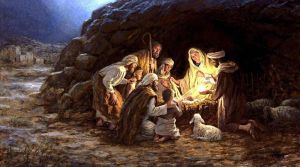 Today is Christmas, the day of Jesus was born in Bethlehem, and it is a traditional practice that in every Church or Christian family, there is a nativity scene. Usually, the baby Jesus was born in a kind of stable or shed, and He was placed on the wooden manger (a place where animals eat). Surely, Mary and Joseph are intently watching on the Baby, while other animals like sheep and cows become the silent witnesses of this most beautiful moment in human history. The scene will not be complete without the shepherds and the angel.
 In Medio Ecclesiae