

Sixth Sunday in Ordinary Time [February 17, 2019] Luke 6:17.20-26
“But woe to you who are rich, for you have received your consolation. (Lk. 6:24)”
 We listen today the Beatitude, but unlike the famous Beatitude from the Gospel of Matthew, we have today from the Gospel of Luke. Unlike from Matthew who has eight sayings of blessedness, Luke has four blessedness and for four “woes”. The most striking difference is while Matthew seems to emphasize “the poor in spirit”, Luke wants us to understand poverty in a more literal sense.
We want to have a happy life, and we do not like to have a difficult and poor life. It is just basic in our human nature. If we study diligently, we expect that we have a good result in our education. If we work hard and labor honestly every day, we wish that we will be rewarded with success. If we live our lives with passion and dedication, we look forward to acquire a fulfilling life.
However, in today’s Gospel, we listen that Jesus is telling us that the blessed one are the poor, the hungry, the weeping, and the persecuted, and for those who are rich, filled, and laughing, “woe” is their lot. Is Jesus pro-poor and anti-rich? Does Jesus want us to suffer, famish, and become malnourished? Does Jesus like that we are justly rewarded for our hard work and labor? Is Jesus hyper melancholic man, who sulk in sadness, and does not know how to enjoy life?
These are tough yet valid questions, and to answer these, we need to go back to the time of Jesus and discover the context behind the saying of Jesus. In the first century A.D. Palestine, the majority of the people, including Jesus Himself, were poor, hungry and oppressed. They were poor not because they were lazy but because they were living under a terrible time to live. Palestine was colonized by the Romans, and it was a common practice to levy a heavy tax on ordinary Israelites. Only some nobilities, few landowners, a handful of rich businessmen and Israelites who were working for the Romans, like the tax collectors, were enjoying a better life. Ordinary Israelites did not only have to face the Romans, but they had to suffer from the abuses from their fellow yet greedy and opportunistic Israelites who wished nothing but enrich themselves. It was a terrible time to live.
The message of Beatitude was more making sense now. Jesus promises hope and consolation for those who are poor and suffering due to injustice, and He woes those who are rich through dishonest and oppressive means. Thus, we know now that by His Beatitudes and Woes, Jesus does not hate all the rich guys, but greed and injustice that poison people’s hearts both the rich and the poor. When we have a good life because of our hard work and honest effort, then we praise the Lord. It is a blessing! Yet, Jesus is also reminding us that in good time, we must not be greedy, but remain humble and even to have concern for our brothers and sisters who are poor, hungry, and weeping because of injustice.
Deacon Valentinus Bayuhadi Ruseno, OP
 Kita mendengarkan hari ini tentang Sabda Bahagia, tetapi tidak seperti Sabda Bahagia yang terkenal dari Injil Matius, kita sekarang mendengarkan dari Injil Lukas. Tidak seperti Matius yang memiliki delapan ucapan berkat, Lukas memiliki empat berkat dan empat “celaka”. Perbedaan yang paling mencolok adalah ketika Matius tampaknya menekankan “orang miskin di hadapan Allah atau miskin dalam roh”, Lukas menekankan kemiskinan dalam arti yang lebih harfiah.
 In Jesus’ time, the scribes are the well-educated Jewish men who are expert in the Law of Moses. Some of them come from the wealthy families, and others hail from the priestly clan. Being able to teach and interpret the Law, they receive the respect and honor from the ancient Jewish society. Thus, ordinary Jews will greet them and prepare them the seats of honor in the synagogues and the banquets. Surely, there is no problem with receiving greetings and sitting as honor guests. Jesus Himself is often greeted as “Teacher” or “Rabbi”, and He attends the banquets as guest of honor (see Mar 14:3). The problem comes when some of the scribes possesses “narcissistic desire” and intentionally look for these privileges.
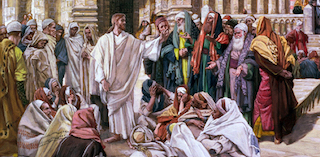 Pada masa Yesus hidup, para ahli Taurat adalah orang Yahudi terdidik dan menjadi ahli dalam Hukum Musa. Beberapa dari mereka berasal dari keluarga kaya, dan yang lain dibesarkan dari klan imam. Mampu mengajar dan menafsirkan Hukum, mereka menerima respek dan kehormatan dari masyarakat Yahudi. Dengan demikian, orang-orang Yahudi kebanyakan akan menyapa dengan hormat para ahli Taurat ini dan mempersiapkan bagi mereka kursi kehormatan di sinagoga dan perjamuan. Tentunya, tidak ada masalah dengan menerima salam dan duduk sebagai tamu kehormatan. Yesus sendiri sering disambut sebagai “Guru” atau “Rabi”, dan Dia menghadiri perjamuan sebagai tamu kehormatan (lihat Mar 14:3). Masalah muncul ketika beberapa ahli Taurat memiliki “hasrat narsistik”, menjadi gila hormat dan dengan sengaja mencari yang kehormatan dan semua hak-hak istimewa.
 We often take for granted that we are created as a bodily creature. Our body is integral to our humanity and created by God as something good; we receive our body as a gift. We freely receive our body from our parents, and our parents from their parents and this goes on till we discover God as the source of this gift. Because our body is a gift from God, we are called to honor our body as we honor the Giver of the gift Himself.
 Tubuh kita adalah bagian integral dari kemanusiaan kita dan diciptakan oleh Tuhan sebagai sesuatu yang baik. Tubuh kita adalah sebuah karunia. Dengan cuma-cuma, kita menerima tubuh kita dari orang tua kita, dan orang tua kita dari orang tua mereka dan ini berlangsung terus sampai kita menemukan Tuhan sebagai sumber dari karunia ini. Karena tubuh kita adalah karunia dari Tuhan, kita dipanggil untuk menghormati tubuh kita sebagaimana kita menghormati Sang pemberi karunia.

 Today, we read the beginning of the Gospel according to Mark. Among the evangelists, only Mark explicitly introduces his work as the “Gospel”. The English word “Gospel” simply means the Good News, or in original Greek, “Evangelion.” Commonly, we understand a gospel as a written account of the life and words of Jesus Christ. The Church has recognized four accounts as canonical or true Gospel. We have Gospel according to Matthew, Mark, Luke, and John.
 Hari ini, kita membaca permulaan dari Injil menurut Markus. Di antara para penginjil, hanya Markus yang secara eksplisit memperkenalkan karyanya sebagai “Injil”. Kata “Injil” berarti “Kabar Baik”, atau dalam bahasa Yunani, “Evangelion”. Biasanya, kita memahami sebuah Injil sebagai karya tertulis tentang hidup dan sabda Yesus Kristus. Gereja telah menetapkan empat karya sebagai Injil kanonik. Kita memiliki Injil menurut Matius, Markus, Lukas dan Yohanes.
 In Medio Ecclesiae