


(Easter special)
Easter Sunday. April 16, 2017 [John 20:1-10]
“On the first day of the week, Mary of Magdala came to the tomb early in the morning, while it was still dark, and saw the stone removed from the tomb (Joh 20:1).”
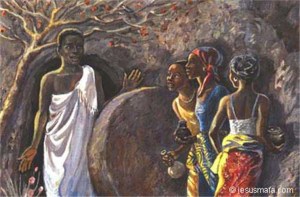 If we read the Resurrection narrative in the four Gospels, we will discover that each Evangelist has his own distinct story. Yet, there are some common features in the Resurrection episode: the empty tomb, the presence of women, the appearance of angel followed by the risen Christ, and the women announcing the Good News to the other disciples. Let us focus on one particular feature that we usually miss. The first witnesses of the resurrection were not men, but women. Where were the male disciples? Where were those men who promised to sacrifice their lives for Jesus? They were in hiding. They were afraid. They were scattered.
When Jesus was betrayed and arrested, the male disciples ran for their lives, but the women faithfully followed Jesus. They were there at the foot of the cross. They witnessed Jesus’ death. They brought Him to the tomb. They returned to the tomb to give him proper burial rites at the first day of the week. Because of their fidelity, they were honored to be the first witnesses of the Resurrection. Not only witnesses, they were the first preachers of Resurrection.
This particular feature is an essential part of the Dominican spirituality. One of the patrons of the Order of Preachers is St. Mary Magdalene, and she was chosen because we honor her as the apostle to the apostles, the preacher to the preachers. By making her our patroness, we acknowledge that the task of preaching is not exclusively limited to the members of the clergy, but to lay men and women as well. The first convent St. Dominic established was in Prouille, France, and this was a convent for religious women. For us, Preaching is a family effort, all brothers and sisters take part and contribute in the mission of naming grace.
While it remains true that only the Dominican priests can give the homily in the Mass, it does not mean that non-clerical brothers and sister can not preach. We, the brothers in formation in Manila, are involved in facilitating retreats and recollections, producing video catechesis in the social media, and are coming up with the “Joyful Friars”, a preaching band group. Our sisters are involved in the teaching ministry. Some of them, like Mary Catherine Hilkert and Helen Alford are in fact professors in great universities in the US and Europe. Our lay Dominicans serve as lay preachers or campus ministers. Yet most importantly, they preach to their children and educate them to be mature and committed Christians.
Further more, for the Dominicans, preaching is not limited to verbal communication, but also takes flesh in various forms, depending on the needs of the people. Fr. Mike Deeb, OP is currently a permanent delegate of the Order to the United States in Geneva. He challenges countries that neglect various issues of injustice like human trafficking, violence, human rights abuses, and many more. James MacMillan is a lay Dominican and a renowned composer from Scotland. He composed mass songs when Benedict XVI visited the UK in 2010. Sr. Katarina Pajchel, OP is both a religious sister and a physicist. She is involved in ATLAS project, a particle physics experiment at the Large Hadron Collider. These names are just few of many Dominicans who preach in their own right.
At the core of Dominican spirituality is the belief that each of us is called to witness to His Resurrection and to bring this Good News. Even better the news is that this spirituality is not only for the Dominicans. Every man and woman, clergy or lay, a Dominican or not, are called to this mission. We are to preach the Resurrection in our unique way. We are called to preach as a redeemed people, a family of God.
Blessed Easter!
Br. Valentinus Bayuhadi Ruseno, OP

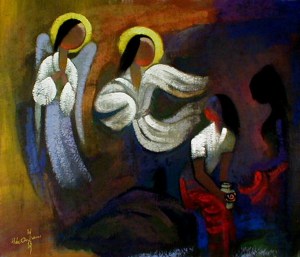 Jika kita membaca narasi Kebangkitan di keempat Injil, kita akan menemukan bahwa setiap Penginjil memiliki cerita unik tersendiri. Namun, walaupun berbeda, ada beberapa hal-hal serupa di dalam narasi Kebangkitan, seperti kubur yang kosong, kehadiran para wanita, hadirnya malaikat diikuti oleh Yesus yang bangkit, dan para wanita mewartakan Kabar Baik bagi murid-murid lainnya. Mari kita fokus pada satu fitur yang biasanya luput dari perhatian kita. Saksi pertama dari kebangkitan bukanlah seorang laki-laki, tapi para perempuan. Pertanyaanya sekarang: Di mana para murid laki-laki? Di mana para pria yang berjanji untuk mengorbankan nyawa mereka demi Yesus? Jawabannya: Mereka bersembunyi, lari dan ketakutan.
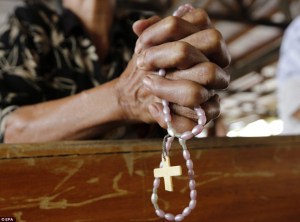 October is the month of the rosary. Allow me to reflect on this ancient yet ever new form of prayer. Why October? It all started when Pope Pius V, a Dominican, dedicated October 7 as the feast of Mary Our Lady of the Rosary after the battle of Lepanto. In this naval battle of October 7, 1571, the smaller Christian army fought the much larger and powerful Ottoman Turks’ forces that planned to invade Europe at the Gulf of Lepanto in Greece. While the battle was being waged, the Holy Pontiff and all Christians prayed the rosary asking the intercession of Our Lady. After hours of confrontation, the enemy’s fleet was roundly defeated.
 Oktober adalah bulan rosario. Izinkan saya untuk menulis tentang doa yang sebenarnya kuno tetapi selalu baru. Mengapa Oktober adalah bulan rosario? Semuanya berawal ketika Paus Pius V, seorang Dominikan, mendedikasikan 7 Oktober sebagai pesta Maria Ratu Rosario setelah pertempuran Lepanto. Pada 7 Oktober, 1571, di Teluk Lepanto di Yunani, tentara Eropa berjuang melawan armada laut Ottoman Turki yang jauh lebih besar dan kuat, yang merencanakan untuk menyerang Eropa. Sementara pertempuran sedang berlangsung, sang Paus dan semua umat berdoa rosario meminta perantaraan Bunda Maria. Setelah berjam-jam konfrontasi, armada musuh pun dikalahkan.
 In Medio Ecclesiae