
Know Who and How to Love

15th Sunday in Ordinary Time [C]

July 13, 2025

Luke 10:25-37

If we found ourselves in the same situation as the parable Jesus told, who would we become? Would we act like the priest and the Levites—ignoring and avoiding the wounded man altogether? Or would we, like the Samaritan, show mercy and help the one in need? Or would we do something entirely different?

In today’s digital age, equipped with high-tech gadgets, we might even do the unthinkable and unimaginable especially in Jesus’ time. Instead of helping, we might pull out our smartphones to record the scene, take a selfie with the victim, or even livestream the incident! As absurd as it sounds, this is not entirely far-fetched.

We are living two millennia after the Good Samaritan, and modern life has made it even harder to do good and help those in need. Before assisting someone injured on the street, we face countless doubts and uncertainties: Is this person truly hurt, or is it a scam? Could I get in trouble for helping? Do I even have time, with work and other responsibilities? The complexities of modern living often paralyze us, making it difficult to love our neighbors, especially those who need it most. So how should we respond?

1. Love for Others Is Love for God

We need to remember that loving our neighbors must be an expression of our love for God. We are called to love God wholeheartedly in all that we do. This means that working hard to provide for our families is an act of love for God, because God entrusted them to our care. Raising our children in wisdom and faith is an expression of devotion to Him because they are gifts from God. Even taking care of our bodies, through good food and habits, honors God, as our bodies are His blessing to us.

2. Know Your Priorities in Love

We are not superheroes; we can’t help everyone at once. Our first responsibility is to love those God has placed in our care. As parents, our primary duty is to protect, provide for, and educate our children. If we spend more time serving in church while neglecting our family, something is wrong. Only when we’ve fulfilled our primary responsibilities should we extend love and help to others which comes naturally.

3. Learn How to Love Well

After knowing who we need to love, then we need to know how to love them. Parenting, for example, demands total dedication. Why? God designed children to need more than just food, shelter, and clothing—they require emotional presence, role models, and constant guidance. Many mental health struggles in children today stem from absent parents—whether physically or emotionally—who assume money alone can solve everything.

Being a Good Samaritan starts at home. If we cannot love those closest to us, how can we truly love strangers?

Valentinus Bayuhadi Ruseno, OP

Guide questions:

How do we love ourselves? How do we love our spouse? How do we love our children? How do we love our vocations? How do we see our priority of love?
Our Weak Love and God Strong Love

Third Sunday of Easter [C]

May 4, 2025

John 21:1-19

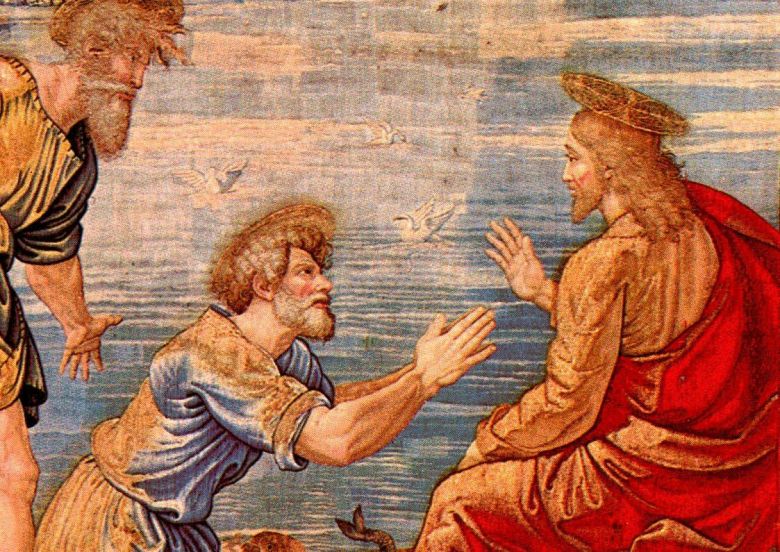
In today’s Gospel, Jesus asks Peter three times, “Do you love me?” Some Church Fathers interpret this repetition as Jesus undoing Peter’s threefold denial. However, a closer look at the Greek text reveals that Jesus uses different words for “love” in each instance. These subtle distinctions deepen our understanding of the passage.

First, Jesus does not simply ask a question, but He makes a demand. In His first request, Jesus calls for a specific kind of love. John the Evangelist uses the Greek word “agape”, which signifies a wilful, sacrificial love, that seeks the genuine good of others. This love is not based on emotions but rather on freedom and commitment. True agape requires giving oneself completely, even to the point of sacrificing one’s life. Here, Jesus demands the highest form of agape from Peter, a love that surpasses all other things.

In His second request, Jesus once again uses “agape”, but this time without the phrase “more than these.” He still calls for sacrificial love, but not to the highest degree. In His third request, Jesus shifts from agape to “philia”, the Greek word for friendship-based love. Unlike agape, which is rooted in free will and dedication, philia depends more on emotions, mutual feelings, and shared interests. While true friendship may require acts of agape, its foundation remains philia. Once common interests fade, friendships often weaken.

But why does Jesus seem to lower His expectations—from total agape to simple agape, and finally to friendship? The answer lies in Peter’s responses. Each time Jesus questions him, Peter replies with “philia”. He cannot bring himself to profess agape, especially not in its highest form. His previous denial has left him broken, ashamed, and hesitant to love Jesus again. Fear holds him back.

Yet, despite Peter’s incomplete answers, Jesus does not rebuke him or seek a more faithful disciple. Instead, Jesus meets Peter where he is. He accepts Peter’s flawed, hesitant love and still entrusts him with the mission of shepherding His flock. Jesus does not require perfection, but He desires humility and sincerity. He sees Peter’s efforts and knows that, in time, Peter will give his life for Him.

God asks each of us for the highest form of love, yet we often fall short. Like Peter, we are wounded, weak, and full of failures. But the Good News is that God accepts our imperfect love and gently leads us toward perfection.

Rome

Valentinus Bayuhadi Ruseno, OP

Reflection Questions:

Do we love God?  Do we love Him with agape or philia?  In what ways do we fail to love God? What keeps us from loving God? How does He continue to love us despite our shortcomings? Can we recall a moment in our life when God’s unwavering love was evident despite our failures? 

Our Worship in the Eucharist

Solemnity of Corpus Christi [B]

June 2, 2024

Mark 14:12-16, 22-26

We are celebrating the solemnity of Corpus Christi, or the Body and Blood of Jesus Christ. Through this feast, the Church reminds us of the infinite value of the Eucharist. St. John Paul II once wrote, “The Eucharist, as Christ’s saving presence in the community of the faithful and its spiritual food, is the most precious possession which the Church can have in her journey through history.” (Ecclesia de Eucharistia, 9). In this reflection, I invite everyone to appreciate this most precious gift; hopefully, we may be more worthy of receiving the Eucharist, and be transformed.

Many of us have been going to the Eucharist for years and even decades. Still, unfortunately, instead of growing in respect and appreciation, some of us are losing true devotion and even becoming disrespectful towards the Eucharist. We skip the Sunday masses without valid reasons. We think it is enough to attend the Mass during Easter and Christmas. We are late to participate in the mass with proper justification. We are busy and distracted with many things in the Eucharist and look for any opportunity to use our gadgets. Some no longer bother to attend the Mass and no longer consider it something meaningful. Some of us still receive the holy Communion in unworthy conditions.

However, these improper things are done not only by the lay people, but also us, the priests. Some offer the Eucharist in inappropriate manners. On one extreme, some treat the Mass just like a performance or theatre; thus, we act excessively, break the rites to entertain the people and seek ovation. On another extreme, some of us are just too lazy to celebrate the Holy Mass; thus, we unjustifiably come late or do not prepare the homily and for the celebration itself. These are abuses, plain and simple. This is grave because these misconducts may cause the sheep to stray away, and the shepherds are responsible for this loss of souls.

Indeed, there are many reasons, but instead of blaming each other, I would like to focus on one thing. We need to recognize and appreciate what the Eucharist is. In most straightforward words, the Eucharist is Jesus Christ Himself. To celebrate worthily, the Eucharist means to offer our due worship to Jesus Christ, the true God. To receive communion is to receive Jesus Himself. The Eucharist is primarily about God, not us and how we get entertained. Therefore, the way we honor (or dishonor) God in the Eucharist will significantly affect our salvation. Indeed, the Eucharist is necessary for our salvation precisely because the Eucharist is about God, who loves us and wants us to be holy like He is holy.

The good news is that we are still on time. We can apply the principle “lex orandi, est lex credendi, est lex vivendi.” (literally, the law of praying is the law of believing, is the law of living). This means how we pray and worship will shape our beliefs, and in turn, our beliefs will form our lives. If we faithfully follow the right ways of worship, with the right intentions and disposition, the right gestures and actions, and with an effort to avoid distractions, we deepen our faith in God. Then, as we have deep faith in God, we will live in ways that will please the Lord.

Rome

Valentinus Bayuhadi Ruseno, OP

God’s Word Prunes Us

5th Sunday of Easter [B]

April 28, 2024

John 15:1-8

Jesus is the vine, and we are His branches. He then declares that unfruitful branches will be cut, and healthy ones shall be ‘pruned.’ In fact, Jesus says, “You are already pruned because of the word that I spoke to you (John 15:3).” What does it mean? How does His word prune us? What is Jesus’ purpose?

If we have the opportunity to visit a vineyard, we will see how the vinedressers work. Among the things that they do is to cut the unhealthy and dead branches and prune the healthy ones. Pruning itself may include removing dead or unhealthy parts of the plant so that the vine may supply its nutrients to healthy branches. But also, the vinedressers would trim and slim down some overgrown branches since these branches typically don’t yield good grapes and suck up nutrients from their neighbour branches. All are done for one purpose: to produce a good quality grape.

Then, how does Jesus’ word prune us, the branches? Firstly, we recognize that we are creatures of language. The language we listen to and learn form who we are. Children who used to hear violent words tend to grow to be violent persons. Children who are fed with discouraging words tend to have low self-esteem. Yet, children who are never told words of proper corrections and discipline may become weak characters who always blame others. Children need to hear both encouraging and loving words as well as words of constructive corrections. Good words will make them grow confident, and proper discipline will make them avoid failures and dangers in the future.

It is the same with the Word of God. Listening to God’s word in the Bible, we discover many affirming words and heart-warming stories. Yet, the same Bible contains words, instructions, and stories that are strong and even demanding. The Gospel has lovely stories like those of Jesus, who blessed children and embraced sinners. Yet, the same Bible narrates Jesus, who said, “repent from our sins and believe in the Gospel.” Jesus, who opens the heavens for all of us, is also the same Jesus who teaches the reality of hell.   

Listening to the holy Scriptures every Sunday in the Eucharist, or even every day in our personal reading, allows God’s word to prune us. If we also do our parts to meditate on the words and internalize them, we are growing in holiness. In times of trials, God’s words strengthen us to hope. When in doubt, God’s words give clarity of faith. When we do wrong, God’s words correct us and invite us to repentance. When in fear, God’s words encourage us to love more and do good works. This is spiritual fruitfulness.

Another exciting thing also is that John used the word ‘καθαίρω’ (kathairo, I clean). This word can mean the act of pruning in the context of a vineyard, but the same word is used to describe Jesus’ act in healing the leper (see Mark 1:40-41). God’s words do not only prune our characters but also directly heal and purify our souls. The Church teaches us that we receive indulgences when we read the Bible for at least 30 minutes in a prayerful way. Have you read God’s words today?

Rome

Valentinus Bayuhadi Ruseno, OP

Easter Joy

Easter Sunday [B]

April 4, 2021

John 20:1-9

photocredit: Larm Rmah

Jesus has risen! Alleluia! He is indeed alive, and we have reason to celebrate and rejoice exultantly. From Palm Sunday till Good Friday, we have witnessed the most excellent drama at the center of our faith. Jesus was received as a king by his people, who would eventually condemn Him. He gave up His body and blood to His disciples and brothers, who ultimately sold, betrayed, denied, and abandoned Him. He was innocent, yet He was condemned as a criminal and suffer horrible death on the cross. He is God, but He was buried just like any man. Yet, these dreadful things are not the end of the story. There is a marvelous twist! He rose from the dead and conquered death—his love triumphs over hatred and sin.

The good news is that Jesus’ story is real. His story is radically different from the box-office-hit movies like the Marvel series. The Avengers may dramatically defeat Thanos and resurrected the missing half of humanity, but they remain the great work of fiction. Jesus is real, as even more real than all of us. And because He has risen, our faith in Him is not in vain. We are saved, and we are redeemed. This is the unshakable foundation of our joy! Blaise Paschal, a Catholic French Philosopher, once commented, “Nobody is as happy as a real Christian.”

Yet, what does it mean to be joyful in our world now? Many of us are still struggling with pandemic covid-19, and we are not sure when this will end. Some of us are losing our beloved ones, and others must face an uncertain future due to economic meltdown. We are becoming more unsure of our lives. What should be joyful? We need to see that joy of redeemed people is not simply fleeting good feelings or outbursts of emotions. If we know this kind of sensation in the Church, we may get disappointed.

To have faith in Jesus means we believe that our lives will eventually make sense in Jesus. Thus, our joy is coming from following Jesus, participating in His drama of love and redemption, including in His cross and death. Jesus’ suffering is not the suffering of a helpless victim but a courageously loving man. Jesus’s death is not the death of a sore loser but a total sacrifice of the lover. Jesus loves us to the fullness, and absolute love demands death. In Christ, our suffering is not a sign of our weakness but our radical love. Our joy is following from the truth that we discover that in Christ, we are created beyond ourselves, but for the infinite love, for God Himself.

In this time of crisis, we may endure more uncertainties, but we may have this moment to die to our illusion that wealth, position, and power can save us. In this time of trials, we may face more hardship, but we can turn this opportunity to love deeply and even to offer ourselves in Christ.

On March 27, 1996, seven Trappist monks were kidnapped from the monastery of Tribhirine, Algeria, by the extremist group. All eventually murdered. They had been warned to leave the monastery as Algeria’s situation worsened, but they refused to go because they wanted to be with the people they served. Brother Christian, the leader, wrote in a letter, “I am certain that God loves the Algerians and that He has chosen to prove it by giving them our lives. So then, do we truly love them? Do we love them enough? This is a moment of truth for each one of us and a heavy responsibility in these times when our friends feel so little loved.”

Happy and Blessed Easter to all of you!

Valentinus Bayuhadi Ruseno, OP

Sukacita Paskah

Minggu Paskah [B]

4 April 2021

Yohanes 20: 1-9

photocredit: Bruno van der Kraan

Yesus telah bangkit! Aleluya! Dia benar-benar hidup dan kita bersukacita. Dari Minggu Palma hingga Jumat Agung, kita telah menjadi saksi drama terbesar di pusat iman kita. Yesus diterima sebagai raja oleh rakyat-Nya yang pada akhirnya akan menghukum Dia. Dia menyerahkan tubuh dan darah-Nya kepada para murid dan saudara-Nya yang akhirnya menjual, mengkhianati, menyangkal, dan meninggalkan-Nya. Dia tidak bersalah, namun Dia dihukum sebagai penjahat dan menderita kematian yang mengerikan di kayu salib. Dia adalah Tuhan, tetapi Dia dikuburkan sama seperti manusia lainnya. Namun, hal-hal mengerikan ini bukanlah akhir dari cerita kita. Ada kejutan yang luar biasa! Dia bangkit dari kematian dan menaklukkan kematian. Kasih-Nya menang atas kebencian dan dosa.

Kabar baiknya adalah kisah Yesus itu nyata. Kisah-Nya sangat berbeda dari film-film box-office seperti film-film Marvel. Avengers mungkin secara dramatis mengalahkan Thanos dan membangkitkan separuh umat manusia yang hilang, tetapi mereka tetap merupakan karya fiksi. Yesus itu nyata, bahkan lebih nyata dari kita semua. Dan karena Dia benar-benar telah bangkit, iman kita kepada-Nya tidak sia-sia. Kita diselamatkan dan kita ditebus. Ini adalah fondasi yang tak tergoyahkan dari sukacita kita! Blaise Paschal, seorang Filsuf Prancis Katolik, pernah berkomentar, “Tidak ada yang sebahagia umat Kristiani sejati.”

Namun, apa artinya bersukacita di dunia kita sekarang? Banyak dari kita masih berjuang dengan pandemi COVID-19 dan kita tidak yakin kapan ini akan berakhir. Beberapa dari kita kehilangan orang yang kita cintai, dan yang lain harus menghadapi masa depan yang tidak pasti karena krisis ekonomi. Kita menjadi lebih tidak yakin dengan hidup kita. Apa bisa kita bersukacita? Kita perlu melihat bahwa sukacita kita bukan hanya perasaan enak yang cepat berlalu atau sebuah luapan emosi. Jika kita hanya mencari sensasi seperti ini di Gereja, kita mungkin kecewa.

Beriman kepada Yesus berarti kita percaya bahwa hidup kita pada akhirnya akan memiliki makna di dalam Yesus. Jadi, sukacita kita datang dari mengikuti Yesus, berpartisipasi dalam drama kasih dan penebusan-Nya, termasuk dalam salib dan kematian-Nya. Penderitaan Yesus bukanlah penderitaan korban yang tidak berdaya, melainkan penderitaan manusia berani. Kematian Yesus bukanlah kematian pecundang, tapi pengorbanan total. Yesus mengasihi kita sepenuhnya, dan kasih total menuntut kematian. Di dalam Kristus, penderitaan kita bukanlah tanda kelemahan kita, tetapi dari kasih radikal kita. Sukacita kita mengalir dari kebenaran yang kita temukan bahwa di dalam Kristus, kita diciptakan melampaui diri kita sendiri, tetapi untuk kasih yang tak terbatas, untuk Tuhan sendiri.

Di masa krisis ini, kita mungkin menanggung lebih banyak ketidakpastian, tetapi kita bisa menjadikan momen ini untuk mati terhadap ilusi kita bahwa kekayaan, posisi, dan kekuasaan dapat menyelamatkan kita. Di masa pencobaan ini, kita mungkin menghadapi lebih banyak kesulitan, tetapi di dalam Kristus, kita dapat mengubah kesempatan ini untuk mengasihi secara mendalam, dan bahkan memberikan diri kita sendiri.

Pada 27 Maret 1996, ada tujuh pertama Trappist diculik dari biara Tribhirine, Aljazair, oleh kelompok ekstremis. Semua akhirnya dibunuh. Beberapa bulan sebelumnya, mereka telah diperingatkan untuk meninggalkan biara karena situasi Aljazair memburuk, tetapi mereka menolak pergi karena mereka ingin tinggal bersama dengan orang yang mereka layani. Brother Christian, pemimpin biara, menulis dalam sebuah surat, “Saya yakin bahwa Tuhan mencintai orang Aljazair dan bahwa Dia telah memilih untuk membuktikannya dengan memberikan hidup kami kepada mereka. Jadi, apakah kami benar-benar mencintai mereka? Apakah kami cukup mencintai mereka? Ini adalah momen kebenaran bagi kami masing-masing dan tanggung jawab yang berat di saat-saat ini ketika teman-teman kami merasa sangat sedikit dicintai. ”

Selamat Paskah!

Valentinus Bayuhadi Ruseno, OP

Leprosy

Sixth Sunday in Ordinary Time [B]

February 14, 2021

Mark 1:40-45

Leprosy in the time of Jesus is not only physically and mentally deadly, but also spiritually incapacitating. Leprosy or currently known as the Hansen’s disease is horrifying sickness because it does not kill the person slowly, but it gradually deforms and incapacitates the person. The bacteria cause terrible damage in peripheral nervous to the point that the person is no longer feeling the sensation, especially pain. Without this sensation, the person fails to recognize and avoid bodily injuries. Losing limbs is shared among the victims with advanced stages of leprosy.

Since the sickness was incurable and highly contagious in ancient time, it was a natural reaction for the people to exclude the infected persons from the community. We can imagine the effects of exclusion suffered by the victims. They were cut from the bare necessities, separated from their family and friends, and aware that they will die a horrible death. People could quickly become insane. This awareness that they would not survive outside society pushes the people with leprosy to gather and form their community. Thus, lepers’ colonies were deemed a practical solution to support one another in the face of the bleak reality of life.

In the Jewish context, skin diseases, especially leprosy, are about biological and mental problems, but it is a religious issue. The Book of Leviticus states that people with certain skin diseases, including leprosy, have to present themselves to the priest and have their bodies examined. The priest may declare that persons as unclean. After the verdict, the persons have to go out from the community, wear rent cloth, and let their hair dishevel. These become visible signs that they are with contagious diseases and unclean. Yet, if a person remains going closer to them, they shall shout, “Unclean! Unclean!” This is to make sure healthy and clean persons will not come nearer. Being declared unclean means the person is not fit for the religious service and cannot enter the holy ground like the temple. Thus, for a Jew who contracted leprosy, he was excluded physically and mentally and religiously. The sickness also cut them from God they serve and worship.

In the Gospel, we see the leper who took the initiative to approach Jesus, thus breaking the most fundamental prohibition to stay away from people and God. The leper’s request was not to be healed, but rather to be ‘clean.’ The deepest desire of this leper is not physical healing, but to worship his God. The real healing comes only when we can approach and worship the true God. Looking at his courage and deepest longing, Jesus was moved by pity and made him clean.

The leper in the Gospel teaches us a lot about the genuine desire for healing. Perhaps, many of us look for God because we wish to be cured of diseases, seek financial success, or free from other problems. Yet, we seldom desire to see God because we want to be healed spiritually, liberated from sins, and be one with Him. The Gospel teaches us that true healing is more than physical health and economic stability, but the union with God.

Valentinus Bayuhadi Ruseno, OP

Photocredit: Claudio Schwartz

Baptism and the Cross

Baptism of the Lord

January 10, 2021

Mark 1:7-11

Baptism of the Lord is one of the defining moments in the life of Jesus. The synoptic gospels [Matthew, Mark, and Luke] writes this event, though with their own perspective and emphasis. We are in the liturgical year B, and thus, we are listening from the Gospel of Mark. Mark’s version is noticeably the shortest, but it does not mean it does not deliver a powerful message. The Baptism of Jesus in the River Jordan is a turning point in Jesus’ life. After this Jesus will be in the desert for 40 days, tempted by the devil, but he will prevail. Then, from this, Jesus will begin His public ministry and unreservedly move toward Jerusalem, to Cross, Death, and Resurrection.

Often, we ask, “why should John baptize Jesus?” We are well aware that John’s baptism is an outward sign of inner repentance. If a person repents, it means that the person has been living a sinful life. Does it mean that Jesus is a sinful man, He asks for John’s baptism? Surely, Jesus who is God, is perfectly sinless, but the question remains, “why should Jesus be baptized?”  Mark does not give us a straight answer, yet the Church offers us the reason. Catechism of the Catholic Church states, “The baptism of Jesus is on his part the acceptance and inauguration of his mission as God’s suffering Servant. He allows himself to be numbered among sinners… Already he is anticipating the “baptism” of his bloody death… [CCC 536].”

Simply put, Jesus’ baptism speaks of this solidarity with us sinners, and this solidarity does not stop in the symbolic baptism of John, but this will find its fulfillment in the cross. As sinners, we deserve to die, but it is God who dies for us. The Church’s answer is beautiful, but is it truly in the mind of the evangelists, especially Mark?

When Jesus is baptized, Mark describes the sky as ‘torn apart’ and a voice came, “You are my Son, the Beloved…” The Greek word for ‘tearing apart’ is ‘schizo,’ and the same word is employed again by Mark when he recounts the happening in the Temple when Jesus died on the cross: the giant curtain that separates the holy place and the holiest place inside the Jerusalem temple [see 15:38]. Meanwhile, Mark also recounts a Roman centurion proclaims that Jesus is truly the Son of God, after witnessing remarkable events during Jesus’ death. From here, we can draw an interesting insight. With this basic pattern between what happens in baptism and in the cross, Mark is telling us that these two events are indeed related. The Baptism points to the Cross, and the Cross is the fulfillment of the Baptism.

It reveals the reason why the Father is so ‘so well pleased with His Son.’ The reason is through baptism, Jesus signals to all of us His eagerness to do His Father’s will. Though Jesus is sinless, He takes up our burden of sin and dies for us as proof of the Father’s love for us.

If in His baptism, Jesus accepts the cross, we, as the baptized Christians, are also called to carry our crosses. As we share Christ’s cross and carry it faithfully, we can hope to love radically. As we love deeply, we may hope for our salvation.


Valentinus Bayuhadi Ruseno, OP

Pembaptisan Yesus dan Salib

Pembaptisan Tuhan

10 Januari 2021

Markus 1: 7-11

Baptisan Tuhan adalah salah satu momen yang menentukan dalam hidup Yesus. Injil sinoptik [Matius, Markus dan Lukas] menulis peristiwa ini, meskipun dengan perspektif dan penekanan yang berbeda. Karena kita berada di tahun liturgi B, kita mendengarkan dari Injil Markus. Versi Markus memang terlihat paling pendek, tetapi bukan berarti tidak menyampaikan pesan yang mendalam. Pembaptisan Yesus di sungai Yordan adalah titik balik dalam kehidupan Yesus. Setelah ini Yesus akan berada di padang gurun selama 40 hari dan dicobai oleh iblis. Kemudian, dari sini, Yesus akan memulai pelayanan publik-Nya, dan bergerak menuju Yerusalem, menuju Salib, Kematian dan Kebangkitan.

Seringkali, kita bertanya, “mengapa Yohanes harus membaptis Yesus?” Kita menyadari bahwa baptisan Yohanes adalah tanda lahiriah dari pertobatan batiniah. Jika seseorang menerima pembaptisan Yohanes, itu berarti orang tersebut membutuhkan pertobatan, dan berarti dia orang berdosa. Apakah ini berarti bahwa Yesus adalah orang yang berdosa, karena Dia meminta baptisan Yohanes? Yesus yang adalah Allah, tidak berdosa. Lalu, “mengapa Yesus tetap dibaptis?” Markus tidak memberi jawaban eksplisit, namun Gereja memberi kita alasannya. Di dalam Katekismus Gereja Katolik tertulis, “Baptisan Yesus adalah penerimaan dan pengukuhan misinya sebagai Hamba Allah yang menderita. Dia membiarkan dirinya terhitung di antara orang-orang berdosa … Dia sudah mengantisipasi ‘baptisan’ dari kematiannya yang berdarah … [KGK 536]. ”

Sederhananya, baptisan Yesus berbicara tentang solidaritas dengan kita para pendosa, dan solidaritas ini tidak berhenti pada baptisan Yohanes, tetapi ini akan menemukan pemenuhannya di kayu salib. Sebagai orang berdosa, kita pantas mati, tetapi Tuhanlah yang mati untuk kita. Pengertian Gereja ini sungguh indah, tetapi apakah ini benar-benar ada di benak para penginjil, terutama Markus?

Ketika Yesus dibaptis, Markus menggambarkan langit ‘terbelah’ dan suara terdengar, “Engkaulah Anak-Ku yang Kukasihi , kepada-Mulah Aku berkenan.” Kata Yunani untuk ‘membelah’ adalah ‘schizo,’ dan kata yang sama digunakan lagi oleh Markus ketika dia menceritakan kejadian di Bait Allah ketika Yesus wafat di kayu salib: tirai raksasa yang memisahkan tempat suci dan tempat tersuci di dalam Bait Suci Yerusalem, terbelah [lih. 15:38]. Sementara itu, Markus juga menceritakan seorang perwira Romawi yang menyatakan bahwa Yesus adalah benar-benar Putra Allah setelah menyaksikan kejadian luar biasa saat kematian Yesus. Dengan pola dasar antara apa yang terjadi di saat pembaptisan dan di kayu salib, Markus ingin mengatakan kepada kita bahwa kedua peristiwa ini memang terkait. Baptisan menunjuk ke Salib, dan Salib adalah penggenapan dari Baptisan Yesus.

Dari sini, kita tahu kenapa Bapa ‘berkenan kepada Putra-Nya.’ Ini karena melalui pembaptisan-Nya, Yesus memberi tanda kepada kita semua bahwa Dia akan melakukan kehendak Bapa-Nya yakni menuju Salib dan Kebangkitan. Meskipun Yesus tidak berdosa, Dia memikul beban dosa kita dan mati untuk kita sebagai bukti kasih Bapa bagi kita.

Jika dalam baptisan-Nya, Yesus menerima salib, kita sebagai umat Kristiani yang telah dibaptis juga dipanggil untuk memikul salib kita. Saat kita berpartisipasi di salib Kristus dan memikulnya dengan setia, kita bisa berharap untuk mengasihi lebih dalam. Saat kita mengasihi lebih dalam, kita bisa berharap untuk keselamatan kita.


Valentinus Bayuhadi Ruseno, OP

Holy Families

Feast of the Holy Family [B]

December 27, 2020

Luke 2:22-40

We are celebrating the feast of the Holy Family, and indeed, we are celebrating not only the family of Jesus, Mary, and Joseph but every human family. Through this liturgical celebration, the Church is inviting us to recognize the importance and the value of our family. Not only acclaiming the fundamental worth of family, but we are also invited to embrace and celebrate family lives.

At a human level, many social experts have understood that healthy and thriving societies begin in robust families. The families do not only fill the communities with human populations, but they provide an environment where children can grow into physically and psychologically mature men and women. A healthy and mature adult turns to be an asset to society.

From the perspective of faith, the Church always considers family as the basic unit of society and the Church herself. In his apostolic exhortation, Familiaris Consortio, Pope St. John Paul II affirmed the family’s fundamental role as the intimate community of life and love. In the family, husband and wife learn to love each other deeper and deeper every day. In the family, parents offer unconditional and sacrificial love for their children. In the family, the children learn to give honor and respect to their parents and their brothers and sisters. Because only in love, human persons find their true fulfillment as God’s image who is Love.

The Scriptures also give premium to family life. To honor our mother and father is one of the Torah’s highest commandments [Exo 20:]. Sirach even claimed that honoring our parents can atone for our sins [Sir 3:3]. St. Paul himself, in his letter to the Colossians, instructed each member of the family on how to behave [see Col 3:12-21].

Yet, going back to Jesus, we discover that for Him, a family is indeed indispensable. As God, Jesus could have come to us directly from heaven. He did not need human aid. Yet, He chose to be born of the virgin Mary, and through the angel, instructed Joseph to become the husband of Mary and, thus, His foster father. When He became man, He entered a human family and grew through Joseph and Mary’s guidance and protection. Jesus has become part of a family, and His presence sanctified His human family. This is a poignant message for all that family is a school of holiness because Jesus is present.

We also admit that family life is not always smooth and sweet. Moments of frustrations, misunderstanding, anger, and sadness often come and struck us. Various problems ranging from economic stability to emotional immaturity beset our familial relationship. However, these ugly situations may be transformed into means of holiness if Jesus is present among us. Raising children can be tough and even irritating, but we can offer this cross to the Lord as prayer. A relationship with our spouse can be filled with misunderstanding, but before we vent our emotions, we may pause a moment and ask the Lord the best course of action we shall take. Thus, through these difficulties, we are made closer to the Lord.

We thank the Lord for the gift of life, love, and family.

Happy feast day of the Holy Family!


Valentinus Bayuhadi Ruseno, OP