
Christ’s Body and Our Body

Solemnity of Body and Blood of Christ [Corpus Christi] – A

June 14, 2020

John 6:51-58

eucharist 3The solemnity of the Body and Blood of Jesus Christ takes its origin from the initiative of St. Juliana of Liege, who asked his bishop and his friends to honor, in a special way, the institution of the Eucharist, and the real presence of Jesus Christ in the Blessed Sacrament. The institution of the Eucharist itself took place in the Last Supper of the Lord, and every Holy Thursday, the Church celebrates this event. However, since Holy Thursday is an inseparable part of the Easter Triduum, the attention is given to the mystery of the Passion and Resurrection of our Lord. Because of its rootedness in Holy Thursday, the solemnity of Corpus Christi is celebrated on Thursday after the Trinity Sunday. Yet, in several countries, the celebration is moved to the next Sunday to accommodate the greater participation of the faithful.

 In the Gospel, Jesus insists that His body is real food, and everyone who wants to have eternal life shall consume His body. We may wonder: why does in His infinite wisdom, Jesus decide to give His body as food for our spiritual nourishment? Why not infuse the grace directly to our souls? The answer may surprisingly simple. It is because our body is real and good. God created man and woman in their fulness human nature, including their bodies, as something very good. Though our body comes from the ground, it has been marvelously designed to receive the bread of God, the spiritual life. Our bodies are fundamentally good, and so good that our bodies are inclined to grace. In the word of St. Augustine, “Capax Dei” (capable of knowing and receiving God).

Since the earliest time, the Church has battling perennial heresy called Gnosticism. In essence, gnosticism teaches there is dualism in our creation, and that the spiritual realm is good and the material world, including our body, is evil. Thus, any material aspect of our humanity has to be disposed of. The Church vehemently opposed this because God has created our material world as good and beautiful. The battle continues in time of St. Dominic de Guzman, the founder of Order of Preachers, who fought the Albigensians [the middle age adaptation of gnosticism). Gratefully, the Albigentians were no more, but unfortunately, the gnosticism lives on.

As Christians, we carry the battle of the Church against the modern-day gnosticism. The kind gnosticism is surprisingly simple without any need to learn a complex system of belief. When we consider our body a mere instrument to achieve success, when we abuse our bodies to feel instant pleasures, when we treat our bodies as mere economic gain, when we say that my body is my right, we unconsciously fall into the trap of this heresy.

But wait, there’s more! The feast of Corpus Christi brings us even greater truth of our body. By becoming man and finally giving His body, Jesus teaches us that body is not only capable of receiving grace, but it is also capable of becoming grace and love for others. In the Last Supper, Jesus has given as a supreme expression that is to offer His own body in love. And yet, to be shared, it has to be broken, and yet despite broken, it is offered in thanksgiving.

 In this time of the pandemic, we are not able to attend the Holy Mass, and we miss a lot the Body of Christ. Yet, the good news is that it is our time also for us to become the Body of Christ for our neighbors in need. Only through sharing our body in love, we fulfill our purpose as bodily creatures created in His image.

Valentinus Bayuhadi Ruseno, OP
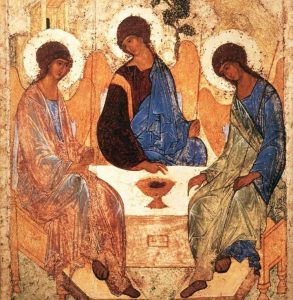
Image of the Trinity

Solemnity of the Most Holy Trinity [A]

June 7, 2020

John 3:16-18

Trinity 2We are re-entering the ordinary season of the Church, and one of the greatest feasts within the ordinary time is the solemnity of the Most Holy Trinity. The Church has placed the celebration of the great feast on Sunday after the Pentecost. The reason may not be that obvious, but if we look at the bigger picture, it is nothing but a natural procession of truth. In Easter, we are celebrating the resurrection of Jesus that cements the divinity of Christ. On the Pentecost, we witness the divinity of the Holy Spirit being affirmed [see last Sunday’s reflection]. Now, we are rejoicing for the Three divine persons in God.

The Trinity Sunday is admittedly the most dreaded by many preachers because many are still at a loss of how to show the beauty of this most profound truth, and others are afraid to explain the Trinity because they may spread erroneous concepts. After all, we are facing the source and summit of all mysteries, the mystery of all mysteries. However, it is not the right excuse not to bring forth the beauty of the Holy Trinity. The preachers have to roll up their sleeves and spend more time in researching and preparing our homilies.

In my reflection, I would like to bring you to the Old Testament. In the Old Testament, the reality of the Trinity is hidden in most parts, and yet the sacred truth comes up in the surprisingly key moments. Let us read Gen 1:1-3, “In the beginning when God created the heavens and the earth, the earth was a formless void and darkness covered the face of the deep, while a wind from God swept over the face of the waters. Then God said, “Let there be light,”; and there was light.” The early Christians like St. Irenaeus of Lyon, immediately saw this as Trinity working as one, God, the Spirit, and the Word. The good news is that the creation is the masterpiece of the Holy Trinity, and to a certain degree, it reflects the perfection of the Trinity.

And wait, something more! In Gen 1:26, when God created the man and the woman, God said, “let us create the man and woman in our image and likeness.” This passage is a bit strange because why God, who is one, suddenly self-refer in plural? The Jewish tradition would interpret that God is addressing His heavenly council, the angels, but again, the Christian tradition instinctively saw them as the three divine persons. The good news is that if we are created in the image of God, and if our God is the Trinity, then we are created in the image of Trinity.

This explains a lot of things. Indeed, we cannot fully comprehend the mystery, but we surprisingly are very close to this mystery. Trinity is both our origin and destiny. As the image of Trinity, we cannot discover real joy by hoarding things to ourselves. We cannot be selfish and truly delighted at the same time. Like the Father and the Son love each other in the Holy Spirit, we are called to give ourselves to others in life.

Why does the Catholic Church fearlessly defend the sacredness of marriage? Because through marriage, the man and woman may give themselves totally to each other in love. Their love is so strong that love can give birth to life. When this new life [children] come to their lives, their love can grow even exponentially. In loving and giving ourselves, we may find the fullness of our identity, the image of Trinity. Indeed, it is tough, but the good news is that we are designed to give love and life. Holy Trinity is our origin, and Holy Trinity is our destiny.

Valentinus Bayuhadi Ruseno, OP

Citra Trinitas

Hari Raya Tritunggal Mahakudus

7 Juni 2020

Yohanes 3: 16-18

trinity 3Kita memasuki kembali masa biasa Gereja, dan salah satu perayaan terbesar dalam masa biasa adalah kesungguhan Tritunggal Mahakudus. Gereja telah menempatkan perayaan besar ini pada hari Minggu setelah Pentekosta. Alasannya mungkin tidak begitu jelas bagi kita, tetapi jika kita melihat gambaran yang lebih besar, itu sebenarnya adalah prosesi kebenaran yang wajar. Di Paskah, kita merayakan kebangkitan Yesus yang mengukuhkan keilahian Kristus, dan pada hari Pentekosta, kita menyaksikan keilahian Roh Kudus ditegaskan [lihat refleksi hari Minggu lalu]. Sekarang, kami bersukacita karena Tiga pribadi Ilahi di dalam Tuhan.
Tritunggal Minggu diakui sebagai yang paling ditakuti oleh banyak pastor atau romo karena banyak yang masih bingung bagaimana menunjukkan kebenaran yang paling dalam ini dan yang lain takut untuk menjelaskan Tritunggal karena bisa-bisa menyebarkan konsep yang keliru. Lagipula, kita berhadapan dengan sumber dan puncak semua misteri iman. Namun, itu bukan alasan yang tepat untuk tidak menampilkan keindahan Tritunggal yang mahakudus. Para imam harus bekerja keras dan menghabiskan lebih banyak waktu dalam belajar dan mempersiapkan homili.

Dalam renungan ini, saya ingin membawa kita semua kembali ke Perjanjian Lama. Dalam Perjanjian Lama, realitas Tritunggal tersembunyi di sebagian besar ayat, namun kebenaran suci ini tampak di saat-saat fundamental. Mari kita baca Kejadian 1: 1-3, “Pada mulanya Allah menciptakan langit dan bumi. Bumi belum berbentuk  dan kosong gelap gulita menutupi samudera raya, dan Roh Allah melayang-layang di atas permukaan air. Berfirmanlah Allah: “Jadilah terang” Lalu terang itu jadi” Umat Kristiani perdana seperti St. Irenaeus dari Lyon, segera melihat ini sebagai Trinitas yang bekerja sebagai satu, Allah, Roh dan Firman. Kabar baiknya adalah bahwa dunia dan segala ciptaan adalah mahakarya dari Tritunggal Mahakudus, dan sampat tingkat tertentu, ciptaan itu mencerminkan kesempurnaan Tritunggal.

Selain itu, dalam Kejadian 1:26, ketika Tuhan menciptakan pria dan wanita, Tuhan berkata, “Baiklah Kita menjadikan manusia menurut gambar dan rupa Kita…” Perikop ini sedikit aneh karena Allah yang satu tiba-tiba menyebut diri sendiri dalam bentuk jamak. Tradisi Yahudi menafsirkan hal ini bahwa Allah berbicara kepada dewan surgawi-Nya, para malaikat, tetapi sekali lagi, tradisi Kristiani melihat ini sebagai tiga pribadi Ilahi. Kabar baiknya adalah bahwa jika kita diciptakan menurut citra Allah, dan jika Allah kita adalah Tritunggal, maka kita adalah citra Tritunggal.

Memang benar bahwa kita tidak dapat sepenuhnya memahami misteri Ilahi, tetapi kita sebenarnya tidak jauh dari misteri ini. Bahkan, kita diundang untuk seperti Trinitas. Sebagai citra Trinitas, kita tidak dapat menemukan sukacita sejati dengan menimbun hal-hal duniawi seperti kekayaan, ketenaran untuk diri kita sendiri. Seperti Bapa dan Putra saling mengasihi dalam Roh Kudus, kita dipanggil untuk memberikan diri kita kepada sesama dalam kasih.

Ini mengapa Gereja Katolik terus menjaga kesakralan pernikahan. Karena melalui pernikahan, pria dan wanita dapat memberikan diri mereka sepenuhnya satu sama lain. Cinta kasih mereka begitu kuat sehingga cinta kasih ini bahkan bisa melahirkan kehidupan baru. Dan saat kehidupan baru ini [anak] datang di tengah hidup sang pria dan wanita, kasih mereka dapat semakin tumbuh bahkan secara eksponensial. Dan dalam pernikahan dan keluarga, kita menemukan identitas kita sebagai citra Trinitas, dan saat kita menemukan hal ini, kita menemukan makna terdalam hidup kita.

Memang mengasihi sangat sulit, tetapi kabar baiknya adalah kita dirancang untuk memberikan kasih dan kehidupan. Tritunggal Mahakudus adalah asal usul kita, dan Tritunggal Mahakudus adalah tujuan kita.

Valentinus Bayuhadi Ruseno, OP

Pray like Jesus

7th Sunday of Easter

May 24, 2020

John 17:1-11a

man in prayer 2We are aware that prayer is a fundamental part of Jesus’ life. He prays on a regular basis, and especially when He is preparing to embrace decisive events, like Baptism on the Jordan [Luke 3:21], the election of the twelve apostles [Luke 6:12], transfiguration [Luke 9:28], and the Passion [Matt 26:36–44]. However, we seldom hear what Jesus says in His prayers. In the Synoptic Gospels [Matthew, Mark, and Luke], we are fortunate enough to hear Jesus’ compact and emotional prayer in the Garden of Gethsemane before He enters into His Passion. However, John the evangelist makes sure that we are going to discover what Jesus prays, and it is substantially longer than we ever heard before.

John devotes the entire chapter of His Gospel for this prayer [John 17:1-26]. As expected, He prays to the Father with extraordinary affection and confidence. Yet, what makes it noteworthy is that Jesus does not say only about Himself and His mission, but also prays for His disciples. Jesus is acting as the priest who is interceding on behalf of His disciples. That is why we call this section the high priest’s prayer of Jesus Christ.

From Jesus’ prayer, we unearth some powerful lessons:

Firstly, if prayer is essential in the life of Jesus, it is because Jesus understands that prayer is His line of communication to the Father. Jesus knows well that communication is the key to every flourishing relationship. Perhaps, we fail to see this truth, and that is why we feel prayer is burdensome. We are not eager to attend the mass because we simply understand it as an obligation. We relegate personal prayer to the sideline as we make other things as our priority. Sadly, we immediately blame God if our plans do not work according to our whim, or we even threaten God to grant our wishes. Thus, changing perspective about prayer is crucial and even life-transforming.

Secondly, if prayer is communication, then it should always be a dialogue. Often when we start growing in prayer, we think that we need to always say something to the Lord. I remember one seminarian asked me, “Father, what else should I say if I am running out of words in my prayers?” I told him, “Perhaps, it is time to listen to God.” The next expected question is, “How do I listen to God?” Surely there is no one-size-fits-all answer to this, but I like what St. Jerome says, “You pray: You speak to the bridegroom. You read [scriptures]: He speaks to you.” Yet, we need to remember that dialogue of words is not the end of the communication. The end is the unity of the persons in dialogue. Jesus says, “I am in my Father, and you are in me, and I am in you [John 14:20].”

Lastly, our prayer involves the third person. This is the direct consequence of Jesus’ priestly prayer. Prayer is a dialogue, but just like other dialogue, it may speak about other persons. This is when we pray to God for others. Because Jesus leaves us an example in His priestly prayer, it is all the more imperative for us to care for others through prayers. In time we cannot reach other people who need our help; prayers remain the best way to love them. Indeed the saints in heaven continue to care for us despite not able to physically appear to us through their prayers.

Prayer unites us with God in love and prayer also unites us with people we love in God.

Valentinus Bayuhadi Ruseno, OP

Berdoa seperti Yesus

Minggu Paskah ke-7

24 Mei 2020

Yohanes 17: 1-11a

man in prayer 4Doa adalah bagian mendasar dari kehidupan Yesus. Dia berdoa secara teratur, dan terutama ketika Dia bersiap untuk merangkul peristiwa-peristiwa yang menentukan, seperti Pembaptisan di Sungai Yordan [Lukas 3:21], pemilihan kedua belas rasul [Lukas 6:12], transfigurasi [Lukas 9:28], dan jalan salib-Nya [Mat 26:36-44]. Namun, kita jarang mendengar apa yang Yesus katakan dalam doa-doanya. Dalam Injil Sinoptik [Matius, Markus dan Lukas] kita cukup beruntung mendengar doa Yesus yang pendek dan emosional di Taman Getsemani sebelum Dia memasuki sengsara-Nya. Namun, penginjil Yohanes memastikan bahwa kita akan menemukan apa yang Yesus doakan dan hal ini jauh lebih panjang daripada yang pernah kita dengar sebelumnya.

Yohanes mencurahkan seluruh bab untuk doa ini [Yohanes 17: 1-26]. Yesus berdoa kepada Bapa dengan kasih dan keyakinan yang luar biasa. Namun, yang membuat doa ini  penting adalah bahwa Yesus tidak hanya berdoa tentang diri-Nya dan misi-Nya, tetapi juga berdoa untuk para murid-Nya. Yesus bertindak sebagai imam yang menjadi perantara bagi para murid-Nya. Itulah sebabnya kita menyebut bagian ini sebagai doa Yesus Kristus sebagai imam besar.

Dari doa Yesus, kita menggali beberapa pelajaran yang penting:

Pertama, jika doa sangat penting dalam kehidupan Yesus karena Yesus mengerti doa adalah jalur komunikasi-Nya kepada Bapa. Komunikasi adalah kunci untuk setiap hubungan untuk berkembang, dan Yesus mengetahui hal ini dengan baik. Mungkin, kita gagal melihat kebenaran ini, dan itulah sebabnya kita merasa doa itu membosankan. Kita malas menghadiri misa karena kita hanya memahaminya sebagai kewajiban. Kita menempatkan doa pribadi hanya sebagai tambahan karena kita menjadikan hal-hal lain sebagai prioritas kita. Anehnya, kita segera menyalahkan Tuhan jika rencana kita tidak berjalan sesuai dengan keinginan kita, atau kita bahkan mengancam Tuhan untuk mengabulkan keinginan kita. Jadi, mengubah perspektif tentang doa adalah penting dan bahkan akan mengubah kehidupan.

Kedua, jika doa adalah komunikasi, maka harus selalu berupa dialog. Sering kali ketika mulai tumbuh dalam doa, kita berpikir bahwa kita harus selalu mengatakan sesuatu kepada Tuhan. Saya ingat seorang frater bertanya kepada saya, “Romo, apa lagi yang harus saya katakan jika saya kehabisan kata-kata dalam doa saya?” Saya mengatakan kepadanya, “Mungkin, ini saatnya untuk mendengarkan Tuhan.” Pertanyaan selanjutnya adalah, “Bagaimana saya mendengarkan Tuhan?” Tentunya tidak ada jawaban yang baku, tetapi saya suka apa yang dikatakan St Heronimus, “Kamu berdoa: kamu berbicara kepada mempelai laki-laki [Yesus]. Kamu membaca [Kitab Suci]: Dia berbicara kepadamu. ” Namun, kita perlu ingat bahwa dialog kata-kata bukanlah akhir dari komunikasi. Akhirnya adalah orang-orang dalam dialog menjadi satu. Yesus berkata pada dirinya sendiri, “Aku di dalam Bapa-Ku, dan kamu di dalam Aku, dan Aku di dalam kamu [Yohanes 14:20].”

Terakhir, doa kita melibatkan orang ketiga. Ini adalah konsekuensi langsung dari doa imam Yesus. Doa adalah dialog, tetapi sama seperti dialog lainnya, doa dapat berbicara tentang orang lain. Inilah saatnya kita berdoa kepada Tuhan untuk orang lain. Karena Yesus memberi kita teladan dalam doa-Nya, maka semakin penting bagi kita untuk memelihara sesama melalui doa. Pada saatnya kita tidak dapat menjangkau orang lain yang membutuhkan bantuan kita, doa tetap menjadi cara terbaik untuk mencintai mereka. Sesungguhnya orang-orang kudus di surga terus memelihara kita meskipun tidak mampu secara fisik menampakkan diri kepada kita, melalui doa-doa mereka.

Doa menyatukan kita dengan Tuhan dalam kasih dan doa juga menyatukan kita dengan orang-orang yang kita kasihi di dalam Tuhan.

Valentinus Bayuhadi Ruseno, OP

Jesus and His Bride in Time of Pandemic

5th Sunday of Easter

May 10, 2020

John 14:1-12

joseph n maryWe have closed our churches for public service for weeks. We shifted to livestreaming masses, and we are learning to adjust and to give priority to our health and life, we realize our hearts remain troubled. We long to see Jesus in the Most Blessed Sacrament, we desire to receive Him in the Eucharist, we want to serve Him in the churches, and we miss the sacrament of confession. We are unsure when it is going to end and be back to normal.

We are like the disciples in the Gospel. Their hearts were troubled because Jesus was about to leave them. They were having a Passover meal, and it was supposed a festive celebration. Yet, Jesus announced to them that someone would betray Him, and He would be taken away from them. The disciples had thrown everything away and followed Jesus because they were hoping that Jesus, as the Messiah, would overthrow the Roman empire and restore the glory of Israel. They could not square with the probability of utter failure. Were they holding on false hope? Was Jesus a hoax? Were their sacrifices useless? We are like the disciples. After we give everything to follow Jesus, to serve His Church, and to work in His vineyard, we feel He is missing. Where is Jesus when we needed Him most?

Jesus knew His disciples’ hearts and assured them as He did to have in God and Jesus. Yet, what comes after this word of affirmation is that Jesus told the disciples that there are many dwelling places in His Father’s house, and He will go to prepare the places. To comfort the disciples, Jesus did not say that He would come back victorious, or He would destroy all enemies of Israel. He said that He is going to prepare a dwelling place. It is just not making much sense.

To understand this, we need to know the wedding ceremony at the time of Jesus. During this time, the wedding was done in two steps. The first one is the betrothal, and the second stage is the wedding celebration. During the betrothal, the couple has exchanged vows and have become husband and wife in the eyes of the Law, but they have not stayed together in one house. They had to wait for around one year before the final ceremony. After around year, the bride would be brought in procession to the home of the groom, and they will have a week-long celebration. Why one-year wait? The reason is practical. It gives enough time for the man to prepare for the celebration as well as build a proper place for the bride.

One particular image that the Church has in relation to Jesus is that she is the bride of Christ. If we apply this Jewish wedding rite to the Church and Jesus, we discover that betrothal has taken place, but not yet the final step. Jesus is not with His Church because He is Father’s House to prepare the dwelling place for us, His bride.

In the time of the pandemic, our hearts are sorely troubled, and with the churches are closed, we feel that our Lord is taken away from us. Yet, a difficult time can actually be a passage going to the much better dwelling place prepared by Jesus. We may not see yet the better things we will experience, yet Jesus assures us that God is in control. In this stormy life, we may see a beautiful place prepared by Jesus, our groom.

Valentinus Bayuhadi Ruseno, OP

Yesus dan Mempelai-Nya di Masa Pandemi

Minggu Paskah ke-5

10 Mei 2020

Yohanes 14: 1-12

last supperKita telah menutup gereja-gereja kita untuk pelayanan publik untuk beberapa minggu sekarang. Kita beralih ke misa livestreaming, dan kita belajar untuk menyesuaikan diri dan mengutamakan kesehatan dan kehidupan kita. Tetapi, kita menyadari bahwa hati kita tetap gelisah. Kita ingin melihat Yesus dalam Sakramen Mahakudus, kita berhasrat untuk menerima-Nya dalam Ekaristi, kita ingin melayani-Nya di paroki dan komunitas, dan kita kehilangan sakramen pengakuan dosa. Kita tidak yakin kapan akan berakhir dan kembali normal.

Kita seperti para murid dalam Injil minggu ini. Hati mereka gelisah karena Yesus akan meninggalkan mereka. Mereka sedang berada pada perjamuan Paskah, dan hal ini seharusnya merupakan perayaan yang menggembirakan. Namun, Yesus mengumumkan kepada mereka bahwa seseorang akan mengkhianati Dia dan Dia akan diambil dari mereka. Para murid telah meninggalkan segalanya, dan mengikuti Yesus karena mereka berharap bahwa Yesus sebagai Mesias akan menggulingkan kekaisaran Romawi dan mengembalikan kemuliaan Israel. Mereka tidak bisa menerima kemungkinan kegagalan total dari Yesus. Apakah mereka berpegang pada harapan palsu? Apakah Yesus menyebarkan kabar hoax? Apakah pengorbanan mereka sia-sia? Kita seperti para murid. Setelah kita memberikan segalanya untuk mengikuti Yesus, untuk melayani Gereja-Nya dan untuk bekerja di kebun anggur-Nya, kita merasa Dia hilang. Di mana Yesus ketika kita paling membutuhkan Dia?

Yesus mengenal hati para murid-Nya dan meyakinkan mereka untuk miliki iman kepada Allah dan kepada-Nya. Namun, apa yang muncul setelah kata penguatan ini adalah bahwa Yesus memberi tahu para murid bahwa ada banyak tempat tinggal di rumah Bapa-Nya dan Dia akan pergi untuk mempersiapkan tempat-tempat itu. Untuk menghibur para murid, Yesus tidak mengatakan bahwa Ia akan kembali menjadi pemenang, atau Ia akan menghancurkan semua musuh Israel. Dia berkata bahwa Dia akan menyiapkan tempat tinggal. Hal ini tidak masuk akal.

Untuk memahami hal ini, kita perlu mengetahui upacara pernikahan di zaman Yesus. Pada masa ini, pernikahan dilakukan dalam dua tahap. Yang pertama adalah pertunangan dan tahap kedua adalah perayaan pernikahan. Pada tahap pertunangan, kedua mempelai sebenarnya telah berjanji dan telah menjadi suami dan istri di mata Hukum, tetapi mereka belum tinggal bersama dalam satu rumah. Mereka harus menunggu sekitar satu tahun sebelum upacara tahap terakhir. Setelah sekitar tahun, pengantin wanita akan dibawa dalam prosesi ke rumah pengantin pria, dan mereka akan mengadakan perayaan selama seminggu. Kenapa menunggu satu tahun? Alasannya praktis. Ini memberi cukup waktu bagi mempelai lelaki itu untuk mempersiapkan perayaan serta membangun tempat yang layak bagi pengantin wanita.

Satu citra Gereja sehubungan dengan Yesus adalah bahwa ia adalah mempelai wanita Kristus [lih. Yoh 3:29; 2 Kor 11:2]. Jika kita menerapkan upacara pernikahan Yahudi pada zaman Yesus ini bagi Gereja dan Yesus, kita menemukan bahwa pertunangan telah terjadi, tetapi belum mencapai perayaan pernikahan. Yesus tidak bersama Gereja-Nya karena Dia ada Rumah Bapa untuk mempersiapkan tempat tinggal bagi kita, mempelai-Nya.

Pada saat pandemi, hati kita pasti gelisah, dan dengan gereja-gereja ditutup, kita merasa bahwa Tuhan kita diambil dari kita. Namun, waktu yang sulit sebenarnya bisa menjadi perjalanan menuju tempat tinggal yang jauh lebih baik yang disiapkan oleh Yesus. Kita mungkin belum melihat hal-hal yang lebih baik yang akan kita alami, tetapi Yesus meyakinkan kita bahwa Allah memegang kendali. Dalam kehidupan yang penuh badai ini, kita dapat melihat tempat yang indah yang disiapkan oleh Yesus, mempelai kita.

Valentinus Bayuhadi Ruseno, OP

Getsemani

Jumat Agung

10 April 2020

Yohanes 18 – 19

Jesus praysJika ada satu hal yang menyatukan orang-orang dari berbagai negara, bahasa, dan agama, ini adalah penderitaan. Dengan coronavirus yang menyebar sangat cepat, orang-orang dengan latar belakang yang berbeda, muda dan tua, kaya dan miskin, dan bangsawan dan rakyat jelata, dan awam dan klerus jatuh tersungkur dan gemetar. Memang, virus mikroskopis ini telah meluluh lantahkan kehidupan banyak orang. Orang-orang sakit kerah, rumah sakit kewalahan, kota-kota terisolasi, keluarga-keluarga terpisah, pekerja-pekerja menganggur, pemerintah-pemerintah tak berdaya, dan gereja-gereja kosong. Penderitaan memaksa kita untuk mengakui kelemahan manusiawi kita dan semua yang kita banggakan, ternyata hampa.

Saya mendengar semakin banyak pertanyaan dari beberapa teman dan umat, “Kapan ini akan berakhir? Aku rindu untuk melakukan rutinitas, kapan kita dapat kembali ke Gereja? Apakah kita akan selamat? Apakah kita akan mati? Di manakah Tuhan dalam masa yang paling sulit ini?” Sebagai seorang imam yang bekerja di sebuah paroki, adalah tugas saya untuk menguatkan umat Allah di saat-saat pencobaan ini, namun saya tidak bisa begitu saja memberikan kata-kata penghiburan namun tidak berisi. Saya tidak bisa hanya mengatakan, “itu akan segera berakhir” meskipun, mereka tahu bahwa itu tidak akan berakhir secepat itu. Adalah kebohongan ketika saya memberi tahu orang-orang, “Tidak apa-apa, jangan khawatir.” Sementara saya sendiri berjuang dengan rasa sakit dan kekecewaan. Ini adalah tahun pertamaku sebagai romo, namun, saya mendapati diri saya terasingkan dari orang-orang yang saya layani. Realitas yang paling menyakitkan adalah bahwa saya tidak dapat merayakan Pekan Suci, waktu yang paling suci dengan orang-orang yang saya kasihi, dan umat yang saya cintai.

Pada saat kebingungan, kesakitan, dan penderitaan ini, saya ingin mengajak Anda semua untuk melihat salib, namun dari balik salib itu, mari kita bersama Yesus dalam sakratul maut-Nya.. Yesus bersama dengan ketiga murid-Nya, pergi ke bukit Zaitun, dan ke bagian bawah bukit ini, ada sebuah taman yang disebut Getsemani. Nama Getsemani berarti “tempat memeras zaitun” dan tempat ini menjadi salah satu penyuplai minyak zaitun bagi kota Yerusalem. Zaitun sendiri adalah minyak yang banyak kegunaannya namun juga berharga. Minyak ini digunakan untuk kebutuhan rumah tangga sehari-hari seperti bumbu makanan dan membakar lampu. Minyak berfungsi sebagai obat dan mengurapi orang sakit. Itu juga digunakan untuk tujuan sakral. Minyak zaitun dipersembahkan sebagai bagian dari kurban harian di Bait Suci [Bil. 28: 5]. Dan para imam seperti Harun dan raja-raja seperti Daud diurapi dengan minyak zaitun. Dengan berbagai kegunaan, dari rumah tangga hingga penggunaan sakral, tidak mengherankan bahwa dalam tradisi Yahudi kuno, pohon zaitun disebut sebagai pohon kehidupan di tengah taman Eden.

Namun, untuk menghasilkan minyak, buah zaitun harus dihancurkan dan diperas. Pertama, buah akan digiling oleh batu kilangan besar. Kedua, setelah hancur menjadi bubur, ini diperas untuk mengekstraksi minyak. Buah dari pohon kehidupan harus dihancurkan untuk menghasilkan kehidupan itu sendiri. Dan Yesus mengerti bahwa Dia adalah pohon kehidupan baru, dan Dia harus dihancurkan terlebih dahulu untuk menghasilkan kehidupan yang benar.

Yesus menghadapi saat yang mengerikan dalam hidup-Nya dan Dia memiliki semua pilihan untuk menghadapinya. Yesus bisa saja lari, Dia bisa memanggil pasukan malaikat untuk membela-Nya, atau Dia bisa dengan mudah menempatkan orang lain untuk disalibkan. Namun, Yesus memilih untuk merangkul salib dan kematian-Nya karena Dia tahu ini adalah cara yang berbuah. Hanya melalui penderitaan dan kematian, Dia dapat mengasihi kita sampai akhir, dan kita mungkin memiliki hidup yang berlimpah.

Dalam menghadapi penderitaan kita, kita dipanggil seperti Yesus untuk merangkulnya, dan bahkan dihancurkan olehnya, sehingga kehidupan sejati dapat mengalir. Memang benar bahwa pada tahun pertama saya sebagai seorang imam, Tuhan memiliki rencana yang berbeda untuk saya, dan saya tidak dapat merayakan Minggu Suci dengan umat yang saya kasihi, tetapi Dia bahkan memberi saya hadiah berharga untuk berpartisipasi dalam penderitaan dan kematian-Nya secara lebih penuh.

Valentinus Bayuhadi Ruseno, OP

Olive

Good Friday

April 10, 2020

John 18 – 19

jesus prays 2If there is one thing that unites people from different nations, languages, and religions, that is the experience of suffering. With the ultra-fast spreading coronavirus, covid-19, people with different backgrounds, young and old, rich or poor, and noblemen or commoners, and laypeople or clergy fall in their knees and tremble. Indeed, this microscopic virus has shattered countless lives. People are dying, hospitals are overwhelmed, cities are isolated, families are separated, workers are jobless, governments are at loss, and churches are empty. Pope Francis notes that “we are just one the same boat”, and this boat is sinking. Suffering forces us to admit our human frailty and all that we are proud of, are a mere breath.

I heard more and more questions from some of my friends, “When is it going to end? We miss to do our ordinary routine, when can we go back to the Church? Are we going to survive? Are we going to die? Where is God in this most troubling time?” As a priest working in a parish, it is our duty to strengthen the people of God in this moment of trials, yet I cannot simply offer a consoling yet untrue words. I cannot simply say, “it is going to end soon” though, at the back of their minds, they know that it is not. It is a plain lie when I tell people, “It is fine, don’t worry.” While I am myself struggling with pain and disappointment. This is my first year as a priest, yet, I find myself exiled from the people of I serve. The most painful reality is that I cannot celebrate the Holy Week, the most sacred time with the people I love and care for.

At this moment of confusion, pain, and suffering, I would like to invite all of you to see the cross, and yet before the cross, let us be with Jesus on His agony in the garden. Jesus together with His three disciples, went to the mount of Olivet, and to the part of this mount, the garden called Gethsemane. The name Gethsemane means “olive press” and some of the olive oil needed by the city of Jerusalem came from this place. Olive itself is a basic and yet precious oil. It is used for daily household needs like cooking, seasoning, and burning the lamp. Since it has a therapeutic effect, the oil serves as a medicine. It is also used for sacred purposes. Olive oil is offered as part of daily sacrifice in the Temple [Num 28:5]. And the priests like Aaron and kings like David were anointed with olive oil. With a wide range of utilities, from household to sacred use, no wonder that in ancient Jewish traditions, the olive tree was considered as the tree of life in the middle of the garden of Eden.

However, to produce the oil, the fruits have to be two-step crushing process. Firstly, the fruits shall be ground by a huge millstone. Secondly, the olive pulp shall be squeezed to extract the oil. The fruits of the tree of life have to be crushed to produce life itself. And Jesus understood that He is the new tree of life, and He has to be crushed first to yield the true life.

Jesus is facing the horrifying time in His life and He has all the options to deal with it. Jesus could have run, He could have summoned the legions of angels to defend Him, or He could simply place someone else to be crucified. Yet, Jesus chooses to embrace His cross and death because He knows this is the most fruitful way. Only through suffering and death, He can love us to the end, and we may have life abundantly.

In the face of our suffering, we are called like Jesus to embrace it, and even be crushed by it, so that true life may flow. It is true that in my first year as a priest, God has a different plan for me, and I cannot celebrate the Holy Week with the people I serve, but He gives me even a precious gift to participate in His suffering and death more fully.

Valentinus Bayuhadi Ruseno, OP

God’s Loving Touch

Fifth Sunday of Lent [A]

March 29, 2020

John 11:1-45

Daniel Bonnell, "Jesus Wept." Oil on canvas, 34 x 46 in. Tags: LazarusAmong the five human senses, the sense of touch is the most basic and foundation to other senses. The sense of sight needs to be in touch with the light spectrum. The sense of taste requires to be in contact with the chemical in the food. The sense of hearing must receive air vibration or sound waves. This sense makes us a human being, a bodily being. No wonder that many traumatic experiences [even mental problems] are rooted in the lack (or excess) of touch.

God, our creator, understands our fundamental need of touch. Thus, to fulfill our deepest desire, He made a radical choice and became a man like all of us. Because Jesus is true God and true man, the disciples were able to see, hear, touch and feel Him. Yet, He gave a more radical gesture as He offered Himself as food to eat and drink to eat, “for my flesh is true food and my blood is true drink [Jn 6:55].” While the pagan deities were feasting on the human blood and sacrifice, our God does the opposite. He gave up His life so that we may live and feel His love.

Following the example of our Savior, the Church is filled with tangible means and bodily gestures as a sign and symbols of the divine presence. No wonder our churches are equipped with beautiful crucifixes, adorned with flowers, and mystified by the burning candle and incense. A sacrament is no other than the visible sign of the invisible grace, and sacraments really intend to connect to our bodies, like blessed water and oil that touch our forehead, the bread that we consume, and words of forgiveness that we need to hear. Amazingly, the Church is called the body of Christ, and our call is to unite as one people of God around this table of Eucharist.

However, the terrible thing befalls our Church. The pandemic caused by the Covid-19 is basically reversing the movement of our faith. We are facing a reality that touching can mean illness, the gathering may bring disaster, and worship may mean death. For the good of the flock, our leaders are forced to close the churches. We now feel the pain of separation from the Body of Christ.

Perhaps, we are like Lazarus who are experiencing spiritual suffering and death. Perhaps, we are like Martha who is asking the Lord, “why are you not coming sooner?” Perhaps, we are like Mary who cannot do anything but mourns and is reduced into silence.

The Gospel of John tells us that Jesus loves Lazarus, Martha and Mary as His close friends. Yet, Jesus did not rescue Lazarus when he got gravely ill, and even Jesus visited them after Lazarus died four days. Jesus allowed terrible things to take place in the life of Lazarus, Martha, and Mary, not because He wanted to punish them, or He does not care, but because He loves them.

In His love, God allows us to endure the sense of losing God, and experience suffering and even death. God knows too well that through suffering, we may love even deeper, we grow in faith, and re-discover God, alive and even closer. After all, there is no true resurrection, unless we enter the darkness of the tomb.

My deepest gratitude and prayer for our medical personal who give their all in to fight the disease and save lives.

Valentinus Bayuhadi Ruseno, OP