

Epiphany [A]
January 4, 2026
Matthew 2:1-12
The story of the Magi is a powerful one because they do not come from the Jewish people, and yet they sincerely seek the newborn King of Israel. The identity of the Magi remains a mystery. The Greek word magos—from which the English word magic is derived—refers to a person learned in the ancient sciences. These ancient sciences were very different from modern ones: experiment and myth, natural observation and ritual, were often intertwined. This was a period when astronomy was closely linked with astrology, and chemistry with alchemy.
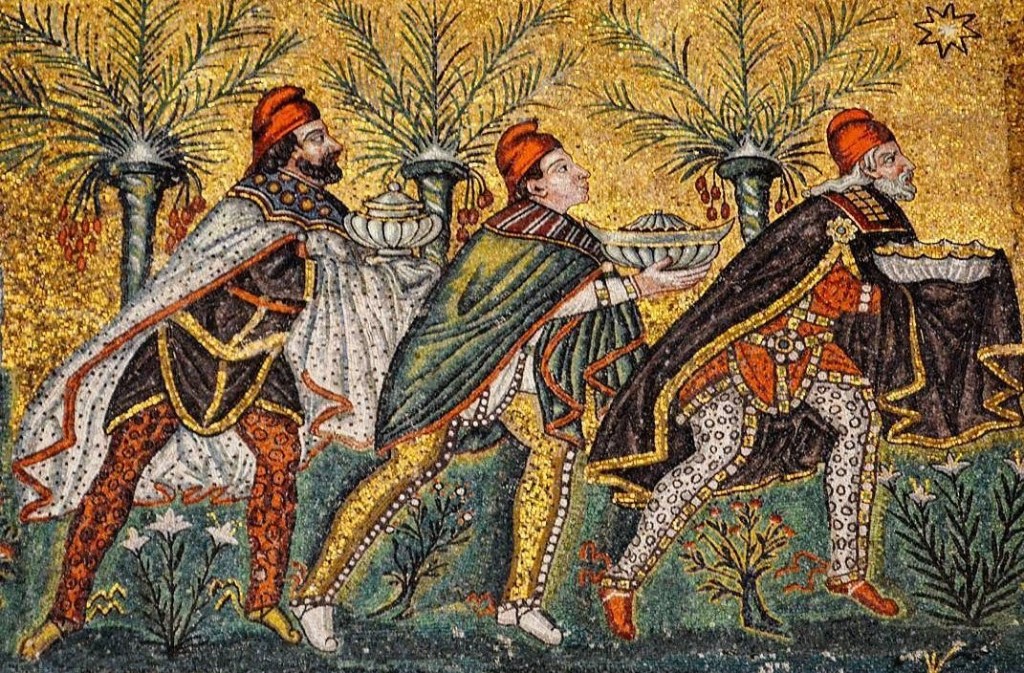
Although not stated explicitly in Scripture, many traditions identify the Magi as the three kings from the East. Tertullian (d. AD 225), interpreting the Epiphany account in light of Psalm 72 and Isaiah 60, refers to the Magi as kings. While the Magi were not necessarily kings, they were likely men of high status, since Herod, the king of Jerusalem, received them and treated them with respect. The number three is commonly derived from the three gifts offered to Christ: gold, frankincense, and myrrh. The earliest clear evidence for three Magi appears in a sixth-century mosaic in the Church of Sant’Apollinare Nuovo in Ravenna, Italy. The names Melchior, Gaspar, and Balthasar emerge in Latin tradition around the same period.
The story of the Magi becomes even more striking when they are contrasted with their Jewish counterparts: Herod, the king of Jerusalem, and the Jewish scholars. When Herod heard the news, he immediately consulted the learned men of his court. After carefully examining the Scriptures, they confirmed the Magi’s discovery and identified Bethlehem as the birthplace of the newborn king. Yet, unlike the Magi—who used their wisdom and knowledge to honor the child—Herod and his learned advisors used their understanding of Scripture to plot the destruction of the promised Messiah.
The contrast between the Magi and Herod becomes a paradigm for what would later happen to Jesus. At the beginning of His life, Jesus was honored by Gentile Magi but sought for destruction by Herod and his advisors. Likewise, at the end of His earthly life, Jesus was condemned by the chief priests and religious leaders, accused of being a false Messiah, while He was recognized by a Roman centurion as the Son of God.
Finally, after the Magi found Jesus and paid Him homage, they returned home by a different way. This detail carries profound symbolism: encountering Jesus leads to true repentance and transformation. We may be busy studying Scripture, engaging in charitable works, or serving in Church ministries, but if we do not truly find Jesus in them, there is no genuine conversion. Without finding Jesus, we may end up finding only ourselves. The danger is that this leads either to frustration when we fail or to pride when we succeed. In either case, we do not find true happiness. Like Herod and his advisors, we may even misuse our knowledge of faith in ways that harm our spiritual life and weaken our faith in Christ.
Rome
Valentinus Bayuhadi Ruseno, OP
Guide Questions:
Am I more like the Magi or like Herod and his advisors in the way I seek Jesus? How do I use the knowledge and gifts God has given me? Do my religious activities truly bring me into an encounter with Jesus? Or have Scripture, ministry, and service become ends in themselves? In what ways has encountering Christ changed my direction in life? What prevents me from recognizing Christ when He comes quietly and vulnerably?


 In Medio Ecclesiae