

Solemnity of Blessed Virgin Mary, the Mother of God [January 1, 2019] Luke 2:16-21
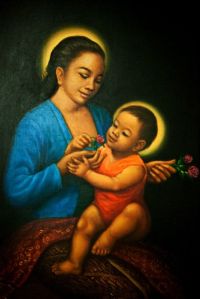 Some of us may wonder why the Church places the celebration of the solemnity of Mary, the Mother of God on January 1, or on the New Year. One may guess that the Church wants us to attend mass on the first day of the year, so as to start the year right. For those who wish to have a long holiday, it might be pretty a killjoy, but for some of us who wish to be blessed for the entire year, it is a nice thought. Yet, surely there is something deeper than that.
One reason is that the Church invites us all to reflect on the past year with gratitude as we count our blessings, and thus, we are able to look forward with faith and hope. In the Gospel, Mary is depicted as someone who always keeping things in heart and reflecting them (see Luk 2:19). Like Mary, we are asked to pause for a while on the momentous day of the year and ponder God’s works in our lives.
Another reason that I think more fundamental is that it is proper to conclude the Christmas octave with the Solemnity of Mother of God. “Octave” simply means eight, and in the Church’s liturgy, it means eight days prolonged celebration of particular grand events in the Church like Easter and Christmas. Like Christmas octave cover December 25 till January 1. If at Christmas day, we are celebrating the birth of Jesus, at the end of the Octave, we are celebrating the woman who gave birth to Jesus. Without a mother who receives the baby in her womb, carries the baby for nine months, and gambles her life in the process of delivery, a baby will not be born. In short, without Mary, there will be no Jesus.
To become a mother is a natural part of being a woman, and yet despite being natural, it remains a very difficult process for a woman. I am not a woman, but I can tell that it is a life of sacrifice because to take care of Br. Ruseno can cause a lot of high blood pressure! It is true that not all mother is perfect. Some have their own share of weakness and mistake, but the mere fact a mother has decided to give birth to her child, she has put her life on the line.
Now if to become the mother of any human being is super tough, how about to become the mother of God? We learn from Mary herself. She was pregnant out of wedlock, and this may lead people to stone her to death. She gave birth to Jesus in a dirty stable without professional help. This may cause her life. She raised the child Jesus who was often beyond her comprehension. Ultimately, she would witness with her own eyes how her only son was humiliated, tortured, and crucified. What a painful experience to bury one’s, own child! Simeon’s prophecy that a sword shall pierce Mary’s soul turned to be a reality (see Luk 2:35).
Indeed, Mary is most blessed among women, in fact among all human beings, but her blessedness does not mean an easy life. In fact, it is the opposite! St. Teresa of Avila once asked God, why He gives so many sufferings to His saints. God answered that it was the way He treated His friends. Then, St. Teresa replied, “That is why you do not have many friends!”
To become a mother is a blessing, but God’s blessing does not mean an easy life. God’s blessing means the opportunity and ability to love. To love despite challenges and trials of life, to give even when it hurts, and to sacrifice when it counts. At this New Year, we are celebrating the motherhood of Mary, indeed the motherhood of every woman. It is a Mothers’ Day in the Church. We pray for every mother that they may be blessed with the gift of love, and we also are given the same blessing in this year.
Deacon Valentinus Bayuhadi Ruseno, OP
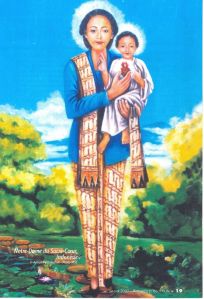 Kita mungkin bertanya-tanya mengapa Gereja menempatkan Hari Raya Maria, Bunda Allah pada tanggal 1 Januari, atau pada Tahun Baru. Orang mungkin berpikir bahwa Gereja ingin kita menghadiri misa pada hari pertama tahun baru ini. Bagi mereka yang ingin memiliki liburan panjang, ini mungkin tidak menyenangkan, tetapi bagi sebagian dari kita yang ingin diberkati sepanjang tahun, itu adalah ide yang bagus. Namun, pasti ada sesuatu yang lebih dalam mengapa tanggal 1 Januari.
 If there is one prayer that can change the course of world history, it is the earnest recitation of the holy rosary. In 1571, through the unceasing prayer of the rosary, a league of Christian nations called by Pope Pius V was able to stop the military advancement of the mighty Ottoman empire to western Europe in the Gulf of Patras, near Lepanto, Greece. In 1917, Our Lady appeared to three little children in Fatima, and one of her messages was to pray the rosary for the peace of the world. Through nation-wide recitation of the rosary, Austria was freed from the communist regime in 1955. In 1960, led by Catholic women marching the streets while praying the rosary, Brazil was also spared from communism.
 Jika ada satu doa yang mampu mengubah jalannya sejarah dunia, itu adalah pendarasan rosario. Pada 1571, melalui doa rosario tanpa henti, liga negara-negara Katolik yang dipanggil oleh Paus Pius V mampu menghentikan kemajuan militer dari kerajaan Ottoman ke Eropa Barat di perang Lepanto, dekat Yunani. Pada tahun 1917, Bunda Maria menampakkan diri kepada tiga anak kecil di Fatima, dan salah satu pesannya adalah berdoa rosario untuk kedamaian dunia. Melalui pendarasaan rosario secara nasional, Austria terbebas dari rezim komunis pada tahun 1955. Pada tahun 1960, dipimpin oleh wanita-wanita Katolik yang turun ke jalan sambil berdoa rosario, Brasil juga terhindar dari komunisme.
 To say “Amen” is something usually we do in prayer. Commonly it is used to end a prayer. Our biblical prayers like Our Father and Hail Mary are usually concluded by amen. In several occasions, amen is mentioned more often. One of my duties as a hospital chaplain is to lead a prayer of healing for the sick. I always ask the family and friends who accompany the patients to pray together. Sometimes, they will say amen at the end of the prayer. However, some others will utter several amens within the prayer, and in fact, some people will say more amens than my prayer! In several occasions, amen is utilized outside the context of prayer. Preachers with a charismatic gift will invite their listeners to say amen. Surely, it is a good technique to keep the listeners awake!
 Mengatakan “Amin” adalah sesuatu yang biasanya kita lakukan dalam doa. Kata ini biasanya digunakan untuk mengakhiri doa. Doa alkitabiah seperti Bapa Kami dan Salam Maria biasanya disimpulkan oleh kata amin. Namun, dalam beberapa kesempatan, amin disebut lebih sering. Salah satu tugas pastoral saya di rumah sakit adalah memimpin doa penyembuhan bagi yang sakit. Saya selalu meminta keluarga dan mereka yang menemani pasien untuk berdoa bersama. Biasanya, mereka akan mengatakan amin di akhir doa. Namun, ada juga beberapa orang akan mengucapkan beberapa amin dalam doa, dan bahkan, ada beberapa orang mengucapkan lebih banyak amin dari pada doa yang saya ucapkan! Dalam beberapa kesempatan, amin digunakan di luar konteks doa. Pengkhotbah karismatik akan mengajak pendengar mereka untuk mengatakan amin sebagai bentuk penegasan. Tentunya, ini adalah juga teknik yang bagus untuk membuat pendengar tidak tertidur!
 Some of us may wonder why the Church places the celebration of the solemnity of Mary, the Mother of God on January 1, or on the New Year. One may guess that the Church wants us to attend mass on the first day of the year, so as to start the year right. For those who wish to have a long holidays, it might be pretty a kill joy, but for some of us who wish to be blessed for the entire year, it is a nice thought. Yet, surely there is something deeper than that.
 Today, the Church is celebrating the feast of the Holy Family. Saint Joseph and the Blessed Virgin Mary are man and woman regarded as the holiest among mortals. And the center of their family is Jesus, the Son of God. They are not only one holy family among others, but they are the perfection of the Holy Family. Looking at our own families, we realize we are nothing to compare to this Holy Family. We are called to be holy like them, but we continue to struggle and fail. Nobody among us is immaculately conceived like the Virgin Mary. No woman among us gives birth to the Son of God through the power of the Holy Spirit. Many of us surely love to sleep, but who among us like St. Joseph, receive genuine appearance of the Angel in our dream? Despite our best efforts, we keep hurting each other, failing each other, and are far from the ideal example of the Holy Family.
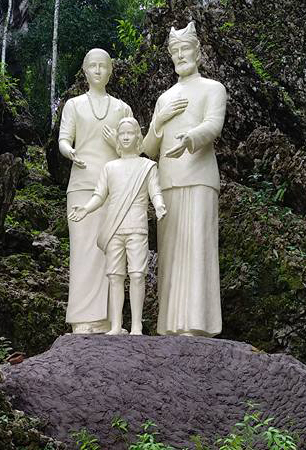 Hari ini, Gereja merayakan Pesta Keluarga Kudus. Santo Yusuf dan Perawan Maria adalah pria dan wanita adalah paling kudus di antara manusia, dan pusat keluarga mereka adalah Yesus, Putra Allah. Sungguh tidak ada keluarga lain yang dapat menyamai keluarga kudus yang satu ini. Melihat keluarga kita sendiri, kita sadar bahwa kita tidak ada apa-apanya dibandingkan dengan Keluarga Kudus ini. Benar bahwa kita semua dipanggil untuk menjadi kudus seperti mereka, tapi kita terus bergulat dan gagal. Tidak ada di antara kita yang dikandung tanpa noda seperti Perawan Maria. Tidak ada wanita di antara kita yang melahirkan Putra Allah melalui kuasa Roh Kudus. Banyak dari kita pasti suka tidur, tapi siapa di antara kita seperti St. Yusuf, yang menerima kabar dari Malaikat Allah dalam mimpi kita? Terlepas dari upaya terbaik kita, kita terus saling menyakiti, gagal, jatuh, dan jauh dari contoh ideal Keluarga Kudus.
 Luke has a poignant and unique way in narrating the story of the Annunciation. He deliberately places the story of Zachariah and of Mary side by side, and lets his readers see both stories in comparison. The first story speaks of a holy man who serves in the Temple. Zachariah is a symbol of the ideal Israelite who stands at the center of the holy ground. The second story speaks of an ordinary woman who lives in Nazareth, a small town far from the center. In a patriarchal society, Mary is a symbol of the poor and marginalized Israelite who is pushed to the peripheries. Angel Gabriel appears to both, and God does marvelous deeds for both. Yet, the Annunciation to Mary turns to be far more excellent. The Angel greets Mary with the title of honor, the highly favored one, while the angel does not even greet Zachariah. The Angel makes Zachariah mute because of his doubt, but he assures Mary when she is confused. The conception of John the Baptist is done through natural means, while the conception of Jesus in the womb of Mary takes place through the supernatural way. Zachariah and Elizabeth represent the outstanding God’s marvel in the Old Testament like when God opened the womb of Sarah, the wife of Abraham, and Hannah, the mother of Samuel, despite their old age and barrenness. Yet, what happens to Mary surpasses and outshines these Old Testament miracles.
 In Medio Ecclesiae