

31st Sunday in Ordinary Time [C] – November 3, 2019 – Luke 19:1-10
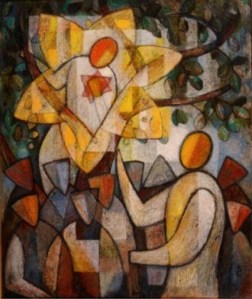 In the time of Jesus, there are at least two kinds of taxes. The first tax goes to the Temple of Jerusalem. This is a “sacred tax”. Those who collect them are performing a sacred duty, and those who pay are fulfilling their due to God. Yet, the second tax is exacted by the Roman government. In order to effectively get the taxes, the Romans employs the local collaborators. The Jews are heavily burdened by this tax because they are unjustly hefty, and often collected by coercion. The Jews understandably loathe those Jewish tax collectors who willingly betray their own people and are involved in greedy malpractices. These are the worst sinners, unclean, corrupt and traitors.
Certainly, Joseph, Mary and Jesus as a poor family, are having a difficult time to pay taxes themselves, and perhaps, fall victims to greedy tax collectors. However, despite this bitter reality, Jesus has a different attitude towards tax collectors. He is known to be the friends of tax collectors and sinners [Mat 11:19]. He shares his table with tax collectors [Luk 5:30]. He presents the tax collector as the protagonist in his parable, while the Pharisee as the bad guy [Luk 18:9ff]. One of His disciples, Matthew, is used to be a tax collector before he leaves everything and follows Jesus.
Today, we listen to the story of Zacchaeus, not ordinary tax collector, but the chief. Despite his high position and richness, he is a small stature. Thus, people look down on him both in a physical and religious sense. Yet, Jesus does something remarkable: He takes the initiative to look upon Zacchaeus who climbs the sycamore tree, calls him by name, and gets Himself invited to Zacchaeus’ house. This is unthinkable: the God-man calls and enters the house of the number-one public enemy in town. We notice that Jesus does not perform any earth-shattering miracles, but Jesus’ simple and loving gesture touches deeply Zacchaeus’ heart. Right there and then, he repents and ready to repair the damages he causes. Jesus declares, “Today salvation has come to this house (Lk. 19:2).”
What Jesus does deeply disturb the minds of orthodox Jews who prefer to distance themselves from the sinners, to avoid the contamination. Thus, they jeer at Jesus. Yet, Jesus takes the opposite direction: to enter the house and share a table even with the worst kind of sinners, chief tax collector, for one reason: “For the Son of Man has come to seek and to save what was lost.” (Lk. 19:10).
The Gospel offers us two attitudes towards our brothers and sisters who are struggling in their lives. We can choose whether like the crowd, to distance ourselves, and let them rot in hell, and even discourage any effort to embrace them, or like Jesus to takes the initiative to help them, even with simple gestures. It is true that when we open ourselves, there is no guarantee that our effort will be successful, and sometimes, we will get betrayed and hurt. Mother Teresa of Calcutta took care hundreds of homeless, but some of them turned against her and threw nasty gossips, and yet Mother Teresa continued to serve till the end of her life. Jesus has made His choice, so also many of His followers, now the choice is ours to make.
Valentinus Bayuhadi Ruseno, OP
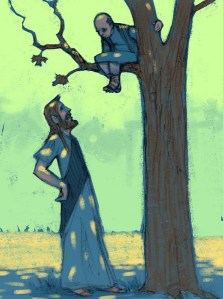 Pada zaman Yesus, setidaknya ada dua jenis pajak atau cukai. Pajak pertama adalah untuk Bait Allah di Yerusalem. Ini adalah “pajak suci”. Mereka yang memungutnya melakukan tugas mulia, dan mereka yang membayar memenuhi kewajibannya kepada Allah. Namun, pajak kedua dibebankan oleh pemerintah Romawi. Untuk mendapatkan pajak secara efektif, orang-orang Romawi mempekerjakan kolaborator lokal. Orang-orang Yahudi sangat terbebani oleh pajak ini karena sangat berat, tidak adil, dan dengan paksaan. Orang-orang Yahudi pada umumnya tentu saja membenci para pemungut pajak Yahudi yang dengan sukarela mengkhianati rakyatnya sendiri dan terlibat dalam praktik korupsi yang tamak. Ini adalah pendosa terburuk, karena najis, korup dan pengkhianat.
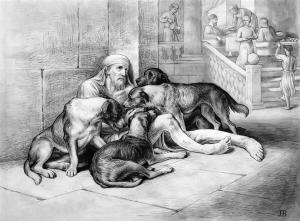 Once again, we listen to one of Jesus’s most remarkable stories. There is a rich man, and this guy is insanely wealthy. He is described as someone clothed with purple and fine linen. In ancient time, fine purple linen is an utmost luxury, and usually only nobilities could afford to buy this kind of cloth. Before the coming of synthetic coloring, purple dye is coming from snails of Mediterranean Sea, and it takes thousands of snails just to dye one ordinary garment. This rich guy is also throwing party every night. At the time of Jesus, where majority must toil to earn a little and to have something to eat, to enjoy feast every night is madly extravagant. At that time, fork, knife, and napkins were not common; thus, people are eating with their hands. In very wealthy houses, they will cleanse their hands by wiping them on hunks of bread that will be thrown away. These are pieces of bread Lazarus longs to receive.
 Chapter 15 of the Gospel of Luke contains three of the most heartwarming as well as powerful parables in the entire Bible. These three parables are known as the parable of the lost sheep, the parable of the lost coin, and the parable of the prodigal son. If we look closer into these three parables, what is so stunning and astonishing is how Jesus bends, twists and stretches human logic and natural tendency to nail His point.
 Bab 15 dari Injil Lukas berisi tiga perumpamaan yang paling mengharukan dan indah di seluruh Alkitab. Tiga perumpamaan ini dikenal sebagai perumpamaan tentang domba yang hilang, perumpamaan tentang koin yang hilang, dan juga perumpamaan tentang anak yang hilang. Jika kita melihat lebih dekat ke dalam ketiga perumpamaan ini, apa yang begitu menakjubkan dan mencengangkan adalah bagaimana Yesus membengkokkan, memutar dan merentangkan logika manusia dan budaya Israel untuk menyampaikan poin terdalam-Nya.
 One of the greatest as well as most humbling realization is that my life and existence is a gift from God. All that exist, from the sub-atomic particle to the purest seraphim owe their being from the Lord. If St. Thomas Aquinas defines justice as to give what is due, then existence is neither due to me nor to all of us. I cannot demand the Lord that He should create me to be the handsomest of all, the richest of all, and the brightest of all. Not even I can ask from Him to possess a face like a Korean actor! Then why did God create me?
 The journey from Jericho to Jerusalem was notoriously dangerous. The path was narrow, steep, filled by sudden turnings. The road became the favorite spot for the robbers to ambush any unguarded traveler. Some criminals were often violent, not only they took everything from the victims, but they would beat them mercilessly. Up to early twentieth century, some tourists and pilgrims were caught off guard when they passed this path, as their cars were ambushed and robbed. The brigands would swiftly escape before the police came.
 Perjalanan dari Yerikho ke Yerusalem terkenal berbahaya. Jalan itu sempit, terjal, dipenuhi belokan mendadak sehingga jalan itu menjadi tempat favorit para perampok untuk menyergap setiap pejalan yang tidak siap. Beberapa penjahat sering melakukan kekerasan, bahwa mereka tidak hanya mengambil semua barang dari para korban, tetapi mereka juga akan memukuli mereka tanpa ampun. Hingga awal abad kedua puluh, beberapa turis dan peziarah menjadi korban ketika mereka melewati jalan ini. Setelah mobil para turis dirampok, para perampok akan dengan cepat melarikan diri sebelum polisi datang.
 Today is the Divine Mercy Sunday. From the Gospel, Jesus institutes the sacrament of reconciliation as He bestows His Holy Spirit upon the Disciples. He grants them the divine authority to forgive (and not to forgive) sins and charges them to be the agents of Mercy. While it is true that only priests can minister the sacrament of confession, every disciple of Christ is called to be an agent of Mercy and forgiveness. Yet, how we are going to be the bearers of Mercy and Forgiveness? I think we need to understand first the dynamic of fear and peace.
 In Medio Ecclesiae