
Featured

Jesus, Our Peace

16th Sunday in Ordinary Time [B]

July 21, 2024

Eph 2:13-18

In his letter to the Ephesians, St. Paul called Jesus ‘He is our peace.’ Yet, why did St. Paul apply this strange title to Jesus? What does it really mean? And, how does this title affect our faith?
To understand Paul, we have to understand also the Old Testament. Afterall, Paul was a member of Pharisees, and thus, not only a zelous but also learned Jew. When St. Paul called Jesus as ‘peace’, he referred to the peace offering of the Jerusalem Temple. The peace offering (in Hebrew, Shalom) is one of sacrifices instructed by the Lord to the Israelites through Moses (see Lev 3). The peace offerings together with other with other sacrifices continued being offered in the time of Jesus and Paul. The ritual sacrifices ceased when the Romans burned down the Temple of Jerusalem in 70 AD, around two decades after Paul’s martyrdom.

As its name suggests, the purpose of this sacrifice is the reconciliation between the Lord, the God of Israel, and the Israelites who have offended the Lord. However, unlike other sacrifices that emphasize on satisfactions of sins and transgressions, like sin offering (chatat) and guilt offering (asham), the peace offering focuses on the result of God’s forgiveness, that is peace. When man offends God because of his sins, man becomes far from God, like an stranger and even enemy. There is enmity between God and man because of sin. There is no peace. However, when the man is forgiven, and his sins are removed, his friendship with God is restored, and there is peace between God and men. This peace causes joy and thanksgiving. The peace offering symbolizes the joy of forgiveness, the thanksgiving of peace achieved.

When St. Paul called Jesus as ‘our peace,’ St. Paul recognized Jesus offered Himself as the peace offering in the cross. Jesus did not only remove our sins, but also reconciled us to the Father. Jesus is the peace because He broke our enmity with God, and brought us back to God in friendship. Only in Jesus, we are at peace with God.

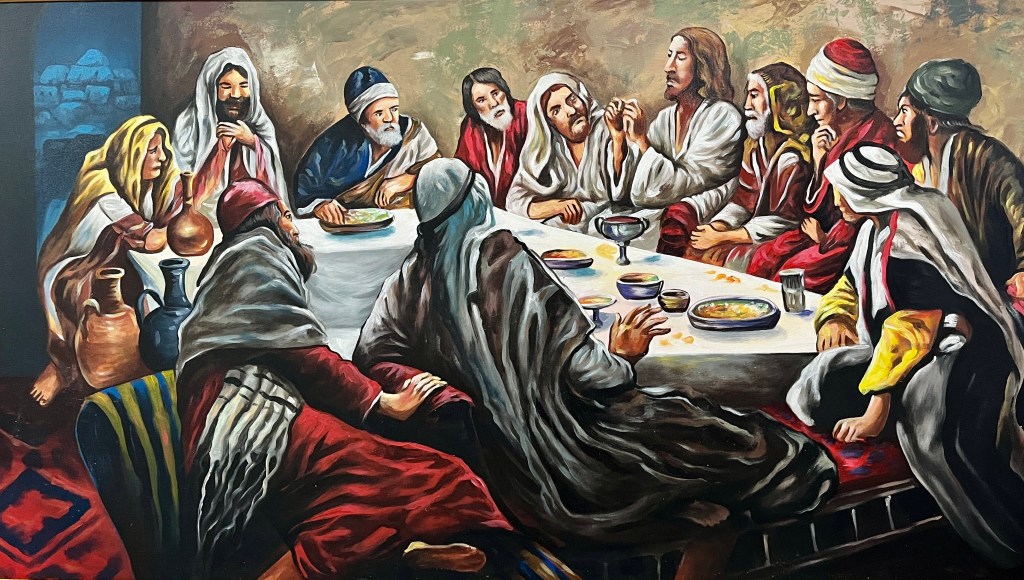
However, peace offering is also a special kind of sacrifice because it is not burnt totally (unlike holocaust sacrifice) but rather being shared also with the priest and the offerers. The fatty parts is burnt because it is for the Lord, some other parts of the animal are for the priests to consume and other parts are for those who offer the sacrifice. Thus, the peace sacrifice is like a meal shared by everyone. The sacrifice becomes the symbol of peace because only people who are at peace with each other can share the same table and food.

However, what is even more remarkable is the Catholic Church has this peace offering. Indeed, our peace offering is the Eucharist. In the Eucharist, Jesus is offered to the God the Father, and then, consumed not only by the priest, but also the faithful who participate in the celebration. Jesus Christ is truly our peace because in the Eucharist, we share the same meal with God.

Valentinus  Bayuhadi Ruseno, OP

Love of Christ urges us.

12th Sunday in Ordinary Time

June 23, 2024

2 Cor 5:14-17

The relationship between St. Paul and the Church in Corinth is complicated. St. Paul was the first missionary to preach the Gospel in Corinth and establish the Church there. Yet, after St. Paul left for another mission, some members of the Church began to disobey Paul and discredit him. In his second letter, St. Paul tried to address this issue, both with tears and joy. What is the problem? How, then, did Paul answer this issue?

Corinth was one of the major cities in ancient Greece, and its strategic location made it wealthy and a major trading hub in the Roman Empire. This situation made the city attractive to many people, including Christian missionaries and preachers. When St. Paul left the city to preach in other places, other so-called ‘apostles’ came and began to teach the Christians in Corinth. Some of them seemed to intentionally discredit Paul by saying that he was not a true apostle. They would cite some proofs like Paul preached a different Gospel, Paul was not a real Israelite, and Paul was not accepting support from the Church (a preacher or missionary was expected to receive their living from the Church). Yet, now Paul was asking for donations.

In his letter, Paul defended himself. He only preached the true Gospel (2 Cor 11:1-6). He is a true Israelite from the tribe of Benjamin and, in fact, from the Pharisees’ group. And, often, he did not receive support from the Corinthians, but instead worked as a tent maker because he did not want to become a burden to the Church (2 Cor 11:7-10). Yet, Paul further explained that the donation he sought was not for himself but for the Church in Jerusalem (2 Cor 8:9).

Paul defended further his apostolic ministry that he received from God for the building of the Church. He was facing persecution both from the Jews and the Greeks; he was beaten in the Synagogue and jailed by Roman leaders. The angry mobs targeted him. Jews opposed Paul because he preached Jesus Christ. The Greeks hated Paul because he drew many people away from the pagan temples. Paul also experienced life-threatening dangers in his journeys: robbers, unfriendly weather, and shipwrecks. Beyond that, he also worked during the days to support himself and preached during the night, and his energy was restlessly spent to deal with various concerns of the Church (see 2 Cor 11:23-29). Paul explained why he was doing all these things: ‘The love of Christ urges us (2 Cor 5:14).’

Christ’s love is enormous; it empowers Paul to do the impossible: love like Jesus. Paul is not the only one who receives this overwhelming love of Jesus but all of us. Jesus loves us dearly to the point of giving up His life for us so that we may become a new creation in Him (2 Cor 5:17). Now, the question is whether we will accept this divine love and make it fruitful in our lives. Are we courageous enough to love like Jesus, as exemplified by St. Paul? Are we ready to face dangers and difficulty in preaching the Gospel? Are we willing to labour day and night for the people Jesus loves?

Valentinus Bayuhadi Ruseno, OP