
Trinity in the Bible and in Our Life

The Solemnity of the Most Holy Trinity [C]

June 15, 2025

John 16:12-15

The mystery of the Holy Trinity stands at the center and foundation of our faith because it reveals the very nature of God. Our logical minds can deduce that there is one God, a perfect Being who created and sustains all things. Yet, we depend on divine revelation to grasp this profound truth. The word “Trinity” does not appear in Scripture, but the Bible, both in the Old and New Testaments, unveils this reality. Scripture affirms there is only one God, yet simultaneously reveals a plurality within His oneness.

One intriguing passage that hints at the Trinity is the very verse that declares God’s oneness—the Shema Israel (Deuteronomy 6:4). The Hebrew text reads: “שְׁמַע יִשְׂרָאֵל יְהוָה אֱלֹהֵינוּ יְהוָה אֶחָד” (Shema Yisrael Adonai Eloheinu Adonai Echad). Most English translations render this as, “Hear, O Israel: The Lord our God, the Lord is one.” However, a more literal translation would be: “Hear, O Israel: The Lord, our God, the Lord, one.” It is striking how the verse mentions the Lord three times before concluding with “one.”

Other Old Testament passages also suggest plurality within God’s unity. For example: Gen 1:1-2 and 1:26 speak of God creating with His Spirit and using the plural “Let Us make man in Our image.” The Angel of the Lord appears as a divine yet distinct figure (Gen 16:7-13; 22:11-18; Exo 3:2-6; Judg 13:18-22). The Spirit of God is active in the Psalms and prophets (Ps 51:11; Isa 63:10-11; 48:16; Eze 36:26-27). Prophet Zechariah (2:10-11) even speaks of “two Yahwehs.” Yet, the fullness of this mystery is only fully revealed in the New Testament.

One of the most definitive Trinitarian passages is Matthew 28:19: “Baptize them in the name of the Father and of the Son and of the Holy Spirit.” Here, Jesus speaks of one name, yet within that one name are three distinct Persons: Father, Son, and Holy Spirit.

However, the Trinity is more than a biblical truth, but it is the most precious gift to us. As St. Paul writes, “No one can say, ‘Jesus is Lord,’ except by the Holy Spirit” (1 Cor 12:3). The Spirit infuses faith in our hearts, enabling us to confess Christ, the Son of the Father. The same Spirit pours hope into us amid trials, especially for confessing the true God (Rom 5:3-5). And when we love, even those hardest to love, we participate in the life of the Triune God, whose very essence is love (1 Jn 4:8).

The Trinity is not merely a doctrine to profess but a mystery we live daily. We enter Christian life through Trinitarian baptism. As Catholics and Orthodox, we begin prayers with the Sign of the Cross, invoking the Father, Son, and Spirit. In the Eucharist, the Holy Spirit transforms the bread and wine into Christ’s Body and Blood, offered to the Father as the perfect sacrifice.

As we celebrate this greatest mystery of our faith, let us give thanks that God invites us into His very life—Father, Son, and Holy Spirit—now and forever.

Rome

Valentinus Bayuhadi Ruseno, OP

Guide Question:

How do we relate with the Holy Trinity? When the first time, we recognize the truth about the Trinity? How do we relate to the Father? How do we relate to Jesus? How do we relate to the Holy Spirit?
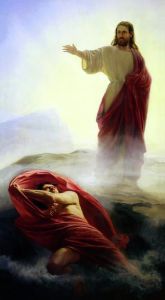
Jesus and Exorcism

Fourth Sunday in Ordinary Time [B]

January 31, 2021

Mark 1:21-28

Jesus performed His first exorcism in the Gospel of Mark. Reading the context, we discover that Jesus was teaching in the synagogue, and the people recognized Him teaching with authority. When Jesus taught with authority, it does not merely mean He preached with eloquence and chrism, but His teachings manifested in powerful signs, like healings and exorcism.

The word exorcism is usually understood as expelling the evil spirits or demons from a person possessed or a place infected. Unfortunately, because of Hollywood movies’ influence, the understanding of exorcism has been corrupted, deformed, and even ridiculed. Yet, the Catholic Church, exorcism is rooted in Jesus Christ Himself.

The literal meaning of ‘exorcism’ is to ‘bind with an oath.’ Then, how did this word become related to evil spirits? When we swear an oath, we need to invoke a higher being as the guarantor of our promise. Naturally, an oath is to say a pledge by invoking the Lord Himself as a witness. In the context of exorcism, the priest-exorcist will invoke the name of God to bind the demons and send them ‘at the feet of the cross of Jesus’ for the judgment. There is no genuine and effective exorcism without invoking the name and power of the true God.

What is interesting is that Jesus drove out demons without invoking the name of God. He said, “Quiet, come out of him!” Jesus was exorcising with His authority, and the demons obeyed Him because they recognized His divine power. The demons also acknowledge Jesus not as Messiah or the king of the Jews, but as ‘the Holy One of God.’ If we go back to the Old Testament, this particular title refers to Israel’s high priest. “… Aaron, the holy one of the Lord… [Psa 106:16].” The demons revealed another dimension of Jesus’ identity: He is the high priest. From this truth, we may conclude that exorcism is a priestly duty.

Participating in the high priestly office of Jesus, the bishops are the chief exorcists in their dioceses. We remember that bishops are high priests in their respective dioceses. Each bishop then may appoint and delegate some well-trained priests to become exorcists. I was fortunate to meet and discuss many things with Fr. Jose Syquia, an exorcist of the Archdiocese of Manila.

However, we must not forget that we also share in the priesthood of Jesus Christ because of our baptism. So, we also have authority over the evil spirits. As laity, we are allowed to say specific prayers of deliverance when we feel extraordinary presence and activities of the evil spirits. The prayer to St. Michael, the archangel, is most recommended for the laity. Yet, we must not forget that the evil spirits work in very subtle ways, primarily through temptations to sin. Often, without realizing it, we are already under the control of the devil as we live a life full of vices. This is our daily war against the kingdom of Satan, and we cannot win without invoking the name of Jesus, constant prayers, the sacraments, and the help of the Church.


Valentinus Bayuhadi Ruseno, OP

Yesus dan Eksorsisme

Minggu Keempat di Masa Biasa [B]

31 Januari 2021

Markus 1: 21-28

Yesus melakukan pengusiran setan atau eksorsisme pertama-Nya dalam Injil Markus. Membaca konteksnya, kita menemukan bahwa Yesus sedang mengajar di sinagoga dan orang-orang mengenali Dia mengajar dengan otoritas. Ketika Yesus mengajar dengan otoritas, ini tidak hanya berarti Dia berkhotbah dengan kefasihan dan krisma, tetapi ajaran-Nya dimanifestasikan dalam tanda-tanda yang nyata dan menakjubkan, seperti penyembuhan dan pengusiran setan.

Kata eksorsisme biasanya diartikan sebagai mengusir roh-roh jahat dari seseorang yang kerasukan atau tempat yang terjangkiti. Sayangnya, karena pengaruh yang datang dari film-film Hollywood, pemahaman tentang eksorsisme telah terdistorsi, dan bahkan menjadi bahan lelucon. Namun, bagi Gereja Katolik, eksorsisme berakar di dalam pribadi Yesus Kristus sendiri, dan sebuah misi yang mulia.

Arti harafiah dari ‘eksorsisme’ adalah ‘mengikat dengan sumpah.’ Lalu, bagaimana kata ini bisa akhirnya berhubungan dengan roh jahat? Ketika kita bersumpah, kita perlu memanggil seseorang yang lebih tinggi dari diri kita sebagai penjamin janji kita. Secara sederhana, sumpah adalah mengucapkan janji dengan memanggil Tuhan sendiri sebagai saksi kita. Dalam konteks eksorsisme, imam yang bertugas sebagai eksorsis akan memanggil nama Tuhan untuk mengikat setan, dan mengirim mereka ‘ke kaki salib Yesus’ untuk menerima penghakiman. Kita tidak bisa mengusir setan dengan menggunakan otoritas kita sendiri karena setan adalah makhluk yang juah lebih kuat dari kita. Hanya dalam nama Tuhan yang benar, eksorsisme yang sejati dan efektif dapat terjadi.

Satu hal yang menarik dari Injil adalah Yesus mengusir setan tanpa menyebut nama Tuhan. Dia hanya berkata, “Diam, keluarlah dari dia!” Yesus mengusir dengan otoritas-Nya sendiri dan setan-setan mematuhi-Nya karena mereka mengenali kuasa ilahi-Nya. Setan juga mengenali Yesus bukan hanya sebagai Mesias atau sebagai raja orang Yahudi, tetapi sebagai ‘Yang Kudus dari Tuhan.’ Jika kita kembali ke Perjanjian Lama, gelar khusus ini mengacu pada imam agung Israel, secara khusus Harun. “… Harun, Yang Kudus dari Tuhan… [Mzm 106: 16].” Melalui mulut setan, Injil mengungkapkan dimensi lain dari identitas Yesus: Dia adalah sang Imam Agung. Dari kebenaran ini, kita dapat menyimpulkan bahwa eksorsisme adalah bagian dari tugas imamat.

Berpartisipasi dalam identitas Yesus sebagai imam agung, para uskup adalah eksorsis utama di keuskupan mereka. Kita ingat bahwa uskup adalah imam agung di keuskupan masing-masing. Setiap uskup kemudian dapat menunjuk dan mendelegasikan beberapa imam yang terlatih untuk menjadi eksorsis di keuskupan mereka. Waktu saya di Manila, saya beruntung bisa bertemu dan berdiskusi banyak hal, dengan Romo Jose Syquia, seorang eksorsis dari Keuskupan Agung Manila.

Namun demikian, kita tidak boleh lupa bahwa karena pembaptisan kita, kita juga mengambil bagian dalam imamat Yesus Kristus. Jadi, kita juga memiliki otoritas atas roh-roh jahat. Sebagai orang awam, kita diizinkan untuk mengucapkan doa-doa pembebasan tertentu ketika kita merasakan kehadiran dan aktivitas roh-roh jahat yang luar biasa. Doa kepada St. Michael, sang malaikat agung, adalah salah satu contoh doa pembebasan yang bisa digunakan kaum awam. Namun, kita tidak boleh lupa bahwa sebenarnya roh-roh jahat bekerja dengan cara yang sangat halus, terutama melalui godaan untuk berbuat dosa. Seringkali, tanpa disadari, kita sudah di bawah kendali iblis saat kita menjalani hidup yang penuh dengan dosa dan kejahatan. Sebagai pengikut Kristus, kita perlu menghadapi perang kita sehari-hari melawan kerajaan Setan, dan kita tidak bisa menang tanpa menyebut nama Yesus, tanpa doa yang konstan, tanpa sakramen, dan tanpa bantuan Gereja.


Valentinus Bayuhadi Ruseno, OP