
Palm Sunday of the Lord’s Passion. March 20, 2016 [Luke 19:28-40/Luke 23:1-49]
“Blessed is the king who comes in the name of the Lord (Luk 19:38).”
 Palm Sunday or Jesus’ entrance to Jerusalem marks the beginning of the most important drama of the Gospel, the drama of the Holy Week. The memory was so significant to the early Christians that the episode was recorded in all four Gospels (Mat 21:1-11, Mark 11:1-11, and John 12:12-19), though with some different emphases. Why was Jesus’ entrance to the ancient city Jerusalem so significant?
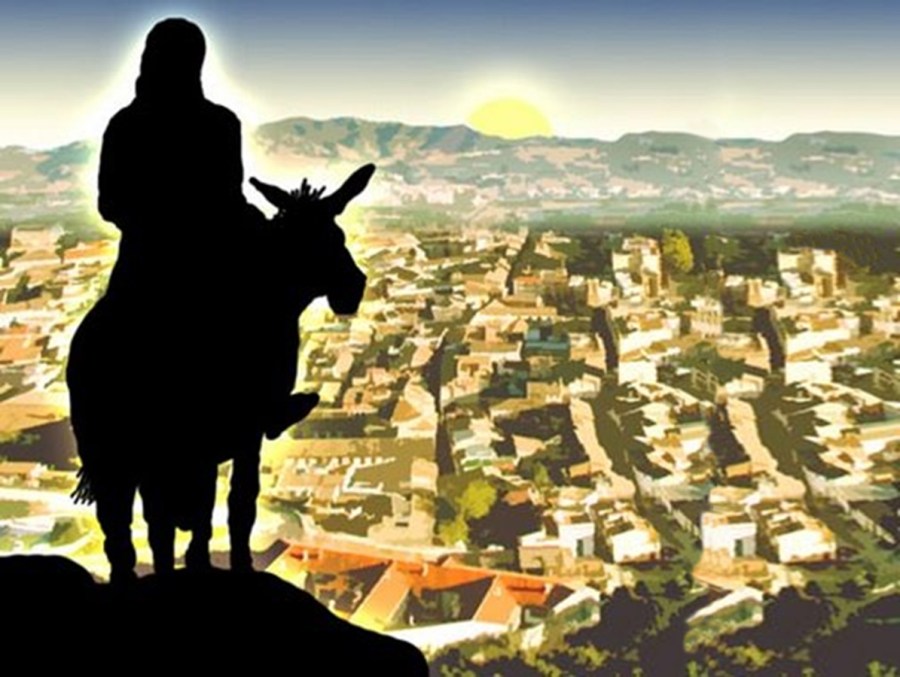
His entrance was unusual and less triumphant because he preferred to ride a meek donkey rather than a combat-ready horse. Yet, his unique entrance was not unexpected by the Jewish people looking forward for the Messiah. By riding on the donkey, he was fulfilling the prophecy of Zechariah, “Rejoice heartily, O daughter Zion, shout for joy, O daughter Jerusalem! See, your king shall come to you; a just savior is he, Meek, and riding on an ass, on a colt, the foal of an ass.” (Zec 9:9). The people who gathered in Jerusalem for annual Jewish festival, could not hide their excitement to this Jesus who had been rumored as the expected Christ. Indeed, the people welcome Him as a king as they shouted, “Blessed is the King who comes in the name of the Lord! (Luk 19:38)” Through his action, Jesus no longer hid His true identity, but revealed publicly that He is the Messiah.
Unfortunately, the moment Jesus revealed who He was, both the Jewish authority and the Roman rulers were ready to pin him down. They did not care whether Jesus came as the peaceful and humble leader or war-freak king. Jesus was the potential troublemaker and the sooner they get rid of him, the better. True enough, lest than a week, Jesus was betrayed, deserted by his followers and condemned to death. The people who acclaimed Him king, now cried to the top of their voice, “Crucify him!” The entrance to Jerusalem is significant because Jesus made a firm decision to live and die to the fullest. Jesus knew this horrifying possibility would take place, but He did not run and look for safety. He freely embraced his identity and mission, and because of this, his death was not in vain. He has made a difference that mattered most.
We are called Christian because we indeed the follower of Jesus Christ, but our name is worthless if we fail to follow Him up to Jerusalem. For some of us, being Christian or Catholic is just a matter of social convenience or family tradition. Our family, our society is Christian then we should be Christians. Often we just remember that we are Christians during special events in our life. In the Philippines, there are KBL Catholics, those who attend the Mass only for ‘Kasal’ or marriage, ‘Biyag’ or baptism and ‘Libing’ or funeral mass. In Indonesia, we are familiar with ‘Na-Pas’ (literally means ‘breath’) Christians, those who only go to the Church during ‘Natal’ or Christmas and ‘Paskah’ or Easter.
But, we must not forget that for some being Christians means hardship, sufferings and death. Christians in war-zones like Syria and Iraq, or when the Christians were minority, live in constant danger and discriminations are so real. Just few weeks ago, four sisters of Missionaries of Charity were brutally executed by the terrorists in Yemen. While they were fully aware of the extent of the danger, they refused to live behind the people they served, the elderly and the disabled. They are the disciples of Christ who lived their authentic Christianity to the end. Both in death and life, their faith has made the world a better.
Philosopher Abraham Kaplan noted that if Socrates said ‘unexamined life is not worth living’, so ‘the unlived life is worth examining. As we are entering the most solemn week in our liturgy, we ask ourselves: have we live our lives to the fullest? Is our Christian faith making any difference? Are we willing to make the change that matters most in our lives?
Br. Valentinus Bayuhadi Ruseno, OP
 In Medio Ecclesiae