

Third Sunday of Lent. John 4:5-42 [March 19, 2017]
“Many of the Samaritans of that town began to believe in him because of the word of the woman (Jn 4:39)”
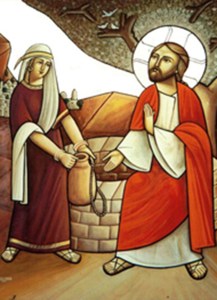 Many of us will see Jesus’ conversation with the Samaritan woman as something ordinary, a chat between a man and a woman. But, if we go back to the time of Jesus, we will discover it as unthinkable. This Samaritan woman embodied what the Jews hated most. Firstly, despite their common ancestry, the Samaritans and the Jews were excommunicating each other. Despite worshipping the same God, they condemned one another as religious heretics and they proclaimed their own religion as the true one. No wonder, sometimes, the encounter between the two turned violent and the Romans had to quell the riots.
Secondly, this Samaritan is a woman. The ancient Jewish society, just like many ancient cultures, placed women as second class citizens. They were treated as objects, either owned by the patriarch or the husband. They could be easily divorced by their husbands if they could not bear a child. Despite some outstanding and exceptional women due to their noble birth and wealth, women generally were discriminated from the public and religious sphere. Many could neither study the Torah nor have a voice of their own. No wonder, many Jews praised the Lord because they were born not as a woman!
However, in today’s Gospel, Jesus talked to a Samaritan woman. Not only talking, He asked for water. Not only did he asked for water, He revealed Himself for the first time as the Living Water as well as the Messiah. The conversation transformed her. While many Jews refused to believe in Jesus, the Samaritan woman believed. Not only did she become a believer, she turned to be a preacher of faith. She spread the Good News to her townsfolk and they came to Jesus because of her. The Gospel of John narrates to us that even a Samaritan and a woman can be chosen by Jesus to be His preacher. The effects of her preaching were unprecedented. The Samaritans began to make peace with other Jews, the disciples who also believe in Jesus.
We are living in a better world. Women can enjoy the same rights that men enjoy almost in all aspects. Indonesia, a country with the largest Muslim population in the world, used to have a woman president. In the Philippines, many major positions are occupied by women, like Chief Justice, Senators, and even military general. Yet, still many women are subject to various forms of exploitation: human trafficking, prostitution, domestic violence, and abuses. Following Jesus means standing up against injustice against women.
The Gospel also points out to us that women are capable of preaching the faith. Surely, women cannot preach in the pulpit, but many of them are responsible for faith growth in many Christ-centered communities. I still remember how my mother taught me the basic prayers and the rosary. She also encouraged me as an altar server to love the Eucharist. In Indonesia, it is a practice in many parishes for priests to receive their daily meals from the people, and many women are doing their best to provide for the priests. Some religious sisters and lay women have contributed to my philosophical and theological formation, and they were great professors. Over and above these, many women have generously supported the Church and her Evangelization mission, through their resources, time, effort and prayer. From the depth of our hearts, we thank them.
Br. Valentinus Bayuhadi Ruseno, OP
 In Medio Ecclesiae