

The Solemnity of the Body and Blood of Jesus Christ. June 18, 2017 [John 6:51-58]
“Whoever eats my flesh and drinks my blood has eternal life, and I will raise him on the last day. (Joh 6:51)”
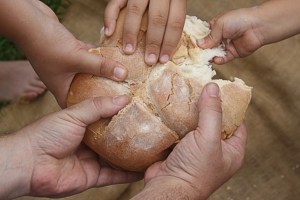 Eating is essential to our life. Nobody would deny that eating is a matter of life and death, but there is always significant different between a beggar sitting by the gate of St. Domingo church and most of us who can enjoy a full meal three times a day. The beggar will ask himself, “How can I eat today?” While, we will inquire ourselves, “Where am I going to eat today? Is the ambience of the restaurant welcoming? Is the food as tasty as Filipino delicacy? Is the food safe from any cancer-causing substance?” For some, eating is about survival, but for some other, this phenomenon has evolved into something mechanically sophisticated. The society provides us with almost unlimited options of what we are going to eat, and seemingly we are masters of these foods as we possess the authority to choose what we like and shun what we don’t. But, we actually are slowly turning to be slaves of our appetite as we shift our focus not on the essential but on the trivial, like how we satisfy our fickle cravings.
What we eat, how we eat, and where we eat reflect who we are, as well as our society, our world. While we can afford to eat at fine-dining restaurants, yet some of our brothers and sisters can only have one instant noodle for the whole day, it means there is something wrong with us, with our world. Once I watched a movie about two young ladies eating fried chicken in one of the fast food restaurants. They were not able to consume everything and threw the leftover at the garbage can. After some time, a poor man came and took that leftover. He brought that home and served it as the dinner for his small impoverished family. Yet, before they ate, they prayed and gave thanks for the food!
Jesus offered Himself as food in the Eucharist, and this offer becomes the sign of the radical justice and mercy of God. It is mercy because despite nobody of us deserve His most holy body and blood, and attain the fullness of life and the resurrection of the body, He continues to give this profound grace to us. It is justice because He does not discriminate. All of us, whether we are men or women, whether rich or poor, whether healthy or sick, are created in His image and likeness and thus, invited to this sacred banquet. Yes, in the Eucharist, we only receive Jesus in a tiny and tasteless host, yet the small bread that scarcely fills our biological needs, is given to all who are coming to Him seeking rest and joy.
St. Paul in his first letter to the Corinthians rebuked the Christians there. One of the major reasons was that some (presumably rich) Christians refused to share the Eucharistic meal with other (presumably poor) Christians, and they let them without food. “When you meet in one place, then, it is not to eat the Lord’s supper, for in eating, each one goes ahead with his own supper, and one goes hungry while another gets drunk. (1 Cor 11:20-21). For Paul, this was a gross injustice and an offence against the Eucharist, because as Jesus gave His body and blood for all, so Eucharist has to symbolize this God’s radical self-giving.
Are we like the Corinthians who take the Eucharist yet neglect our hungry brothers and sisters around us? Are we living our identity as God’s image, and thus, reflect God’s radical justice? Do we become more like Christ, and manifest His boundless mercy? Do the body and blood of Christ in the Eucharist have effect in us?
Br. Valentinus Bayuhadi Ruseno, OP
 In Medio Ecclesiae