

27th Sunday in Ordinary Time. October 8, 2017 [Matthew 21:33-43]
“There was a landowner who planted a vineyard… (Mat 21:33).”
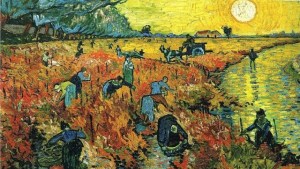 The image of a vineyard is close to Israelites’ hearts because this springs from their prophetic tradition. Isaiah uses this metaphor to describe Israel and God (see Isa 5:1-8). Consistent with this great prophet, Jesus crafts His parable of the vineyard to describe the relation between God and His people. God is the just and generous vineyard owner, and we are His workers. Now, it is up to us to work hard for the Lord in His vineyard and receive abundant harvest, or be lazy, and expelled from the vineyard.
However, there is another way of looking at this parable. For three consecutive Sundays, we have listened to parables that feature a vineyard and people who are involved in this vineyard. If there is one common denominator in these three parables, it is about the difficult and often problematic relationship between the landowner and the workers.
In ancient Israel, big landowners were hiring workers or leasing their land to farmer-tenants. At the end of the day, the workers received their wage, or at the harvest, tenants got their share of their labor. Here the situation became very thorny and conflict-ridden. The owners wanted the highest profit from their land, while the workers desired the greatest income from their labor. At times, the Israelite laborers received very little wage or very small share from the harvest. With very little income, they had to pay high taxes to the Roman colonizers and contributions to the Temple. Thus, what remained was barely enough to feed the family. Disgruntled and hungry workers were very prone to violent actions. However, it was true also that some good landowners gave more than enough wages, but some workers tended to be lazy, abusive to fellow workers, and are even involved in stealing the harvest.
In our time, we seem to face more complex issues in relation to employer, employees and employment. With global networking and communication, an American company may hire Filipino workers working in Manila serving European customers. With almost unrestricted mobility, millions of workers from Indonesia or the Philippines try their luck in Middle East countries. With steady increase of automation, many manual works are gradually replaced by robots. More and more people prefer to buy things or avail service online. One of the hottest debates now in the United Nations is the usage of Artificial Intelligence (AI) to “judge” human right cases in the International Tribunal. The AI has become so sophisticated that it can predict the verdicts of human judges. Now, highly skilled human profession like a judge can even be replaced by an AI. Many professions that were trending years ago have become extinct now, and more seem to follow. Yet, despite these advancements and complexity, the fundamental issue remains: whether both the employers and the employees give what is expected and receive with are due to them?
Jesus’ parable is not only relevant for our time, but it continues to challenge our fundamental understanding of our dignity as God’s co-workers in His vineyard. As workers, do our attitudes in the workplaces reflect the good attitudes of Jesus’ followers? As owners or superiors, do we manifest that delicate balance between God’s justice and His generosity? Finally, as God’s co-workers, do we work for a better world for us and future generations, or we simply aim for our selfish interest and greed?
(Note: today is the feast day of Our Lady of the Holy Rosary of La Naval de Manila, before whom I kneel down every morning and pray for inspiration guiding my Sunday reflections. May she continue to guide us in our journey of faith. Happy Fiesta!)
Br. Valentinus Bayuhadi Ruseno, OP
 In Medio Ecclesiae