

Fifth Sunday of Lent [March 18, 2018] John 12:20-33
“Amen, amen, I say to you, unless a grain of wheat falls to the ground and dies, it remains just a grain of wheat; but if it dies, it produces much fruit. (Jn. 12:24)”
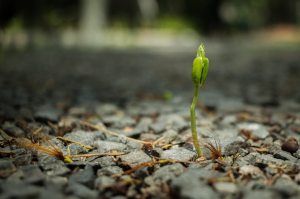
The hour of Jesus’ suffering and death has come. Jesus knows well that Jewish leaders want him dead, and there is no other punishment worse than crucifixion. Yet, Jesus does not see His suffering and death as defeat and shame, but in fact, it is the opposite. His crucifixion shall be the hour that He will be glorified and draw all men and women to Himself. It is the moment of victory because Jesus sees Himself as a grain of wheat that falls to the ground and dies, and then bears many fruits. It is not a kind of positive thinking technique to vilify the suffering or a pep talk to ignore the pain, but rather Jesus chooses to embrace it fully and make it meaningful and fruitful.
In the theological level, Jesus’ suffering, death, and resurrection are the summits of the work of redemption, our salvation. Jesus is the resurrection and life so that whoever knows and believes in Him may have the eternal life. Jesus’ choice of a grain of wheat, a basic material for making bread, may allude to the sacrament of the Eucharist through which Jesus gives the fullness of Himself to us in the form of a bread. Thus, through our participation in the Eucharist, we share this fruit of salvation.
However, through His sacrifice and death, Jesus also offers us a radical way to live this life. Truly, there is nothing wrong in pursuing wealth, success and power because these are also gifts from God and necessary for our survival and growth. Yet, when we are too captivated by these alluring things, and make other things and people simply tools to gain these, we choose to live the way of the world. Since the dawn of humanity, the world has offered us an inward-looking and self-seeking way of life. It is “Me First,” my success, my happiness at the expense of others and nature. Some people exploit nature and steal other people’s hard-earned money to enrich themselves. Some objectify and abuse even their family members, people under their care, just to have an instant pleasure. Some others manipulate their co-workers or friends to have more power for themselves. These are precisely what the world offers. These are good as far as they fulfill our transitory needs as a human being, but when we make them as the be-all and end-all, we begin losing our lives. Science calls this effect the hedonic treadmill: We work hard, advance, so we can afford more and nicer things, and yet this doesn’t make us any happier. We fail to find what truly makes us human and alive, and despite breathing, we already dying. As Jesus says, “Whoever loves his life, loses it (Jn 12:25).”
Paradoxically, it is in dying to ourselves and in giving ourselves, our lives to others that we may find life and bear fruits. Sometimes, we need to offer our lives literally. St. Maximillian Kolbe offered his life in exchange for a young man who had children in the death camp Auschwitz. Later Pope John Paul II canonized him and declared him as a martyr of charity. Not all of us are called to make the ultimate sacrifice like St. Maximillian, and we can die to ourselves in our little things, and give ourselves for others in simple ways. The questions then for us: how are we going to die to ourselves? How shall we give ourselves to others? What makes our lives fruitful for ourselves and others?
Br. Valentinus Bayuhadi Ruseno, OP
Photo by Harry Setianto SJ
 In Medio Ecclesiae