

Reflection on the 25th Sunday in Ordinary Time [September 23, 2018] Mark 9:30-37
“Whoever wants to be first must be last of all and servant of all.” (Mk. 9:35)
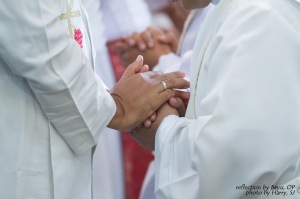 While I was reflecting on this Sunday’s Gospel, I was able to discover some news about our Church. Good News! The Catholic Church in the Philippines is preparing herself for the 500 years of the arrival of Christianity in this archipelago. The first baptism and Eucharist were taking place in 1521 as the Spanish missionaries began their evangelization mission. As part of this grand preparation, the Bishops of the Philippines have decided to celebrate this year as the year of the clergy and the consecrated persons. The major theme of this year is the renewed servant-leaders for the new evangelization. In view of this, many programs and activities are organized to help both the ordained ministers and the religious brothers and sisters to deepen their commitment to God and their service to the people.
Not so good news. It is also true, however, that today the Church is also facing a deep crisis. In many countries and places, the clergy, as well as the religious persons, are caught in scandals and shameful things. One among the worst is the sexual abuses involving the minors done by priests and even bishops, and the massive cover-up staged to tolerate this structural evil. Yet, this is not the only thing that plagues the Church. Some ordained ministers are dishonest and having double-standard lives. Some are secretly enriching themselves. Others may not commit any scandal, but are lacking in compassion and enthusiasm in serving the people of God. Many stories are circulating of priests refusing to hear confession or anointing the dying because they like to prioritize their scheduled hobbies or religious persons who are grumpy and easily irritated with others. These attitudes simply drive people away from the Church. The rest of us perhaps are just nothing but mediocre clergy or religious. This reminds me of Pope Francis who points that holiness as opposed to ‘bland and mediocre existence.’
Our Gospel narrates Jesus who in private teaches the disciples, who will be the first and models of Church’s leaders. The Gospel itself can be divided into two parts. The first part speaks of Jesus foretelling his impending suffering and death in Jerusalem. Here, reacting to Jesus’ words, the disciples drop silence. Perhaps, the memory of Jesus scolding Peter and calling him “Satan” is still fresh in the mind of the disciples and nobody wants to repeat the same embarrassment. The second part of the Gospel tells us of the topic of greatness. This time, the disciples have a different reaction. Not only do they initiate the discussion, but they are also passionately arguing among themselves. We can imagine Peter boasting himself as the leader among the apostles, or John telling everyone that he is the closest to Jesus, or Matthew being proud of his richness. After all, these are our first Pope and first bishops. Yet, when Jesus asks them, they once again fall silent.
The apostles seem to forget that Jesus’ disciples have to carry their cross and follow Jesus to Jerusalem. Jesus, however, understands that human desire for excellence is a gift from God. Jesus does not forbid His apostles to have dreams and strive for greatness, but He makes a radical twist. He directs this powerful energy from achieving one selfish interests into serving others. Thus, Jesus’ unforgettable line: “Whoever wants to be first must be last of all and servant of all.” (Mk. 9:35) Indeed, they need to excel, but not any worldly measures, but in serving and empowering others. In his exhortation, Gaudete et Exsultate, Pope Francis calls this “the Logic of the Cross.” True happiness is a paradox. If the clergy, the religious and all of us want to be genuinely happy, then it is not so much on the wealth and success we have gained, but from our service and sacrifice for others.
We continue to pray for our priests and bishops, as well as our religious brother and sisters. We pray not only that they may avoid scandals, but they may be holy. As Pope Benedict XVI puts it, “holiness is nothing other than charity lived to the full.”
Br. Valentinus Bayuhadi Ruseno, OP
 In Medio Ecclesiae