

2nd Sunday of Advent [A] – [December 8, 2019] – Matthew 3:1-12
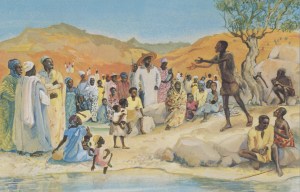 John the Baptist is a prominent figure in four Gospels, and he powerfully appears before Jesus begins His public ministry. But, who is this John the Baptist? His name is simply John, and the Church calls him the Baptist to distinguish him from other John in the Bible like John the son of Zebedee, one of Jesus’ disciples. John the Baptist is the miracle son of Zacharia and Elizabeth in their old days. And since Elizabeth and Mary, the mother of Jesus, are relatives, John and Jesus are closely related to each other.
Certainly, there is something strange about this John. He is eating locust and honey. Surely, it is an exotic food, but we need to remember he is living in the desert, and this kind of food is common. He is wearing clothing made of camel’s hair and a leather belt around his waist. It is just a fashion statement or he has nothing to wear. John’s clothing reminds us of the things Prophet Elijah wore in his time [see 1 Kings 1:8]. John is presenting himself as a prophet, and not any prophet, he is the new Elijah. The appearance of Elijah is an important sign of the imminent coming of the Messiah [Mal 4:5].
One thing for sure about John is that he becomes very popular, and people from all over the country come to him, to listen to his preaching and to be baptized as a sign of repentance. Yet, despite the great number of followers, he remains true to his mission. He is preaching on the coming of someone who is much greater than him, even he declares that “is unworthy to carry His sandals.” He is God’s instrument in fulfilling the prophecy, and he has a specific role to play.
Now, we know a little background about John the Baptist, what will be next for us? Certainly, we are not called to follow him in wearing clothing made of camel’s hair or to eat locust everyday, but we are to prepare the way for the coming of the Savior. How? Some of us are called literally to baptize people like myself. Some are commissioned to preach and educate people. Yet, all of us is to live a life of repentance. The repentance has to be alive and penetrating all aspects of life. The word used by John in Greek is “metanoiete” and it does not simply mean “repent!” but more precisely, “keep repenting!”
The first stage of repentance is certainly turning away from a sinful life, but it is more than that. Repentance is not about one-done-deal action, but a life-long process. The word “Metanoia” is coming from two words, “meta” meaning “changing” and “nous” meaning “mind”; Thus, “metanoia” means changing of mind, changing the way we see life and the way we live. Our mind is no longer earth-bond, but fixed into God. The transformation is not from sinful life to a good life, but a life that is even closer to God. It implies changing of priority. Do we make God our priority? It entails holiness. Do we do things that are pleasing to God? This presupposes the love of God. Do we love God more than other things, or do we love other things more than Him?
Valentinus Bayuhadi Ruseno, OP
 In Medio Ecclesiae