

Christmas Vigil – December 24, 2019 – Luke 2:1-14
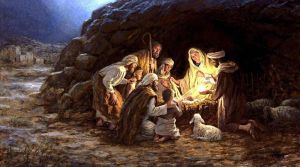 Today is Christmas, the day of Jesus was born in Bethlehem, and it is a traditional practice that in every Church or Christian family, there is a nativity scene. Usually, the baby Jesus was born in a kind of stable or shed, and He was placed on the wooden manger (a place where animals eat). Surely, Mary and Joseph are intently watching on the Baby, while other animals like sheep and cows become the silent witnesses of this most beautiful moment in human history. The scene will not be complete without the shepherds and the angel.
The nativity scene is indeed beautiful and always remains us of the simplicity of Christmas that we often miss.
However, if we go back to the time of Joseph and Mary, to first-century Palestine, we will discover a slightly different yet have a deeper meaning. Most probably, Joseph and Mary were not resting in a wooden stable, but inside a stone cave since this is a common feature in hill country Judea. Inside the stone cave is warm and sometimes spacious, and the shepherds use them as a safe and warm shelter for their sheep at night. The mangers provided for sheep were not made of wood, but stone. Sometimes, we see Baby Jesus half-naked on the manger, but Luke describes that Jesus was wrapped in a swaddling cloth. It is normal practice that a new-born baby will be cleansed, and then be enclosed by the cloth to keep the baby warm, protected and comfortable.
We discover that Jesus was born in a stone cave, rested on a stone manger and swaddled in cloth. These three things point to an even greater reality in the life of Christ: His death and resurrection. After the crucifixion, his body was enclosed in cloth, put inside the cave tomb, and rested on the large stone. Yet, it is also the same stone tomb where Jesus rose from death. From the very beginning of Jesus’ life here on earth, His destiny has been foretold: by His death and resurrection, He will save us.
However, there is something even more remarkable. Jesus was placed on a manger, and a manger is none other than a place for animal’s feed. From the beginning, Jesus is already presented to us as a food that will satisfy those who come to Him. Then, what “kind of food” is He? It is not a coincidence that Jesus was born in Bethlehem. The word Bethlehem comes from two Hebrew words: “Beth” meaning “house” and “Lehem” meaning “bread”; thus, Bethlehem is a house of bread. Jesus is given to us as bread, and indeed, Jesus calls Himself as the bread of life [Jn 6:35]. It is interesting also to ask why the shepherds were the first persons invited to see Jesus. One of the possible answers is that the shepherds are the first men who are aware of the birth of a lamb. The shepherds recognized that this holy Baby is a new-born lamb. Indeed, later, Jesus would be called as the Lamb of God [John 1:29]. In ancient Israel, lambs were also the main sacrificial animal in the Temple. Baby Jesus came to feed us, and He came as the bread of life and sacrifice that saves us.
While it is good to spend Christmas with vacation or festive celebration, the best way to celebrate Christmas is none other than to celebrate the Eucharist, to mediate the simplicity and humility of God who came to us as little baby, and to ponder His infinite love that He offered Himself to feed us. This is the beauty of Christmas, that God has chosen to love us to the end.
Valentinus Bayuhadi Ruseno, OP
 In Medio Ecclesiae